

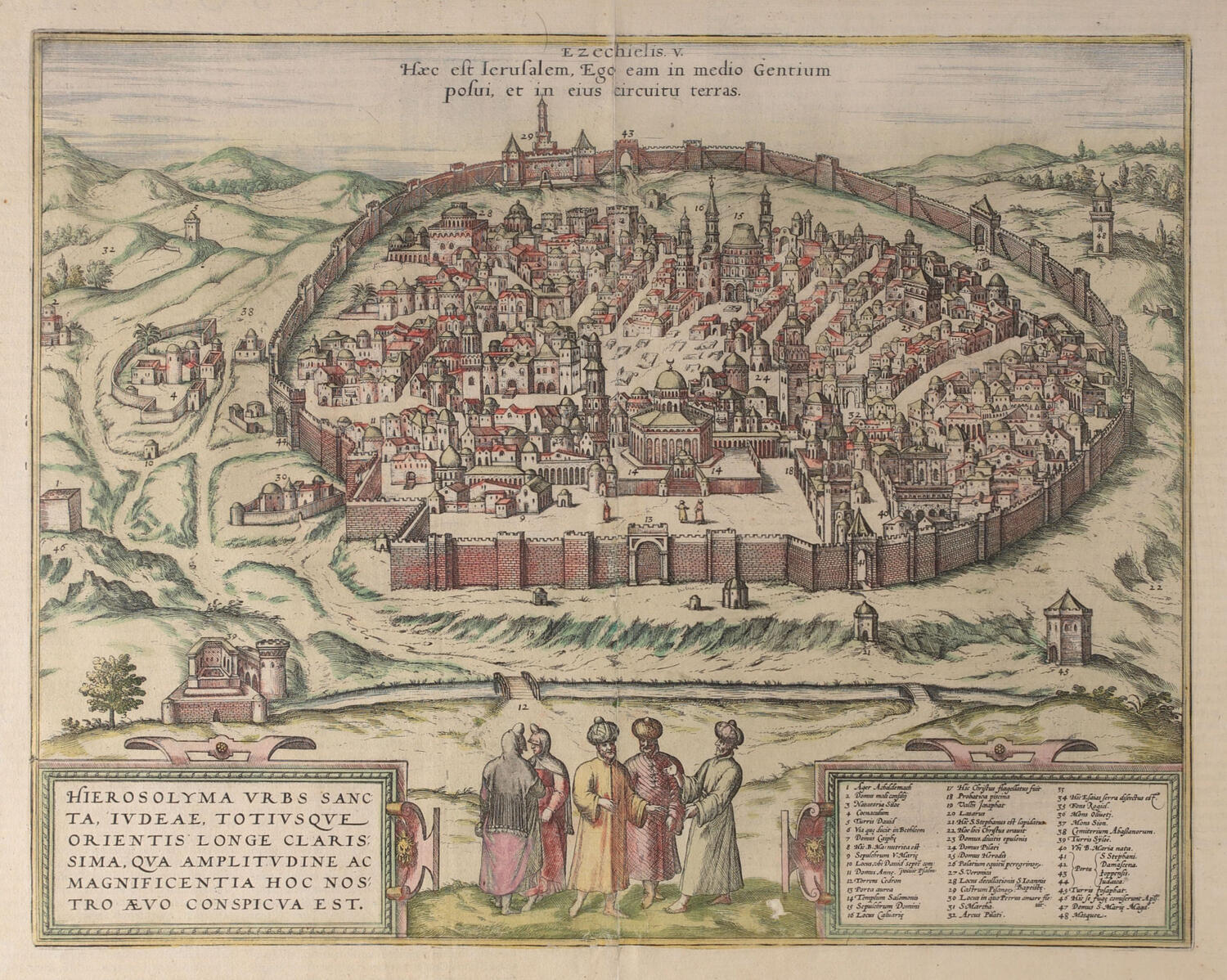
Map of Jerusalem
In this seventeenth-century map, Jerusalem is depicted as a fairly dense city within a wall, with only a few structures outside. Men in Arab dress stand in small groups conversing with one another in the foreground. A Latin inscription in the top center reads: “This is Jerusalem. I placed it in the middle of the gentiles and placed lands in a circle around her” (Ezekiel 5:5). A second Latin inscription on the bottom left reads: “Jerusalem, the Holy City of Judea, and by far the most distinguished city of all the Orient. This is evident in our time by its greatness and splendor.”
Credits
George Braun and Franciscus Hogenberg. From the collection of the National Library of Israel, courtesy of Eran Laor Map Collection. Latin translation by Brandon Bourgeois.
Published in: The Posen Library of Jewish Culture and Civilization, vol. 5.
You may also like


Map of the Land of Israel
This map, in a manuscript copy of Be’er mayim ḥayim (A Spring of Living Water), a commentary on Rashi published in Worms or Friedberg in the late fifteenth or sixteenth century, is based on Rashi’s…

Divre Yosef (The Words of Joseph)
Sultan Mehmed began his reign in the year 856, according to their count [1452 CE]. The king ordered the building of sailing ships on the top of the…
Kore’ ha-dorot (Reader for the Generations)
And after the rabbi [Joseph Karo] went to Safed he studied in the study house of the rabbi, our master, Jacob Berab, and became a disciple of our master R. Berab, as is written in several places. The…
Seder ha-dorot (Order of the Generations)
Behold I request of all standing at the gate to knock,And he who wishes to enter deep within this composition of mine,Let him understand and be wise and contemplate the introduction I have composed.Fo…
Sheyris Yisroel (Remnant of Israel)
The German holy community of Amsterdam was founded in the year 5396 [1635/6]. This I discovered in a few pages of a book written by Maharam Maarsen, one of the first German Jews in Amsterdam…
You may also like
Map of the Land of Israel
This map, in a manuscript copy of Be’er mayim ḥayim (A Spring of Living Water), a commentary on Rashi published in Worms or Friedberg in the late fifteenth or sixteenth century, is based on Rashi’s…
Divre Yosef (The Words of Joseph)
Sultan Mehmed began his reign in the year 856, according to their count [1452 CE]. The king ordered the building of sailing ships on the top of the…
Kore’ ha-dorot (Reader for the Generations)
And after the rabbi [Joseph Karo] went to Safed he studied in the study house of the rabbi, our master, Jacob Berab, and became a disciple of our master R. Berab, as is written in several places. The…
Seder ha-dorot (Order of the Generations)
Behold I request of all standing at the gate to knock,And he who wishes to enter deep within this composition of mine,Let him understand and be wise and contemplate the introduction I have composed.Fo…
Sheyris Yisroel (Remnant of Israel)
The German holy community of Amsterdam was founded in the year 5396 [1635/6]. This I discovered in a few pages of a book written by Maharam Maarsen, one of the first German Jews in Amsterdam…