

Beauty
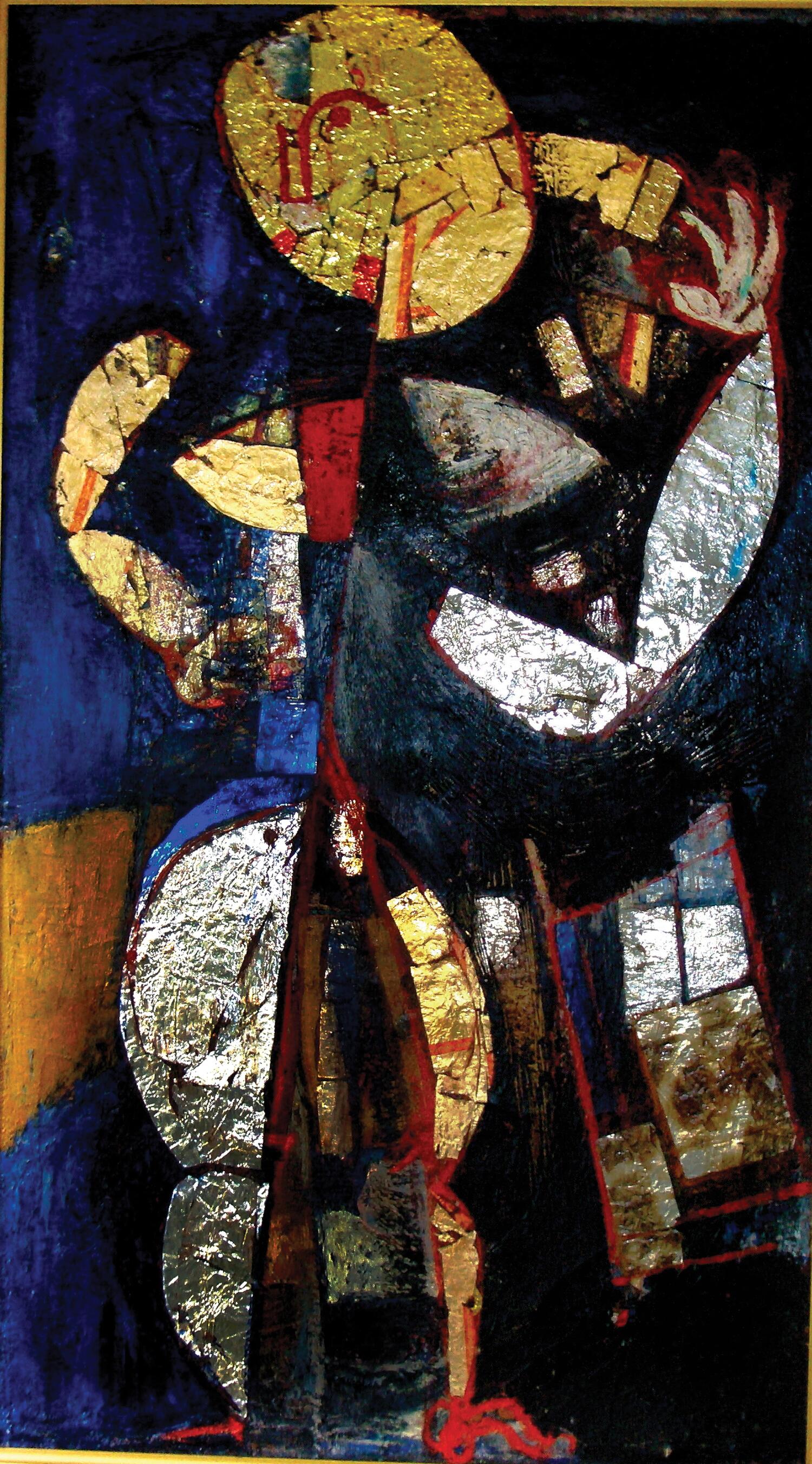

Moses Feigin painted both realist and abstract paintings, sometimes mixing both styles in one painting. In the late 1960s, he became fascinated by the world of the carnival, seemingly evoked by the central figure in this picture. This work is painted in his signature palette of red, yellow, indigo, and orange.
We’re sorry. The Posen Library’s licensing agreements prevent this image from being printed or downloaded.
Credits
Private collection of Luba Matusovsky, www.lubaproart.com.
Published in: The Posen Library of Jewish Culture and Civilization, vol. 9.
You may also like

Exhibition Announcement, Jack Glenn Gallery, Artforum, October 1970
This ad for an exhibition at California State University Fullerton was intended as a manifesto. The artist Judy Gerowitz announced that she was divesting herself of “all names imposed upon her through…

Handball Players, Houston Street, NY
Leon Levinstein, widely admired for his street photography, held himself at a distance from the art world and never produced a book of his work. He kept his day job as a graphic designer and went out…

Warsaw Kneel
West German chancellor Willy Brandt kneels in front of the Jewish Heroes Monument, paying tribute to Jews killed by the Nazis during the 1943 uprising in the Warsaw ghetto, December 7, 1970.

Portrait of a Man
Though he also worked in other media, Dmitry Borisovitch Lion preferred to work with ink on paper. His drawings have feathery, broken lines, and sometimes include text, illegible letters, and shapes…

Codex Artaud VII
Codex Artaud VII is one of a series of thirty-four scrolls that Nancy Spero based on the writings of Antonin Artaud, a writer and theater director famous for conceptualizing the “Theatre of Cruelty.”…

Red Horizon
Eric Bulatov created many paintings that paired nature scenes with Soviet slogans, suggesting that the control of the Soviet regime was everywhere, in every corner of its citizens’ lives. In Red…
You may also like
Exhibition Announcement, Jack Glenn Gallery, Artforum, October 1970
This ad for an exhibition at California State University Fullerton was intended as a manifesto. The artist Judy Gerowitz announced that she was divesting herself of “all names imposed upon her through…
Handball Players, Houston Street, NY
Leon Levinstein, widely admired for his street photography, held himself at a distance from the art world and never produced a book of his work. He kept his day job as a graphic designer and went out…
Warsaw Kneel
West German chancellor Willy Brandt kneels in front of the Jewish Heroes Monument, paying tribute to Jews killed by the Nazis during the 1943 uprising in the Warsaw ghetto, December 7, 1970.
Portrait of a Man
Though he also worked in other media, Dmitry Borisovitch Lion preferred to work with ink on paper. His drawings have feathery, broken lines, and sometimes include text, illegible letters, and shapes…
Codex Artaud VII
Codex Artaud VII is one of a series of thirty-four scrolls that Nancy Spero based on the writings of Antonin Artaud, a writer and theater director famous for conceptualizing the “Theatre of Cruelty.”…
Red Horizon
Eric Bulatov created many paintings that paired nature scenes with Soviet slogans, suggesting that the control of the Soviet regime was everywhere, in every corner of its citizens’ lives. In Red…