

Commandment II
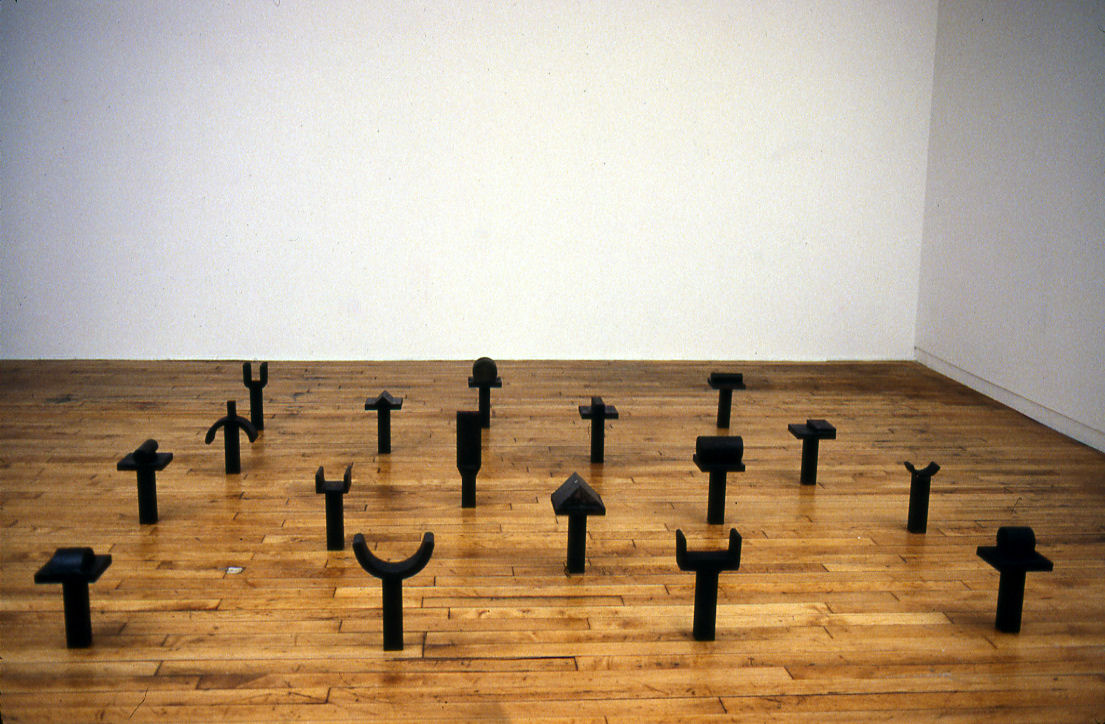

Commandment II is from a series of forged-iron sculptures Kirili began in the late 1970s. They are among his best-known works and reflect his strong interest in religious concepts and ancient texts. The grouped forms in this work suggest abstracted alphabets and incorporate both straight-edged geometric and curved shapes. No more than ninety centimeters high, they are nonetheless suggestive of monuments. Commenting on this series, Kirili noted, “There is an old mystery, for which I can provide no explanation, about why there is pattern of circumvolution in art and religion; it’s something that seems to occur naturally in humanity. . . . There is circumvolution with the Torah in the synagogue: inside the synagogue they turn with the Torah so that everyone kisses [it]. Circumvolution, verticality are fundamental drives in each human—and in my art, too.”
We’re sorry. The Posen Library’s licensing agreements prevent this image from being printed or downloaded.
Credits
The Jewish Museum, New York, museum purchase with funds provided by Vera and Albert List, Hyman L. and Joan C. Sall, and Fine Arts Acquisition Fund, 1984-137a-q. Courtesy of the artist.
Published in: The Posen Library of Jewish Culture and Civilization, vol. 10.
You may also like

Self-Portrait in Blue Bathroom, London, 1980
This is the first of a series of photographs called The Ballad of Sexual Dependency, recording LGBT life in New York’s East Village in the 1980s.

Dissolving Myths
Maor was a member of The Common Factor: Kibbutz, a group of artists who were interested in criticizing long-held Zionist and socialist beliefs and myths, at a time when many felt that the kibbutz…

Altamira Elegy
Motherwell’s most famous series of artworks was his Elegies to the Spanish Republic, which he intended as “a funeral song” for the losing side, the Republicans, in the Spanish Civil War (1936–1939)…

Untitled
Baron’s abstract collages were made from found materials, such as scraps of paper, string, and bits of fabric, which she sometimes found in junkyards. She considered them personal and political…

Lo Tishkach (Thou Shalt Not Forget)
Berman’s best-known work is her Holocaust memorial for the Stroum Jewish Community Center on Mercer Island in Washington State. The twelve-foot-high bronze sculpture consists of stylized Hebrew…

Feast in Paradise, No. 2
In the early 1980s, Eshel-Gershuni began making what she called “fetishes” or “impossible jewelry,” transferring her skills as a jewelry-maker to sculpture. She combined expensive materials like gold…
You may also like
Self-Portrait in Blue Bathroom, London, 1980
This is the first of a series of photographs called The Ballad of Sexual Dependency, recording LGBT life in New York’s East Village in the 1980s.
Dissolving Myths
Maor was a member of The Common Factor: Kibbutz, a group of artists who were interested in criticizing long-held Zionist and socialist beliefs and myths, at a time when many felt that the kibbutz…
Altamira Elegy
Motherwell’s most famous series of artworks was his Elegies to the Spanish Republic, which he intended as “a funeral song” for the losing side, the Republicans, in the Spanish Civil War (1936–1939)…
Untitled
Baron’s abstract collages were made from found materials, such as scraps of paper, string, and bits of fabric, which she sometimes found in junkyards. She considered them personal and political…
Lo Tishkach (Thou Shalt Not Forget)
Berman’s best-known work is her Holocaust memorial for the Stroum Jewish Community Center on Mercer Island in Washington State. The twelve-foot-high bronze sculpture consists of stylized Hebrew…
Feast in Paradise, No. 2
In the early 1980s, Eshel-Gershuni began making what she called “fetishes” or “impossible jewelry,” transferring her skills as a jewelry-maker to sculpture. She combined expensive materials like gold…