

Cover, Di malke Shvo: dramatishe poeme
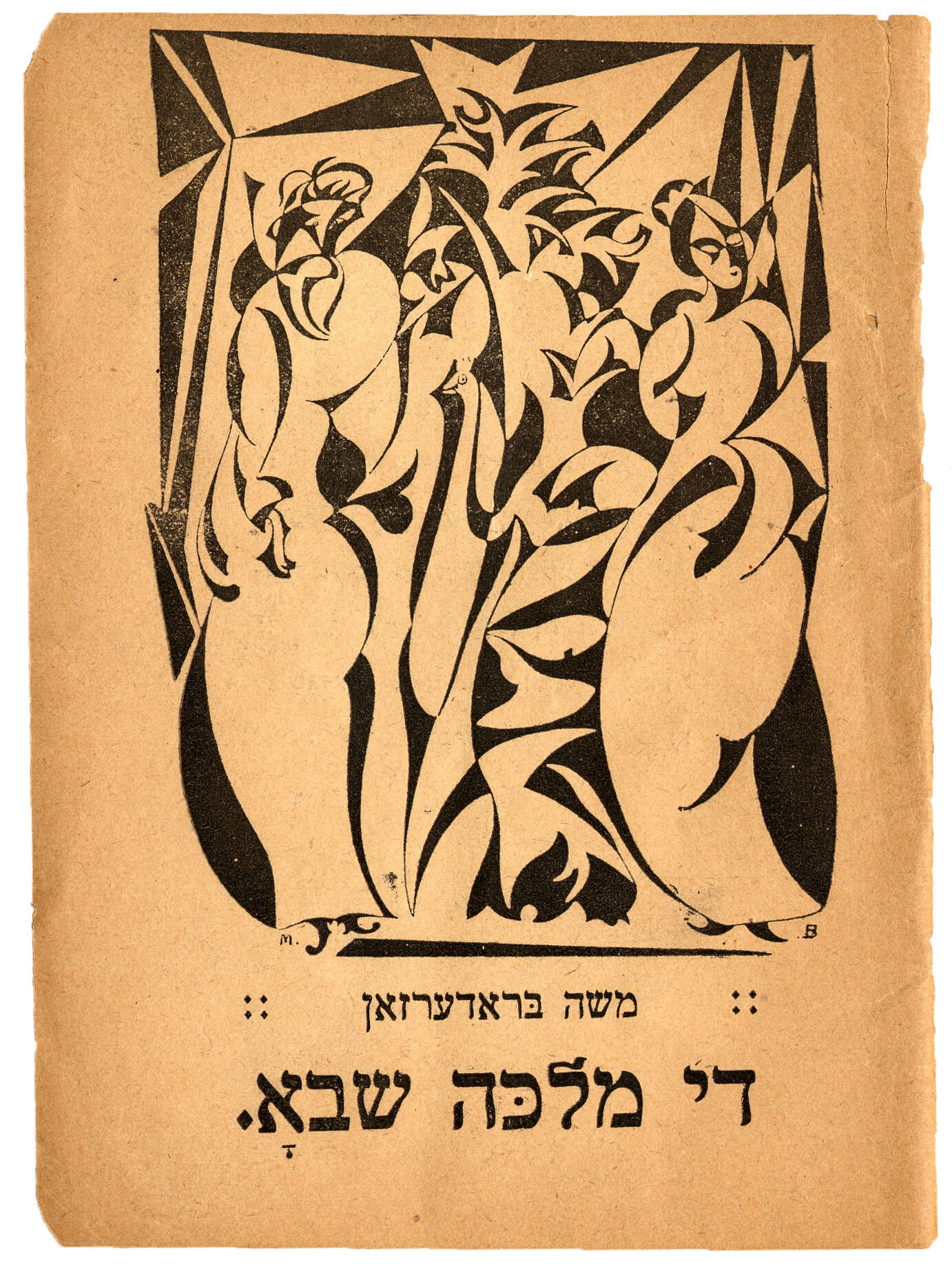

In 1920 and 1921, Broderzon, the guiding force of Yung-yidish (Young Yiddish), a literary and artistic group he co-founded in Łódź, published over half a dozen books of poetry and plays. Prolific and multi-talented, he illustrated many of his own books in a striking abstract style, including the cover of this play, Di malke Shvo (The Queen of Sheba). The journal published by Yung-yidish was subtitled Lider in Wart un Zeichnugen (“poems in word and drawings”), expressing the group’s desire to put visual and word art on an equal footing by combining text with drawings and woodcuts.
We’re sorry. The Posen Library’s licensing agreements prevent this image from being printed or downloaded.
Credits
Courtesy YIVO Institute for Jewish Research
Published in: The Posen Library of Jewish Culture and Civilization, vol. 8.
You may also like

The Meeting: A Jewish Youth and Two Women in an Urban Alley
The Meeting, Schulz’s only surviving oil painting, obliquely explores a theme he returned to many times in his writing and art, namely, sadomasochism, this time in the context of an encounter between…

Jacob Kramer
The rough-hewn sculptures that Epstein created early in his career, like that of the painter Jacob Kramer (1892–1962), departed from the conventions of classical Greek sculpture in a radical way that…

Of the High Priest’s Tribe
An important Jewish genre painter, Kaufman drew inspiration for his romantic depictions of traditional Jewish life from trips to Moravia and Upper Hungary, Galicia and Bukovina and areas of Russian…

Seven-Branched Candelabrum
Menorahs with seven arms are traditionally displayed in synagogues as a reminder of the Second Temple in Jerusalem. This brass menorah by Gyula Pap also has seven arms but is strikingly different in…

Cover of Albatros, No. 3
Albatros, a journal of literature and graphic art, debuted in Warsaw in 1922 and published its final two issues in Berlin. The journal was edited by the Hebrew-Yiddish poet Uri Zvi Greenberg and…

Portrait of Saul Tchernichovski
Saul Tschernikhovsky is considered one of the great modern Hebrew poets. His poems are part of the canon of Israeli literature, and his portrait appears on Israeli currency. Pasternak painted this…
You may also like
The Meeting: A Jewish Youth and Two Women in an Urban Alley
The Meeting, Schulz’s only surviving oil painting, obliquely explores a theme he returned to many times in his writing and art, namely, sadomasochism, this time in the context of an encounter between…
Jacob Kramer
The rough-hewn sculptures that Epstein created early in his career, like that of the painter Jacob Kramer (1892–1962), departed from the conventions of classical Greek sculpture in a radical way that…
Of the High Priest’s Tribe
An important Jewish genre painter, Kaufman drew inspiration for his romantic depictions of traditional Jewish life from trips to Moravia and Upper Hungary, Galicia and Bukovina and areas of Russian…
Seven-Branched Candelabrum
Menorahs with seven arms are traditionally displayed in synagogues as a reminder of the Second Temple in Jerusalem. This brass menorah by Gyula Pap also has seven arms but is strikingly different in…
Cover of Albatros, No. 3
Albatros, a journal of literature and graphic art, debuted in Warsaw in 1922 and published its final two issues in Berlin. The journal was edited by the Hebrew-Yiddish poet Uri Zvi Greenberg and…
Portrait of Saul Tchernichovski
Saul Tschernikhovsky is considered one of the great modern Hebrew poets. His poems are part of the canon of Israeli literature, and his portrait appears on Israeli currency. Pasternak painted this…