

David Ben-Gurion Standing on His Head (Sharon Hotel Beach, Herzliya)
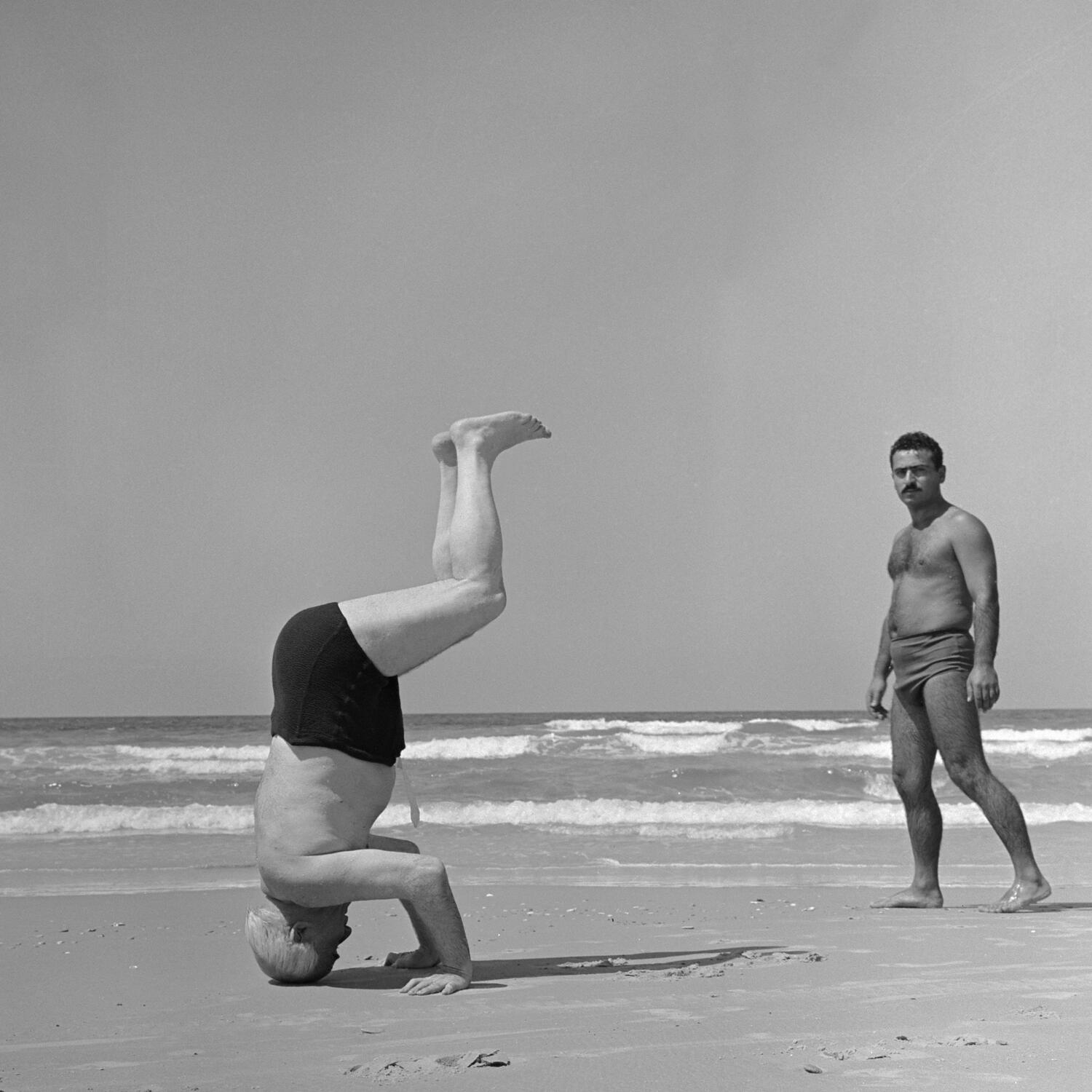

Paul Goldman was notable for keeping his distance from his subjects, perhaps as a show of respect. He photographed many of Israel’s early leaders. Here, David Ben-Gurion, Israel’s first prime minister, is doing a handstand on Herzliya beach after a lesson by Dr. Moshe Feldenkrais, inventor of the Feldenkrais Method, a form of physical exercise designed to increase well-being and self-awareness through movement.
We’re sorry. The Posen Library’s licensing agreements prevent this image from being printed or downloaded.
Credits
Paul Goldman, MUSA, Eretz Israel Museum, Tel Aviv Collection.
Published in: The Posen Library of Jewish Culture and Civilization, vol. 9.
You may also like

Jacob’s Ladder
Helen Frankenthaler’s approach to painting forged a new direction for modern art. She developed a technique in which thinned oil paint seeped directly into the canvas, staining the fabric and yielding…

Alphabet of Creation
This calligraphic print appears in Ben Shahn’s book Alphabet of Creation, based on a tale about how God created the world through the letters of the Hebrew alphabet taken from the Zohar, a thirteenth…

La Kahena
The title of this painting, La Kahena, alludes to a seventh-century military Berber queen who opposed the Arab conquest of North Africa. Legend has it that she was Jewish and also a sorceress. The…

Rythme Coloré
Rythme coloré (Colored Rhythm) embodies the concept of Simultanisme, a style developed by Sonia Delaunay and her husband Robert Delaunay in the 1910s. Simultanisme (also known as Orphism) was based on…

Sick, Sick, Sick
Sick, Sick, Sick was very different from other comic strips of the 1950s. It had the format of a comic strip but did not have conventional story lines or superheroes. Instead, it was more like an…

Leonard Bernstein
Al Hirschfeld was most famous for his caricatures of actors, musicians, and other figures from the arts and public life. He himself preferred to be known as a “characterist.” After the birth of his…
You may also like
Jacob’s Ladder
Helen Frankenthaler’s approach to painting forged a new direction for modern art. She developed a technique in which thinned oil paint seeped directly into the canvas, staining the fabric and yielding…
Alphabet of Creation
This calligraphic print appears in Ben Shahn’s book Alphabet of Creation, based on a tale about how God created the world through the letters of the Hebrew alphabet taken from the Zohar, a thirteenth…
La Kahena
The title of this painting, La Kahena, alludes to a seventh-century military Berber queen who opposed the Arab conquest of North Africa. Legend has it that she was Jewish and also a sorceress. The…
Rythme Coloré
Rythme coloré (Colored Rhythm) embodies the concept of Simultanisme, a style developed by Sonia Delaunay and her husband Robert Delaunay in the 1910s. Simultanisme (also known as Orphism) was based on…
Sick, Sick, Sick
Sick, Sick, Sick was very different from other comic strips of the 1950s. It had the format of a comic strip but did not have conventional story lines or superheroes. Instead, it was more like an…
Leonard Bernstein
Al Hirschfeld was most famous for his caricatures of actors, musicians, and other figures from the arts and public life. He himself preferred to be known as a “characterist.” After the birth of his…