

Drawings Published in Harper’s
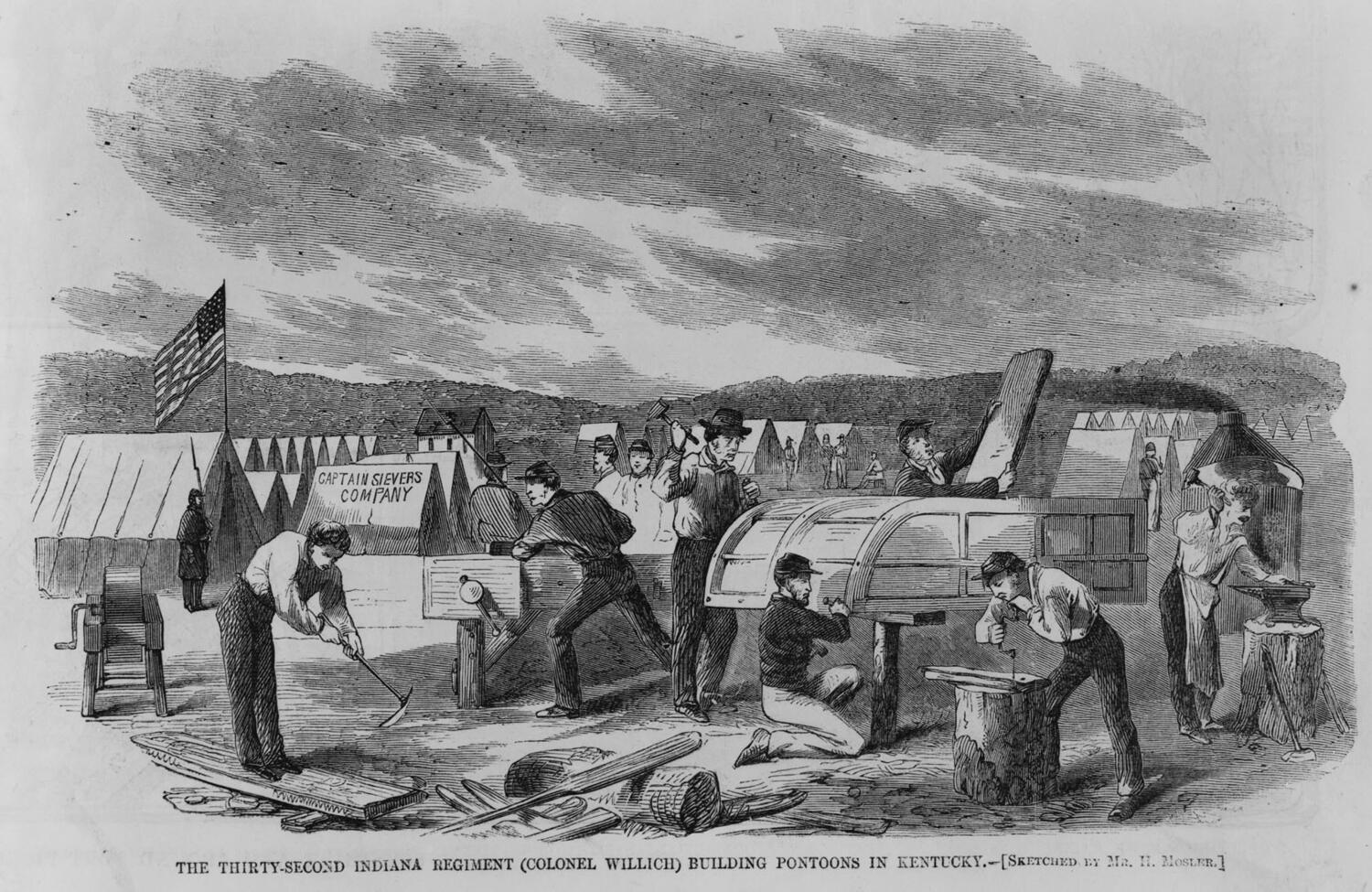

An illustration for the monthly magazine Harper’s, The Thirty-Second Indiana Regiment (Colonel Willich) Building Pontoons in Kentucky was likely drawn by Henry Mosler during the Civil War. Engravings like these constituted the photojournalism of their day. Before the rise of photography, line drawings were common in magazines and newspapers, providing a source of income for artists.
We’re sorry. The Posen Library’s licensing agreements prevent this image from being printed or downloaded.
Credits
Library of Congress Prints and Photographs Division Washington DC., 20540. LC-USZ62-124302.
Published in: The Posen Library of Jewish Culture and Civilization, vol. 6.
You may also like

The Twelve-Year-Old Jesus in the Temple with the Scholars
When Max Liebermann first exhibited this painting, it caused not only a sensation but a scandal. Some critics objected to a Jew daring to depict Jesus, and they were offended by Liebermann’s realistic…

Return of the Prodigal Son
The Christian parable of the prodigal son, from Luke 15:11–12, was a favorite subject of artists from the seventeenth through the nineteenth century. A son squanders his inheritance and is reduced to…

The Avenue de l’Opéra, Sunlight, Winter Morning
In late 1897, Camille Pissarro, the noted impressionist artist, known for his many landscapes and cityscapes, came to Paris and rented a room in the Hôtel du Louvre, which gave him a good view of the…

At the Restaurant
Though Benjamin-Eugène Fichel is better known for his historical paintings set in the eighteenth century, in this painting he documents modernity itself. Here a wealthy couple orders a meal in a…

The Death of Tasso
One of Friedrich Friedländer’s best-known paintings, The Death of Tasso, depicts the death of the Italian poet Torquato Tasso (1544–1595). Tasso was famous for his epic poem, La Gerusalemme liberate (…

Ferdinand II, 1810–1859 Bourbon King of Two Sicilies
Geskel Salomon’s portraits are striking for the way they convey the personalities of their sitters; we, as viewers, feel strongly that we are looking at real, flesh-and-blood people. Here, Salomon has…
You may also like
The Twelve-Year-Old Jesus in the Temple with the Scholars
When Max Liebermann first exhibited this painting, it caused not only a sensation but a scandal. Some critics objected to a Jew daring to depict Jesus, and they were offended by Liebermann’s realistic…
Return of the Prodigal Son
The Christian parable of the prodigal son, from Luke 15:11–12, was a favorite subject of artists from the seventeenth through the nineteenth century. A son squanders his inheritance and is reduced to…
The Avenue de l’Opéra, Sunlight, Winter Morning
In late 1897, Camille Pissarro, the noted impressionist artist, known for his many landscapes and cityscapes, came to Paris and rented a room in the Hôtel du Louvre, which gave him a good view of the…
At the Restaurant
Though Benjamin-Eugène Fichel is better known for his historical paintings set in the eighteenth century, in this painting he documents modernity itself. Here a wealthy couple orders a meal in a…
The Death of Tasso
One of Friedrich Friedländer’s best-known paintings, The Death of Tasso, depicts the death of the Italian poet Torquato Tasso (1544–1595). Tasso was famous for his epic poem, La Gerusalemme liberate (…
Ferdinand II, 1810–1859 Bourbon King of Two Sicilies
Geskel Salomon’s portraits are striking for the way they convey the personalities of their sitters; we, as viewers, feel strongly that we are looking at real, flesh-and-blood people. Here, Salomon has…