

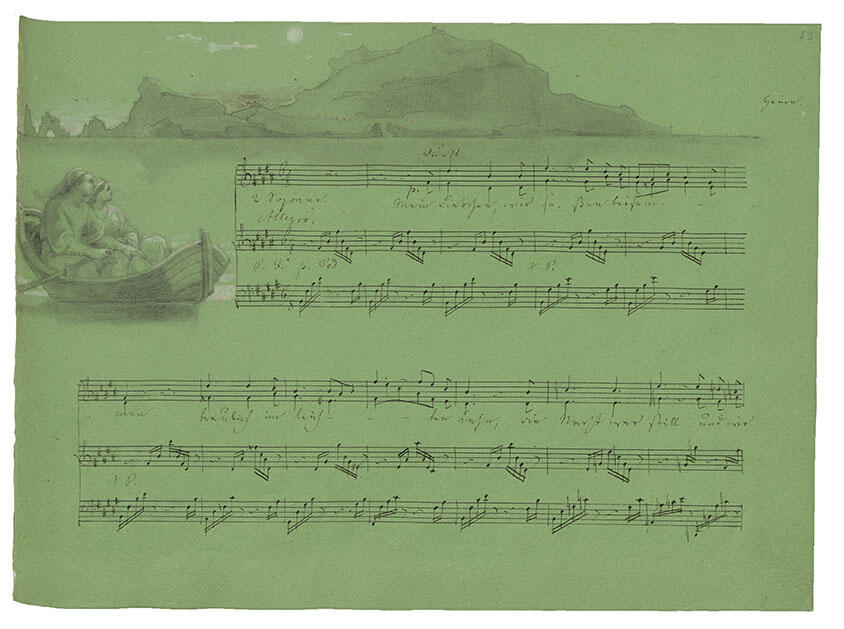
Duette: Mein Liebchen, wir sassen beisammen (Duet: My Sweetheart, We Sat Together)
Image
Please login or register for free access to Posen Library
Already have an account?
Engage with this Source


Related Guide
Music and Opera in Jewish Culture
1750–1880
One of the most striking changes in European Jewish culture toward the later eighteenth century was marked by the entry of Jews into art music, opera houses, and the stage.
You may also like

Marsch der Israelitischen national Garde in Warschau
This illustration depicts three Polish Jewish soldiers taking part in the Polish uprising of 1830 and 1831. The rendering of an “Israelite National Guard in Warsaw” alongside solemn, patriotic music…

Ancienne melodie de la synagogue
Charles-Valentin Alkan was the first composer to incorporate Jewish melodies in art music. His “Ancienne melodie de la synagogue,” a prelude for solo piano or organ, was published in 1847, along with…
Hallelujah: Eine Cantatine für 4 Männerstimmen mit begleitung einer obligaten orgel und des chores ad libitum
The manuscript is believed to be the earliest extant Reform Jewish liturgical composition. An early example of the work of Giacomo Meyerbeer, “Hallelujah” was probably prepared for use at a service at…

Seu Shearim (Lift Up Your Heads, O Gates)
The music for “Se’u She‘arim (Lift Up Your Heads, O Gates)” resembles the choral marches found in grand opera. The words are from Psalm 24: O gates, lift up your heads! Up high, you everlasting doors…

Esther’s Triumph
Friends, let’s celebrate this day—Viva!
Purim, occasion to be gay—Viva!
Safe and free from Haman’s wrong,
Let’s shout in unison this song—Viva, viva, viva . . .
Esther, brilliant as the sun—Viva!
G…
Kerakh shel romi (City of Rome)
The Bah (Bayit Hadash) was asked concerning the practice in synagogues of using music which is sung in the houses of worship (of non-Jews). It is only forbidden regarding…