

The Eyes of the Nation
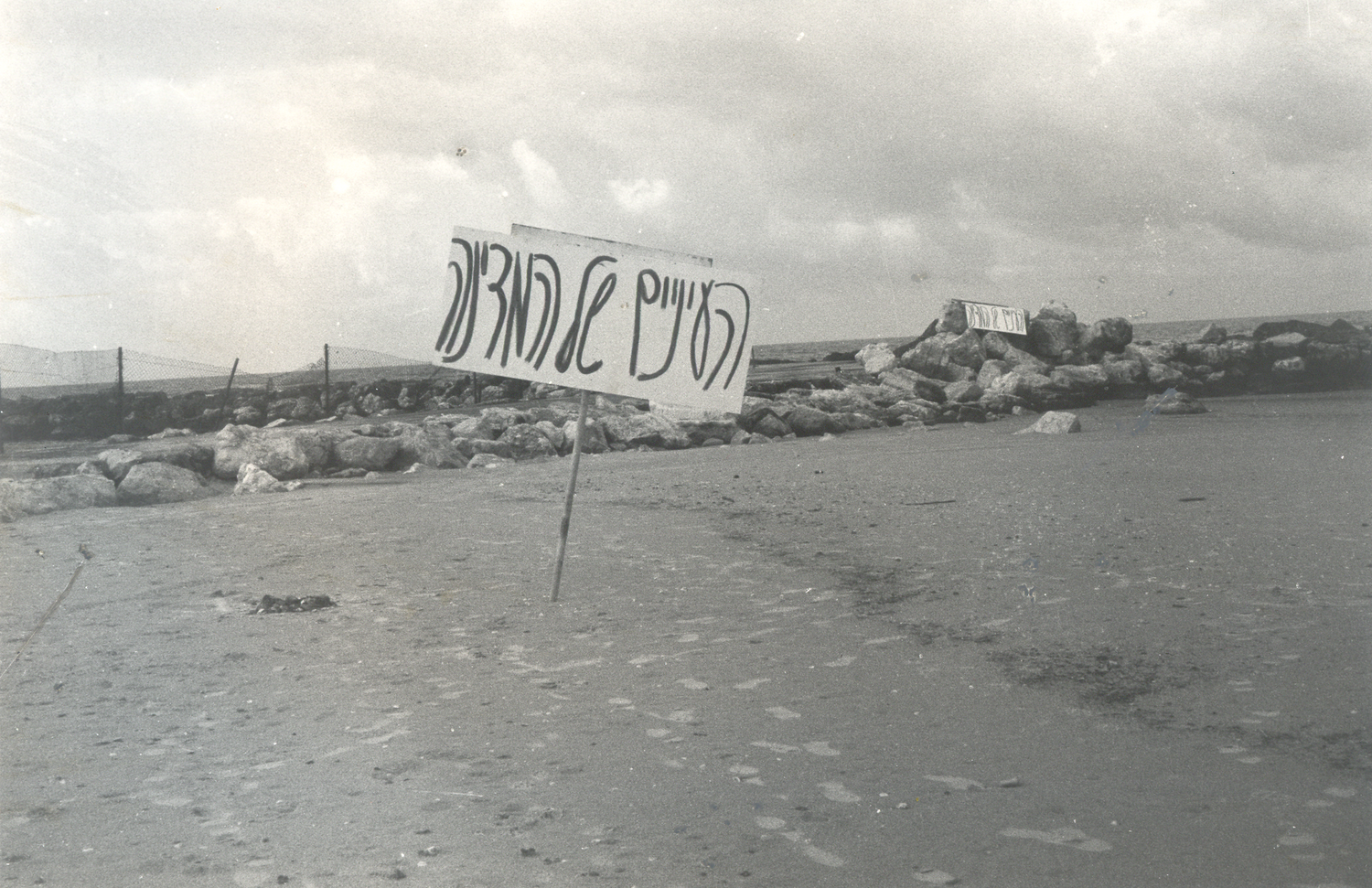

After the Yom Kippur War (1973), it became increasingly common for Israeli artists to address political issues and criticize Israeli society. In 1974, Na’aman placed two signs on the Tel Aviv beach reading, in Hebrew, “The Eyes of the Nation,” a reference to the capture of Mount Hermon by Israel during the war. The mountain’s altitude and its location in the Golan Heights provided Israel with a new strategic early-warning system, leading it to be nicknamed “the eyes of the nation.” Facing west, toward the water, Na’aman’s signs implicitly questioned how the State of Israel defined its borders.
We’re sorry. The Posen Library’s licensing agreements prevent this image from being printed or downloaded.
Credits
Collection of the Tel Aviv Museum of Art. Courtesy of the artist. Image courtesy of Tel Aviv Museum of Art.
Published in: The Posen Library of Jewish Culture and Civilization, vol. 10.
You may also like

Remembrance
Remembrance was commissioned by Congregation Agudas Achim in Bexley, Ohio. The nine-foot-tall bronze sculpture depicts smoke rising from a crematorium, intertwined with the arm of a survivor…

Shadow and Synagogue
Shadow and Synagogue is one of a series of about one hundred photographs by Tress that appear in his 1975 book, Shadow, A Novel in Photographs. In the book’s visual narrative, the photographer’s…

Druksland
Druks was commissioned to create this self-portrait in the form of a topographical map, by Steendrukkerij de Jong & Co., a large European printing house, who used it as a promotional gift for their…

She Said to Him, “You Be the Driver and I’ll Be the Madam,” Then They Picked Up the Fender and Posed, Hillbrow, 1975
Photographer David Goldblatt dedicated much of his work to documenting racial injustice in South Africa. The title of the photograph tells its story. Two Black South Africans use a car fender to role…

Cabbalistic Sphere
Cabbalistic Sphere, a sculpture made from polished aluminum, is one of Kaish’s many works inspired by ancient Jewish texts. Some of her works with spiritual and metaphysical themes are abstract…

The Dead Class
In The Dead Class, the most famous of Kantor’s theater pieces from the 1970s, the main characters of the play are elderly men (who are to be understood as being dead), who return to their school desks…
You may also like
Remembrance
Remembrance was commissioned by Congregation Agudas Achim in Bexley, Ohio. The nine-foot-tall bronze sculpture depicts smoke rising from a crematorium, intertwined with the arm of a survivor…
Shadow and Synagogue
Shadow and Synagogue is one of a series of about one hundred photographs by Tress that appear in his 1975 book, Shadow, A Novel in Photographs. In the book’s visual narrative, the photographer’s…
Druksland
Druks was commissioned to create this self-portrait in the form of a topographical map, by Steendrukkerij de Jong & Co., a large European printing house, who used it as a promotional gift for their…
She Said to Him, “You Be the Driver and I’ll Be the Madam,” Then They Picked Up the Fender and Posed, Hillbrow, 1975
Photographer David Goldblatt dedicated much of his work to documenting racial injustice in South Africa. The title of the photograph tells its story. Two Black South Africans use a car fender to role…
Cabbalistic Sphere
Cabbalistic Sphere, a sculpture made from polished aluminum, is one of Kaish’s many works inspired by ancient Jewish texts. Some of her works with spiritual and metaphysical themes are abstract…
The Dead Class
In The Dead Class, the most famous of Kantor’s theater pieces from the 1970s, the main characters of the play are elderly men (who are to be understood as being dead), who return to their school desks…