

Grace after Meals according to a Cairo Geniza Fragment
About This Entry
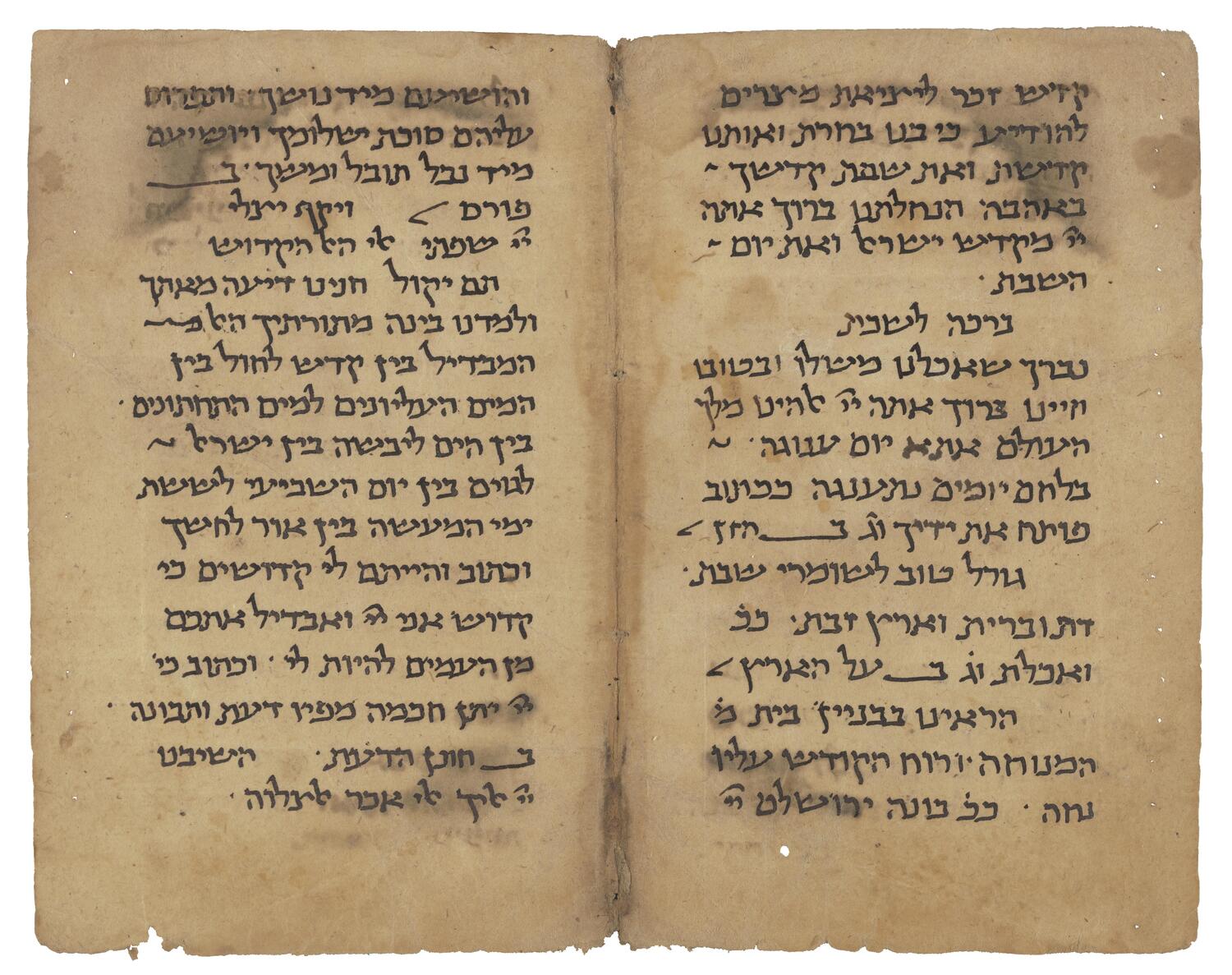
This Grace after Meals from the Cairo Geniza probably has roots in the eastern Mediterranean, perhaps in Palestine or Syria, and was likely copied in the twelfth century. It contains many uncommon variations, which may have been inserted by the scribe or were representative of a larger communal tradition, or both. This version blends features of many known rites.
With the mercy of Heaven.
Blessed are You, Lord our God, King of the universe, who in goodness feeds the entire world, with kindness, and with mercy. He gives food to all living beings for His lovingkindness with us is forever, and His great goodness we have never lacked, and may He never let us lack, our King, food from now and forever, for the sake of His great name. For He feeds and sustains all, and His table is set for all, and He has prepared for all His creatures which He created in His mercy and in His abundant kindness, as it is stated: You open Your hand, and satisfy every living thing with favor (Psalms 145:16). Blessed are You, Lord, who provides food for all. We thank You, Lord our God, for having given us as a heritage a desirable, good, and spacious land, the covenant, the Torah of life, and food and for bringing us out of the land of Egypt and freeing us from the house of slavery, and for the laws of Your will that You made known to us, and for Your covenant that You placed in our flesh, and for Your Torah that You taught us, and for the life, grace, kindness, sustenance, and support, that You bestow upon us and lend to us in every season and at every time. For all of them, Lord our God, we thank You and bless Your great and holy name forever and ever, as it is stated: You will eat and be satisfied and bless the Lord your God, for the good land that He has given you (Deuteronomy 8:10). And speedily remember for us the covenant of our forefathers, and in Your great goodness satisfy our souls, and we will thank Your great name, Selah. Blessed are You, Lord, for the land and for the food. Have mercy, Lord our God, upon us and upon Your people Israel, and upon Jerusalem Your city, and upon Zion, the abode of Your glory, and upon the great and holy House that bears Your name, and the royal house of David may You speedily restore to its place in our days, and build Jerusalem soon. [ . . . ]
[A]nd bring us up to it, and let us rejoice in its rebuilding. Blessed are You, Lord, who builds in His mercy Jerusalem; Amen. Blessed are You, Lord our God, King of the universe, our Father, our King, our Mighty One, our Holy One, the Holy One of Jacob, the merciful and good King, who performs good, as each and every day He performs goodness with us. He has dealt kindly with us; He will deal kindly with us forever, granting us grace, kindness, and mercy, and all goodness. May the Merciful One reign forever and ever. May the Merciful One be praised in heaven and on earth. May the Merciful One be honored on His throne of glory. May the Merciful One lead us upright. May the Merciful One save us from poverty. May the Merciful One rebuke those who think evil upon us. May the Merciful One remove illness from among us. May the Merciful One bless the work of our hands. May the Merciful One grant us success in all our endeavors. May the Merciful One plant His To-rah in our hearts. May the Merciful One bless the table at which we have eaten, make our table like Abraham’s, plant all delicacies upon it, and arrange all delights on it. May the Merciful One spread over us the tabernacle of peace. May the Merciful One be for us a helper and a support. May the Merciful One make us worthy of the coming of the King Messiah, and of the life of the world to come. He gives great salvation to His king, and performs mercy for His anointed, for David and for his seed, forever (Psalms 18:51). May He who makes peace in His high places, in His mercy make peace for all Israel. The blessing is completed, with the help of God.
Source: Chester MS Add. 3162, fols. 1b–4a

Published in: The Posen Library of Jewish Culture and Civilization, vol. 3: Encountering Christianity and Islam.
You may also like

Kaddish of Renewal
Kaddish le-ḥadata
The Justification of [Divine] Judgment
Tsiduk ha-din

A Page with An Abbreviated Grace After Meals, for the Sabbath
Grace after Meals for Weekdays according to Cairo Geniza Fragments
Grace after Meals in a House of Mourning
On the Blessing over the Signs of Virginity
Halakhot Gedolot
You may also like
Kaddish of Renewal
Kaddish le-ḥadata
The Justification of [Divine] Judgment
Tsiduk ha-din
A Page with An Abbreviated Grace After Meals, for the Sabbath
Grace after Meals for Weekdays according to Cairo Geniza Fragments
Grace after Meals in a House of Mourning
On the Blessing over the Signs of Virginity
Halakhot Gedolot