

Guide for the Reader [of Scripture]
About This Entry
This Arabic treatise explains how to read (i.e., chant with proper pronunciation and cantillation) the text of the Hebrew Bible according to the Tiberian Masoretic tradition. An addendum to Abū ’l-Faraj Hārūn’s grammatical writings, this treatise was written during the height of Karaite interest in biblical exegesis. Guide for the Reader [of Scripture] (Hidāyat al-qāri’) was popular throughout the medieval period. It was later condensed, and both longer and shorter versions were translated into Hebrew and transmitted in Yemen, northern France and Germany, and Italy.
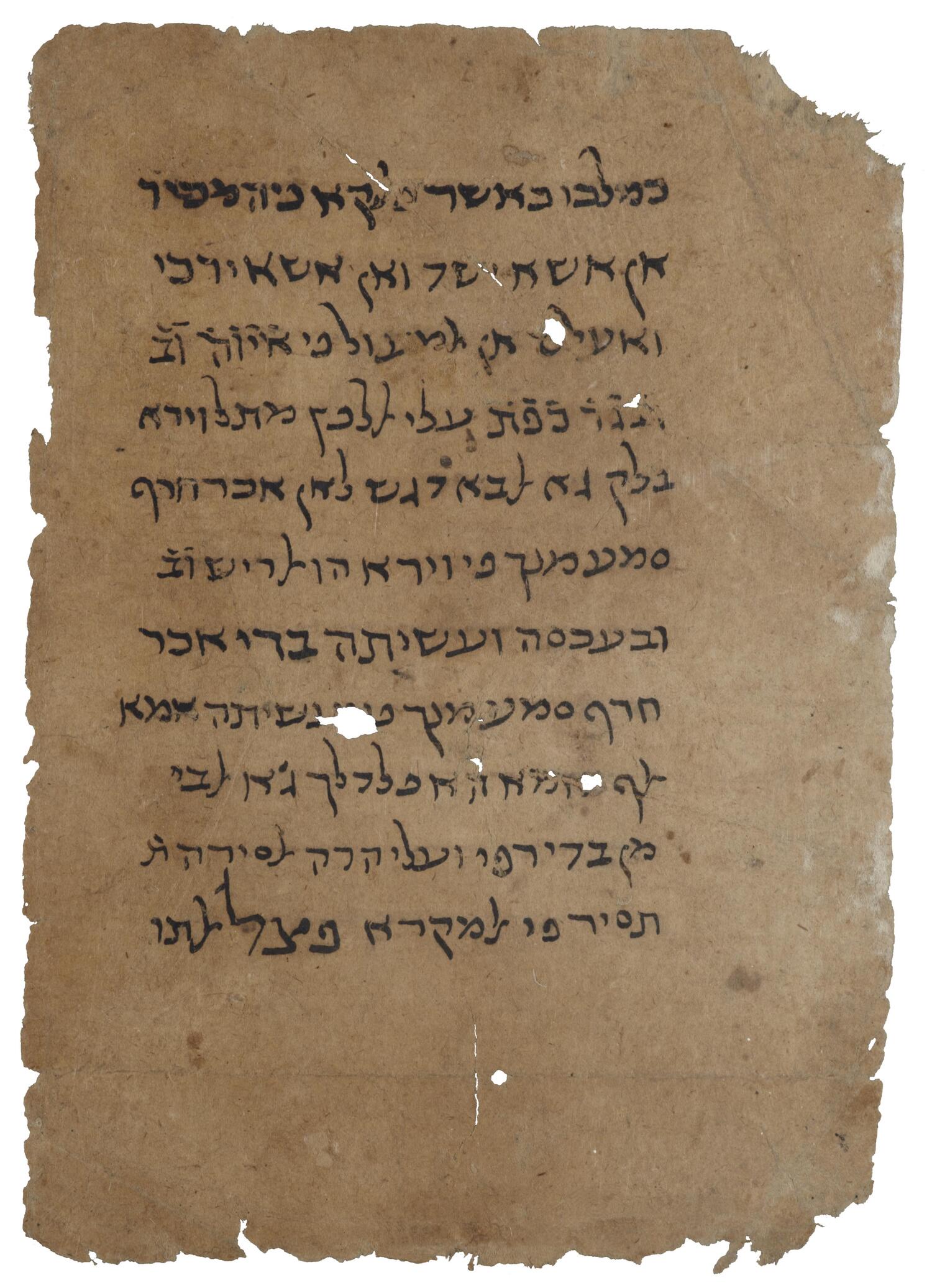

If one were to say “What do you say concerning the formation of these accents?” the response would be that they originated by convention among the people of the language, by the help of which they fully expressed their purposes, as in the aforementioned examples and others. They established them by convention, just as they established the vowels by convention, as will be explained. [ . . . ]
If it be said “What is the origin of the melodies of the accents before the aforementioned arrangement was fixed?” the response would be as follows. It is possible that the people of the language paused on one letter and made it slightly longer than another one to the extent that they could make thereby their intentions known. My claim that the accents have been fixed since the time of the prophets, peace be upon them, is supported by three things.
One of these is that the nation has not been cut off from the Holy Land. The period in which they were cut off from it was between the two temples, concerning which it is stated אז תרצה הארץ את-שבתתיה בהשמה מהם Then the land shall enjoy its sabbaths while it lies desolate without them (Leviticus 26:34, 43). When the land completed its rest in the periods of its lying fallow, העיר יהוה את-רוח כרש מלך-פרס the Lord stirred up the spirit of Cyrus king of Persia (Ezra 1:1, etc.) and he sent up the two groups [of returnees] to the holy land, the group of Ezra and the group of Nehemiah. [ . . . ] After they arrived in the Holy Land they were not cut off from it until this day. Now the reading that Ezra, peace be upon him, and his congregation used to read is the reading of the Land of Israel today. It has remained the way [of reading] that has been transmitted among them from generation to generation, from one offspring to another, until now. If it be said: the wicked Edom deported the people, filled ships with them, left them without a sailor or a helmsman, and caused the hot baths to overwhelm them with smoke until they died, in accordance with what is said to have happened during the conquests of Jerusalem by Edom; the response should be: Although it did to them what you have mentioned, Edom only cut them off from Jerusalem. This is demonstrated by the fact that there was pilgrimage to Tiberias from the direction of the Levant and the East and to Gaza from the direction of the West during the period the people of Edom were in control of the Land of Israel, which was about five hundred years, in accordance with what is mentioned in their chronicles. Those who dwelt in the land all taught their children the Torah and the Scriptures, I mean the remainder of the twenty-four books. If all this is indeed so, then it must be the case that the people used to teach their children what they knew and were familiar with concerning the correct division of the accents and their musical rendition.
The second point is that those who were exiled and did not come back with Ezra and Nehemiah, peace be upon them, remained scattered and they lost [knowledge of] the accents, and began to read with different cantillations. Therefore, you see that the [Jews of] Byzantium read in a way that is different from that of the people of Iraq. The [Jews of] Persia have a way of reading that is different from that of the [Jews of] Byzantium and the Iraqis. The people of the West have [a reading] different from all of the aforementioned. Indeed, perhaps some community that you do not know has a way [of reading] that differs from all of these, such as those whom Edom drove away to remote countries, as we have mentioned. It is the general consensus of those just mentioned that the way of reading of the Land of Israel is the original one and this is what is called the Tiberian reading. [ . . . ]
The third point is that if somebody were to read בראשית (Genesis 1:1) with the accent tevir or an accent other than the ṭifḥa,1 he would provoke the congregation to point out his error and angrily censure him. [ . . . ] Now, if all this is the case, it strengthens my claim that the accents have been established since the time of the prophets. If this were not the case, then anybody who wished to change [the reading] could change it without being called to account for this, just as there would be no calling to account of somebody who wanted to recite in prayer the Psalms or some passage from the twenty-four books without the intention of reading [the text] in order. [ . . . ]
It is an established fact that the reading has various characteristic features, which the reader must learn in order to ensure a correct cantillation of what he reads. When he does not know this, the cantillation is produced in a corrupt fashion. If it be said “So what benefit is there in the accents apart from what you have stated?” the response would be that their benefit is that they enable the congregation, however numerous, small or large, all to read one word together, and that they continue, whatever they read, in a coordinated way. Such a thing cannot be achieved without the established accents. Surely you see that Muslims, whether they be two or more, cannot read with the same degree of coordination as the Jews read, since each one has his own way [of reading]. One makes long a place that another makes short. One reads melodically a place that another reads flat. For this reason they are unable to achieve what Jews do, because a group and individuals intone according to specific rules, and they do not change that from letter to letter. If somebody were to change something, [his reading] would be rejected and declared to be incorrect.
Notes
Words in brackets appear in the original translation unless otherwise indicated. Biblical verses are from NKJV.
[I.e., with the incorrect melody.—Ed.]
Credits
Abū ’l-Faraj Hārūn, Guide for the Reader [of Scripture], trans. Geoffrey Khan, from Geoffrey Khan, The Tiberian Pronunciation Tradition of Biblical Hebrew, vol. 2 (Cambridge, UK: University of Cambridge, 2020), 26–36 (CC BY 4.0). Scripture taken from the New King James Version ® . Copyright © 1982 by Thomas Nelson. Used by permission. All rights reserved.
Published in: The Posen Library of Jewish Culture and Civilization, vol. 3: Encountering Christianity and Islam.
You may also like

The Comprehensive Book
Kitāb al-ḥāwī

A Manuscript Copy of the Abridgment of Abū ’l-Faraj Hārūn’s Hidāyat al-qāri’
The Book of [Hebrew] Roots
Kitāb al-uṣūl

An Early Manuscript Copy of The Sufficient Book
Judah Ḥayyūj’s Book on Verbs That Contain Weak and Lengthening Letters: Translator’s Introduction
Kitāb al-af‘āl dhawāt ḥurūf al-līn, Introduction
The Book of Reprobation
Kitāb al-taswi‘a, Introduction (selections)
You may also like
The Comprehensive Book
Kitāb al-ḥāwī
A Manuscript Copy of the Abridgment of Abū ’l-Faraj Hārūn’s Hidāyat al-qāri’
The Book of [Hebrew] Roots
Kitāb al-uṣūl
An Early Manuscript Copy of The Sufficient Book
Judah Ḥayyūj’s Book on Verbs That Contain Weak and Lengthening Letters: Translator’s Introduction
Kitāb al-af‘āl dhawāt ḥurūf al-līn, Introduction
The Book of Reprobation
Kitāb al-taswi‘a, Introduction (selections)