

The Hanging of Jud Süss
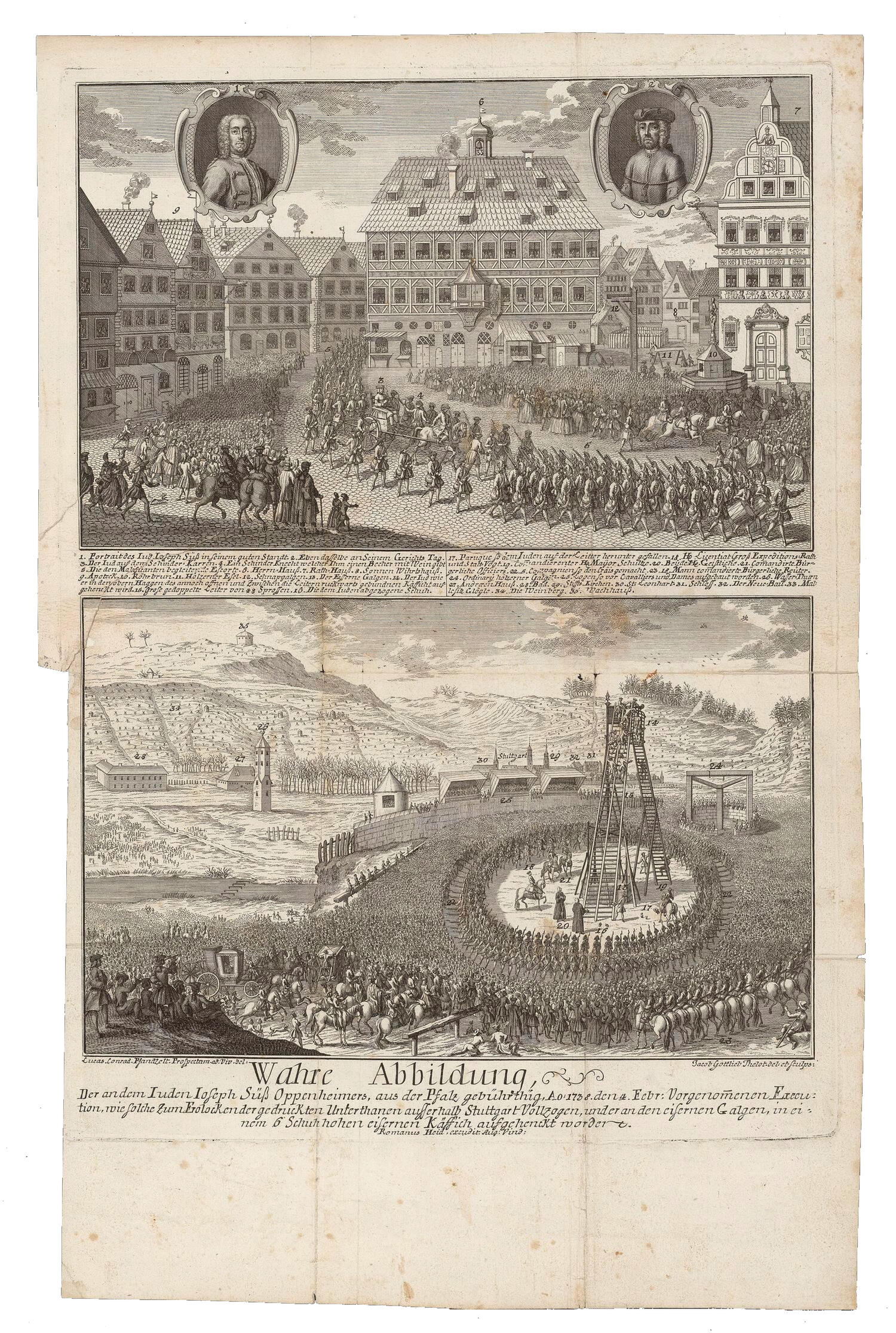

Joseph ben Issachar Süsskind Oppenheimer was a financier and court Jew who served as adviser to Duke Karl Alexander of Württemberg. Economic reforms enacted by Karl Alexander (and informed by Oppenheimer) angered the Protestant Württemberg States, especially after Karl had converted to Catholicism, and stoked anti-Jewish sentiment. Oppenheimer, who had embraced an ostentatious and promiscuous lifestyle and dabbled in economic intrigues, was resented for Karl’s financial policies. After Karl Alexander’s death in 1737, Oppenheimer was arrested and charged with a variety of crimes. In 1738, he was executed, and his body was exhibited in an iron cage for six years. Created by the Augsburg copper engraver Jacob Gottlieb Thelot, this engraving was one of many depictions of Oppenheimer’s public execution, including his transfer from Stuttgart to a gallows set up outside the city. The large composition, with two scenes, presents the hanging as a great spectacle seen by thousands of people. A legend at the bottom provides a detailed description of the events, pointing out the homes, the nature of the infantry, the building of the gallows, and so on. The artist (Lucas Conrad Pfandzelt) carefully depicted the way several attendants labored to drag Oppenheimer up the 52-step ladder to the gallows, as two clergymen standing at the base of the ladders made a final attempt to convince him to convert.
Credits
Published in: The Posen Library of Jewish Culture and Civilization, vol. 5.
You may also like

Portrait of Eliseba Lopes Suasso de Pinto

Three Representatives of the Prague Burial Society

Portrait of Menachem Vivante

Portraits of the Franks-Levy Family

Schraubtaler (Screw Medal) of Jud Süss Oppenheimer

Portrait of Rachel da Costa with the Child Catharina Suasso

Related Guide
Early Modern Visual and Material Culture
Early modern Jewish visual culture flourished, with illuminated manuscripts, ornate synagogues, and portraiture alongside increasing non-Jewish interest in Jewish customs and greater Jewish self-representation.
You may also like
Portrait of Eliseba Lopes Suasso de Pinto
Three Representatives of the Prague Burial Society
Portrait of Menachem Vivante
Portraits of the Franks-Levy Family
Schraubtaler (Screw Medal) of Jud Süss Oppenheimer