

Holocaust Memorial, Judenplatz, Vienna, Austria
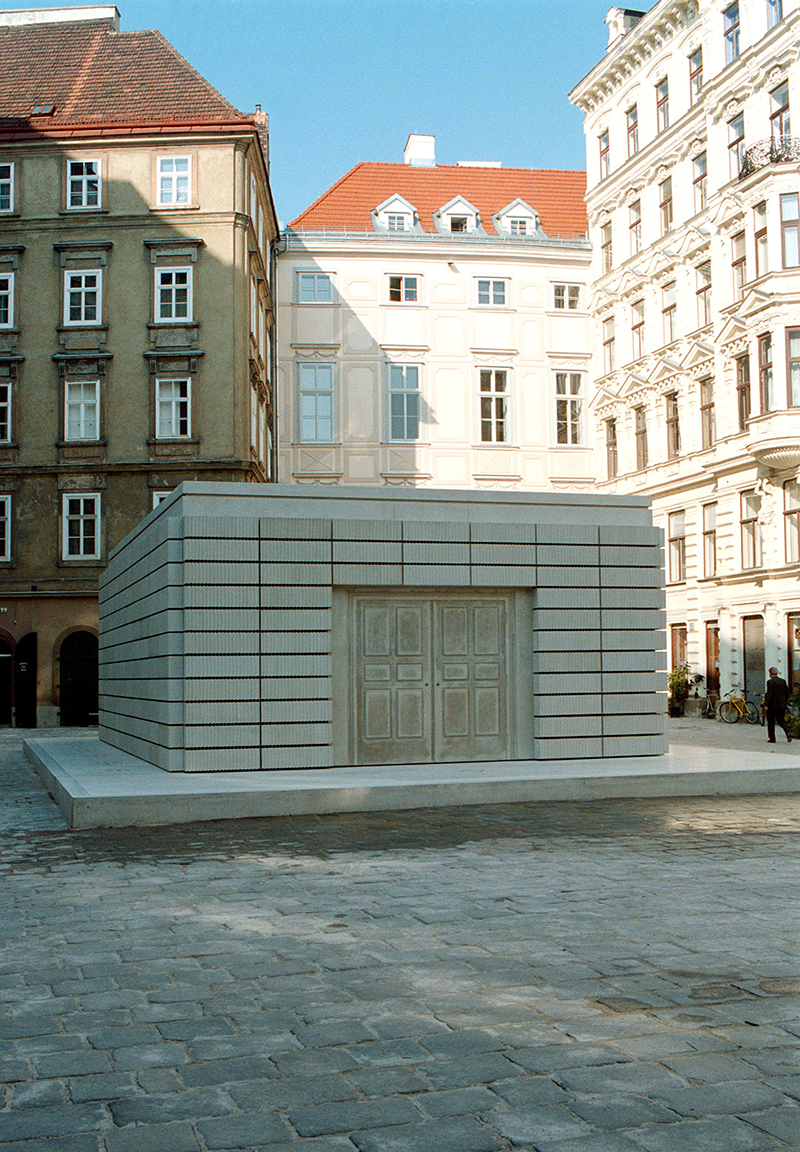

Whiteread’s memorial for Austrian Jewish victims of the Holocaust is located in Vienna in a square known as the Judenplatz. Sometimes called the Nameless Library, the steel and concrete structure has a façade meant to resemble shelves of books with their spines turned inward. Its double doors have no doorknobs or handles. Twelve feet high, twenty-four feet wide, and thirty-three feet long, the memorial also resembles a bunker and the artist confirmed that military fortifications were one inspiration for its design. Not meant to be beautiful, it was intended to provoke discomfort by making public a shame that some would prefer would remain hidden. The Judenplatz is also the site of a medieval synagogue that was burned down in 1420 during anti-Jewish violence. Recent excavations have revealed the remains of the synagogue below the square.
We’re sorry. The Posen Library’s licensing agreements prevent this image from being printed or downloaded.
Credits
Courtesy of the artist and Luhring Augustine, New York.
Published in: The Posen Library of Jewish Culture and Civilization, vol. 10.
You may also like

The Last Village Mukhtar, Dir-el-Kassi/Elkosh, from Non-Historical Moments
Glotman’s Non-Historical Moments project focuses on family photographs of Palestinians expelled from the village of Dir-el-Kassi during Israel’s War of Independence. A moshav, or cooperative farm…

Father Touches My Hair
Carucci is known for exploring the complex intimacies of family life in her photographs. She has said that she doesn’t deliberately set out to be provocative but rather strives for unflinching honesty…

Jude
Cherkassky’s gold Star of David with the word “Jude” in its center was displayed in Collectio Judaica at the Rosenfeld Gallery in 2003. It was the artist’s first major solo exhibition. The theme of…

Berlin Jewish Museum, Berlin, Germany
Liebeskind’s design for a new extension to the Berlin Jewish Museum was the winner of a 1989 competition and was the first of his designs to be built. Its zigzagging shape was intended to evoke the…

The South Tower
The award-winning photographer, Meyerowitz, was the only photographer officially allowed to enter Ground Zero in the days immediately following the collapse of the World Trade Towers in the terrorist…

The Great Vehicle
The Great Vehicle is one of dozens of wheeled sculptures Rantzer created for “The Zionists,” his 2001 solo exhibition at the Gordon Gallery in Tel Aviv. The overall themes of the show were migration…
You may also like
The Last Village Mukhtar, Dir-el-Kassi/Elkosh, from Non-Historical Moments
Glotman’s Non-Historical Moments project focuses on family photographs of Palestinians expelled from the village of Dir-el-Kassi during Israel’s War of Independence. A moshav, or cooperative farm…
Father Touches My Hair
Carucci is known for exploring the complex intimacies of family life in her photographs. She has said that she doesn’t deliberately set out to be provocative but rather strives for unflinching honesty…
Jude
Cherkassky’s gold Star of David with the word “Jude” in its center was displayed in Collectio Judaica at the Rosenfeld Gallery in 2003. It was the artist’s first major solo exhibition. The theme of…
Berlin Jewish Museum, Berlin, Germany
Liebeskind’s design for a new extension to the Berlin Jewish Museum was the winner of a 1989 competition and was the first of his designs to be built. Its zigzagging shape was intended to evoke the…
The South Tower
The award-winning photographer, Meyerowitz, was the only photographer officially allowed to enter Ground Zero in the days immediately following the collapse of the World Trade Towers in the terrorist…
The Great Vehicle
The Great Vehicle is one of dozens of wheeled sculptures Rantzer created for “The Zionists,” his 2001 solo exhibition at the Gordon Gallery in Tel Aviv. The overall themes of the show were migration…