

Homesickness
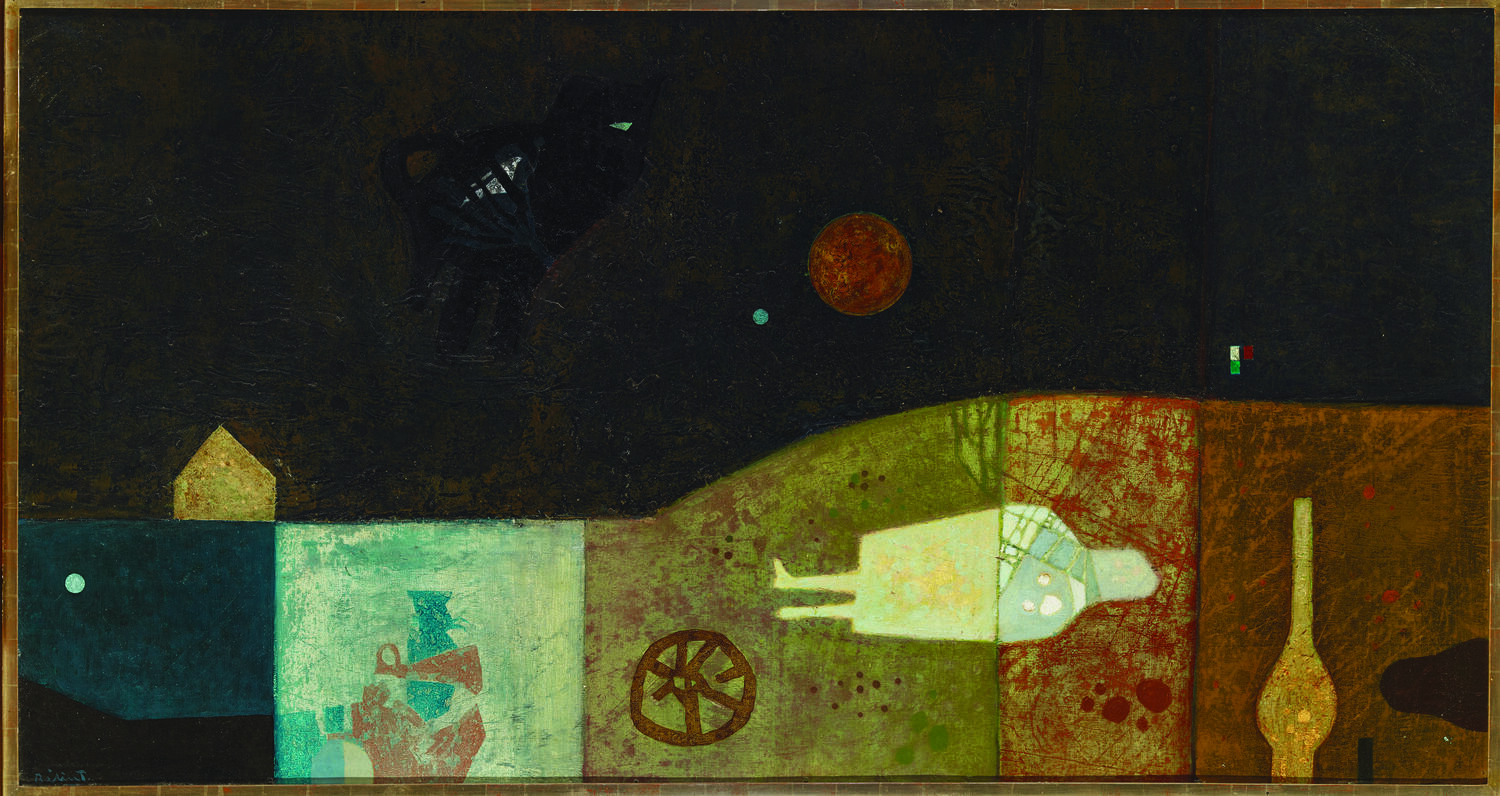

In the 1940s and 1950s, Endre Bálint’s paintings began to feature mythological and fantastical symbols and figures, in a style sometimes reminiscent of Hungarian folk art and archaic art. In Homesickness, a human or humanoid figure lies in what looks like a burial mound, along with a wheel and some unidentifiable objects, one of which resembles an amphora. Influenced by post-World War II surrealist art, his work presents art as a manifestation of the subconscious. By 1959, when Homesickness was painted, Bálint had fled Hungary and was living in Paris.
We’re sorry. The Posen Library’s licensing agreements prevent this image from being printed or downloaded.
Credits
© Courtesy Nudelmann Numismatica.
Published in: The Posen Library of Jewish Culture and Civilization, vol. 9.
You may also like

Leonard Bernstein
Al Hirschfeld was most famous for his caricatures of actors, musicians, and other figures from the arts and public life. He himself preferred to be known as a “characterist.” After the birth of his…

Tzadik
Tzadik is one of a series of paintings that Morris Louis made in the years 1954 to 1958, known as the Veils. These were groundbreaking works that serve as a link between abstract expressionism and…

Warsaw Ghetto Uprising
Arnold Belkin, sometimes called the Canadian son of Mexican muralism, created traditional murals but also painted ten of what he called “portal murals.” These were large-scale paintings that could be…

Message Number 7B, Ecclesiastes VII: 6
Mathias Goeritz began his Messages series in the late 1950s and continued adding to it until the end of his career. He set out to create a modernist religious art. Works in the series often referred…

Astérix le Gaulois, no. 1, cover
Astérix le Gaulois is set in the first century BCE, during Rome’s conquest of Gaul (France), focusing on the inhabitants of a small village who, given superhuman strength by a magic potion prepared by…

Social Housing Blocks in Upper Nazareth
For many years, Amiram Erev worked as a photographer for Solel Boneh, the large Israeli construction company founded by the Histadrut, Israel’s General Federation of Labor. The company played a key…
You may also like
Leonard Bernstein
Al Hirschfeld was most famous for his caricatures of actors, musicians, and other figures from the arts and public life. He himself preferred to be known as a “characterist.” After the birth of his…
Tzadik
Tzadik is one of a series of paintings that Morris Louis made in the years 1954 to 1958, known as the Veils. These were groundbreaking works that serve as a link between abstract expressionism and…
Warsaw Ghetto Uprising
Arnold Belkin, sometimes called the Canadian son of Mexican muralism, created traditional murals but also painted ten of what he called “portal murals.” These were large-scale paintings that could be…
Message Number 7B, Ecclesiastes VII: 6
Mathias Goeritz began his Messages series in the late 1950s and continued adding to it until the end of his career. He set out to create a modernist religious art. Works in the series often referred…
Astérix le Gaulois, no. 1, cover
Astérix le Gaulois is set in the first century BCE, during Rome’s conquest of Gaul (France), focusing on the inhabitants of a small village who, given superhuman strength by a magic potion prepared by…
Social Housing Blocks in Upper Nazareth
For many years, Amiram Erev worked as a photographer for Solel Boneh, the large Israeli construction company founded by the Histadrut, Israel’s General Federation of Labor. The company played a key…