

Menaḥem Egozi’s Gal shel egozim (Nut Garden)


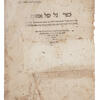
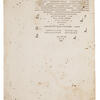
These are two pages from a book printed by Doña Reina Mendes at the Hebrew printing press she founded at her residence, Belvedere. This work, Gal shel egozim (Nut Garden) by Menaḥem Egozi, is a collection of homilies on the book of Genesis.
Credits
-
Menahem Egozi, from Gal shel egozim (Belvedere, 1593?). Courtesy of the Library of Congress.
-
Menahem Egozi, from Gal shel egozim (Belvedere, 1593?). Courtesy of the Library of Congress.
Discussion Questions
Why would being a widow have been advantagious for Reina in establishing her press?
Why do you think Reina would have established a press as the means to support herself?
How might this story change our perspective of women and literacy in the early modern period?
Published in: The Posen Library of Jewish Culture and Civilization, vol. 5.
You may also like

Tsemaḥ David (The Sprout of David): On the Invention of the Printing Press
The Book of Expurgation
Sefer ha-zikuk


Me‘on ha-sho’alim (Abode of the Supplicants)
Editor’s Apology: She’elot u-teshuvot Maharil
Approbation for a Prayer Book
This 1617 letter from the Council of the Four Lands in Poland provided the first authorized status for a prayer book, protecting it from plagiarism and competition.
Proofreader’s Preface: Seder tefilot ke-minhag kahal kadosh Sefarad (The Order of the Prayers of the Holy Congregation of Spain)

Related Guide
Jewish Printing and Book Culture
Jewish printing unified far-flung communities by standardizing religious texts, created textual uniformity, and enabled vernacular translations, and facilitated the spread of Jewish texts and knowledge.
You may also like
Tsemaḥ David (The Sprout of David): On the Invention of the Printing Press
The Book of Expurgation
Sefer ha-zikuk
Me‘on ha-sho’alim (Abode of the Supplicants)
Editor’s Apology: She’elot u-teshuvot Maharil
Approbation for a Prayer Book
This 1617 letter from the Council of the Four Lands in Poland provided the first authorized status for a prayer book, protecting it from plagiarism and competition.