

Mental Maps—Involuntary Memory
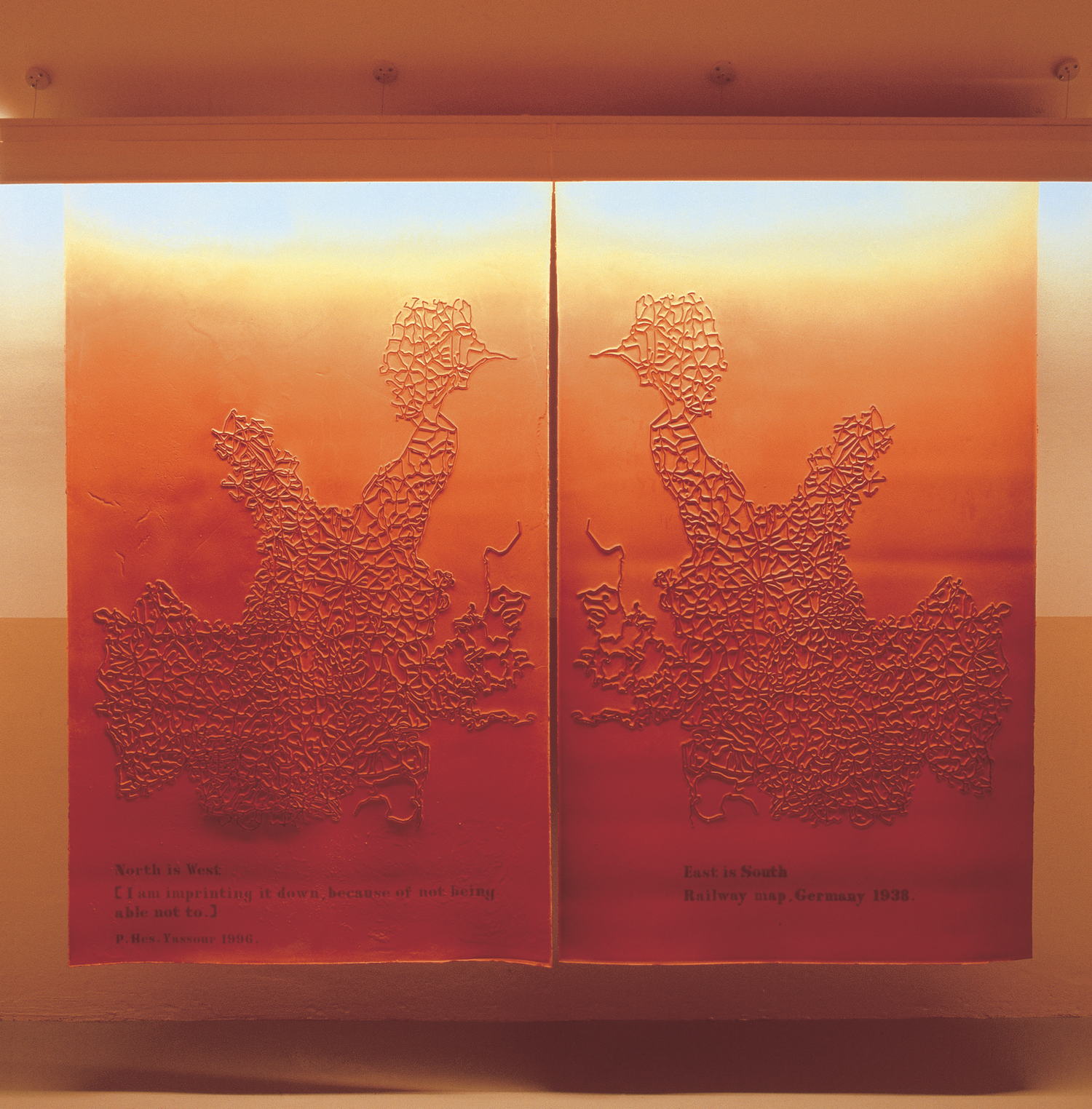

Mental Maps depicts mirrored images of a 1938 German railway map made from rubber and pigment. The left panel contains two lines of text that read “North is West” and “[I am imprinting it down, because of not being able not to].” The right panel reads “East is South” and “Railway map, Germany 1938.” The neon lights illuminating the map’s surface generate a slightly ominous glowing effect. The artist believed that it was not necessary to explain exactly how the railway maps foreshadow the way that train cars would come to be used in the deportation, displacement, and deaths of Nazi Germany’s victims—even Jews who did not directly experience the Holocaust “remember” it, even involuntarily and these memories continue to shape post-Holocaust generations. She has commented that the doubled image alludes to “the menacing image of the third Reich Symbol.”
We’re sorry. The Posen Library’s licensing agreements prevent this image from being printed or downloaded.
Credits
Courtesy of the artist.
Published in: The Posen Library of Jewish Culture and Civilization, vol. 10.
You may also like

Home for the High Holy Days
Wolin spent six years photographing a hundred Jewish residents of Wyoming, eventually publishing the photographs in a 2000 book, The Jews of Wyoming: Fringe of the Diaspora. Her black-and-white…

Pond (55)
In 2000, Cohen Levy had an exhibition, at the Tel Aviv Museum of Art, of a series of paintings of ponds. Each of the paintings has a pattern: a single image, such as leaves, eyes, or fish, which is…

Memory: The Homosexual Memorial Imagination
Memory: The Homosexual Memorial Imagination was the winner of a contest held in 1998 by Beth Simchat Torah, a pioneering LGBT synagogue located in New York City, to choose an artwork memorializing the…

A Sad Story
Although Bergner did not personally experience the Holocaust, it was a recurring theme in his art. Here, in a painting in the style of a child’s drawing, a child wearing a hat, typical of others seen…

Tefillin (Triptych)
Laurence’s Tefillin questions both western art and patriarchal aspects of Judaism. The triptych portrays parts of women’s naked bodies, bound in the leather straps of tefillin, the small black leather…

Dorothy A. Richman, Rabbinical Student, Jewish Theological Seminary
This portrait of Dorothy Richman, a rabbinical student at the Jewish Theological Seminary (JTS) in New York, appeared in Leibovitz’s 1999 book, Women. Richman was one of the first female rabbinical…
You may also like
Home for the High Holy Days
Wolin spent six years photographing a hundred Jewish residents of Wyoming, eventually publishing the photographs in a 2000 book, The Jews of Wyoming: Fringe of the Diaspora. Her black-and-white…
Pond (55)
In 2000, Cohen Levy had an exhibition, at the Tel Aviv Museum of Art, of a series of paintings of ponds. Each of the paintings has a pattern: a single image, such as leaves, eyes, or fish, which is…
Memory: The Homosexual Memorial Imagination
Memory: The Homosexual Memorial Imagination was the winner of a contest held in 1998 by Beth Simchat Torah, a pioneering LGBT synagogue located in New York City, to choose an artwork memorializing the…
A Sad Story
Although Bergner did not personally experience the Holocaust, it was a recurring theme in his art. Here, in a painting in the style of a child’s drawing, a child wearing a hat, typical of others seen…
Tefillin (Triptych)
Laurence’s Tefillin questions both western art and patriarchal aspects of Judaism. The triptych portrays parts of women’s naked bodies, bound in the leather straps of tefillin, the small black leather…
Dorothy A. Richman, Rabbinical Student, Jewish Theological Seminary
This portrait of Dorothy Richman, a rabbinical student at the Jewish Theological Seminary (JTS) in New York, appeared in Leibovitz’s 1999 book, Women. Richman was one of the first female rabbinical…