

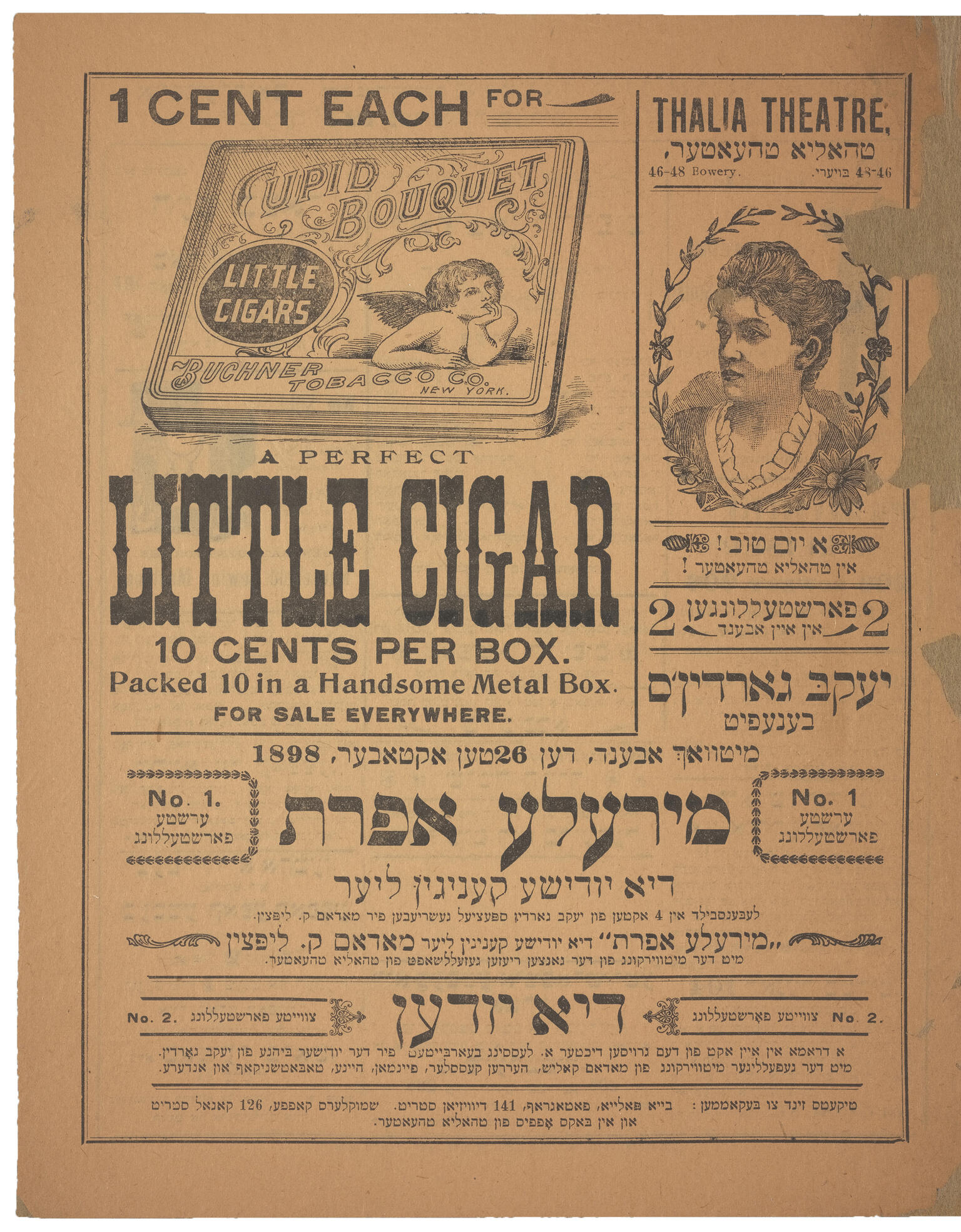
Mirele Efros
Image
Please login or register for free access to Posen Library
Already have an account?
You may also like


Benefit Lunch with Bertha Kalich
This full-page advertisement for a benefit lunch, to be held that day, December 14, 1898, at the Thalia Theater in New York City, with the famed Yiddish actress Bertha Kalich (ca. 1872–1939), includes…

Don Carlos at the Turn of the Century
Karle:Who is coming? What do I hear! God Almighty![Markwitz standing in the door.]Markwitz, tall, thin appearance. Threadbare elegance of the nineties. He is, without a doubt, a…
Purim Eve, a One-Act Comedy
Cast [in this passage]Abraham Levi: Rich merchant
Aneta: Abraham Levi’s wife
Max, Yosef, and Aron: Abraham and Aneta Levi’s sons
Frida and Klerchen: Abraham and Aneta Levi’s daughters
Shmuel Natan: Zionis…
Aneta: Abraham Levi’s wife
Max, Yosef, and Aron: Abraham and Aneta Levi’s sons
Frida and Klerchen: Abraham and Aneta Levi’s daughters
Shmuel Natan: Zionis…

Alla Nazimova as Hedda Gabler
Napoleon Sarony took this photograph of Alla Nazimova in the English-language performance of Ibsen’s Hedda Gabler. Alla Nazimova (1879–1945) was born Mariam Edez Adelaida Leventon in Yalta, Crimea, to…

Announcement for Bar Giora Performance
Moriah Soirée
Bar Giora
A Play in Seven Acts
By: David YellinAdapted from Schiller’s Wilhelm Tell
(On the life of the Jews before the destruction of the Second Temple and their overthrowing of the Roman…
Bar Giora
A Play in Seven Acts
By: David YellinAdapted from Schiller’s Wilhelm Tell
(On the life of the Jews before the destruction of the Second Temple and their overthrowing of the Roman…

The Melting Pot
Vera [Agitated, coming nearer]: Irony, Mr. Quixano? Please, please, do not imagine there is any irony in my congratulations.David: The irony is in all the congratulations. How can I endure them when…