

Mishneh Torah, Book of Love: Laws of Prayer
About This Entry
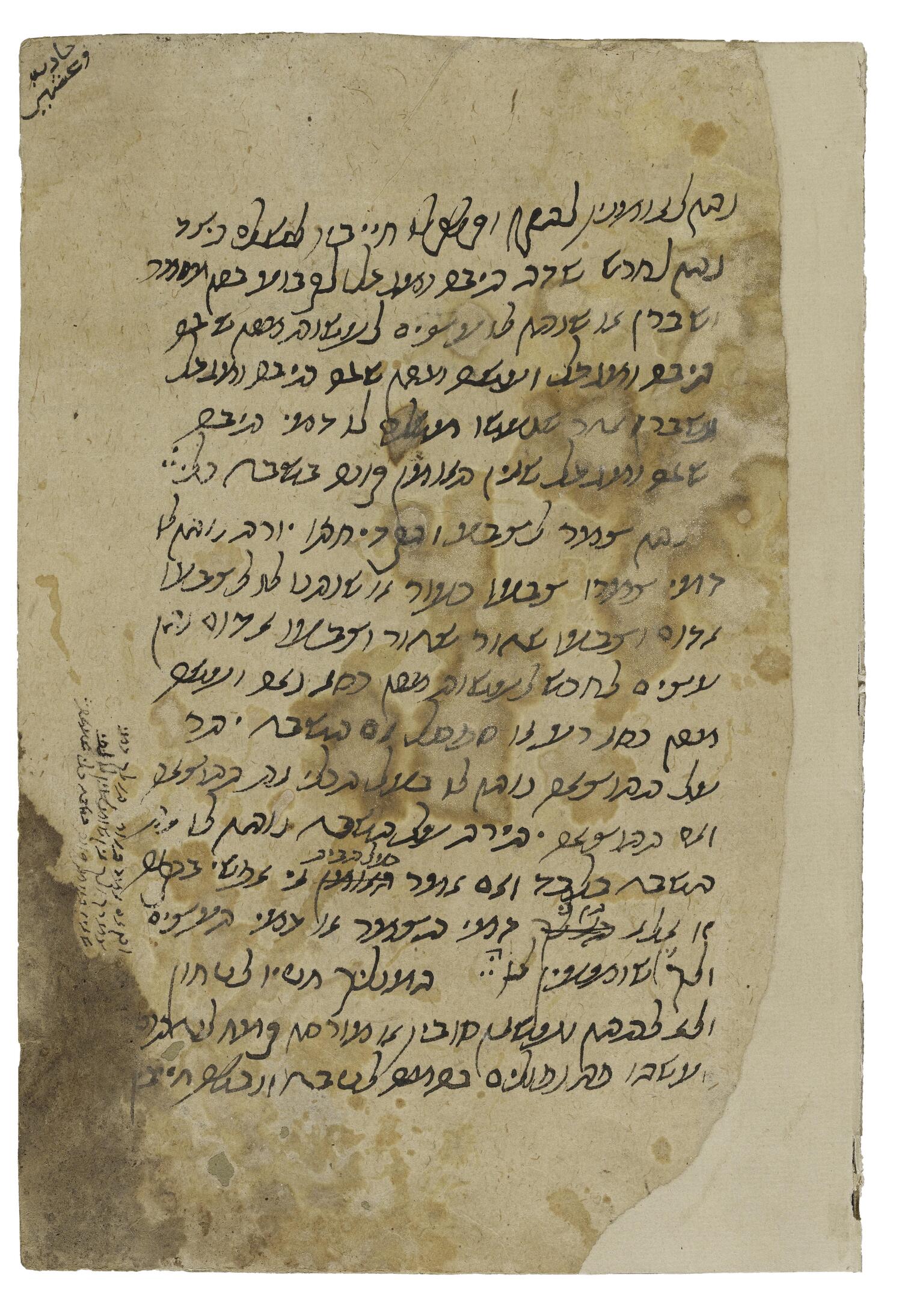
Here Maimonides presents the biblical obligation to pray and the history of the formulation of the Jewish liturgy. The opening of the “Laws of Prayer” is typical for Maimonides, who almost invariably reviewed the primary sources and the definition of a particular obligation at the beginning of each section. While Maimonides insisted that the obligation of daily prayer is biblical, many other medieval authorities held this obligation to be merely rabbinic. In the latter part of this excerpt, Maimonides reflects on the historical circumstances of the shift from prayer as a fluid, individualized text to a more formal liturgy.
Laws of Prayer and of the Priestly Blessing.
These comprise two affirmative duties: first, to serve the Lord daily in prayer; secondly, that the priests should bless Israel daily. These two precepts are expounded in the following chapters.
First Chapter
1. To pray daily is an affirmative duty, as it is said: And ye shall serve the Lord, your God (Exodus 23:25). The service, here referred to, according to the teaching of tradition, is prayer, as it is said: And to serve Him with all your heart (Deuteronomy 11:13), on which the sages commented, “What may be described as service of the heart? Prayer.” The number of prayers is not prescribed in the Torah. No form of prayer is prescribed in the Torah. Nor does the Torah prescribe a fixed time for prayer. Hence, women and slaves are under an obligation to pray, this being a duty, the fulfillment of which is independent of set periods.
2. The obligation in this precept is that every person should daily, according to his ability, offer up supplication and prayer; first uttering praises of God, then, with humble supplication and petition, ask for all that he needs, and finally offer praise and thanksgiving to the Eternal for the benefits already bestowed upon him in rich measure.
3. One who was fluent would offer up many prayers and supplications. If one were slow of speech, he would pray as best he could and whenever he pleased. Thus also, the number of separate services depended on an individual’s ability. One would pray once daily; others, several times in the day. All, however, turned during prayer to the sanctuary, in whichever direction that might be. This was the uniform practice from the times of Moses to those of Ezra.
4. When the people of Israel went into exile in the days of the wicked Nebuchadnezzar, they mingled with the Persians, Greeks, and other nations. In those foreign countries, children were born to them, whose language was confused. Everyone’s speech was a mixture of many tongues. No one was able, when he spoke, to express his thoughts adequately in any one language, otherwise than incoherently, as it is said: And their children spoke half in the speech of Ashdod and they could not speak in the Jews’ language but according to the language of each people (Nehemiah 13:24).
5. Consequently, when any one of them prayed in Hebrew, he was unable adequately to express his needs or recount the praises of God, without mixing Hebrew with other languages. When Ezra and his council realized this condition, they ordained the Eighteen Benedictions in their present order.
6. The first three blessings consist of praises of God and the last three, of thanksgiving to Him. The intermediate benedictions are petitions for the things which may stand as categories of all the desires of the individual and the needs of the community. The object aimed at was that these prayers should be in an orderly form in everyone’s mouth, that all should learn them, and thus the prayer of those who were not expert in speech would be as perfect as that of those who had command of a chaste style. For the same reason, they arranged [in a fixed form] all the blessings and prayers for all Jews so that the substance of every blessing should be familiar and current in the mouth of one who is not expert in speech.

Notes
Words in brackets appear in the original translation.
Published in: The Posen Library of Jewish Culture and Civilization, vol. 3: Encountering Christianity and Islam.
You may also like

Letter of Consolation: On Prayer

Manuscript of Autograph Draft of the Guide of the Perplexed
Dalālat al-ḥā’irīn
Guide of the Perplexed: On Prayer
Guide of the Perplexed III:32 (selections)
On Astrology and Prayer
Commentary on b. Shabbat 156b
Responsum: On the Blessing over the Signs of Virginity

Drawing of the Block Mold Used for Making Tefillin
You may also like
Letter of Consolation: On Prayer
Manuscript of Autograph Draft of the Guide of the Perplexed
Dalālat al-ḥā’irīn
Guide of the Perplexed: On Prayer
Guide of the Perplexed III:32 (selections)
On Astrology and Prayer
Commentary on b. Shabbat 156b
Responsum: On the Blessing over the Signs of Virginity