

Moses Breaking the Tablets of Law
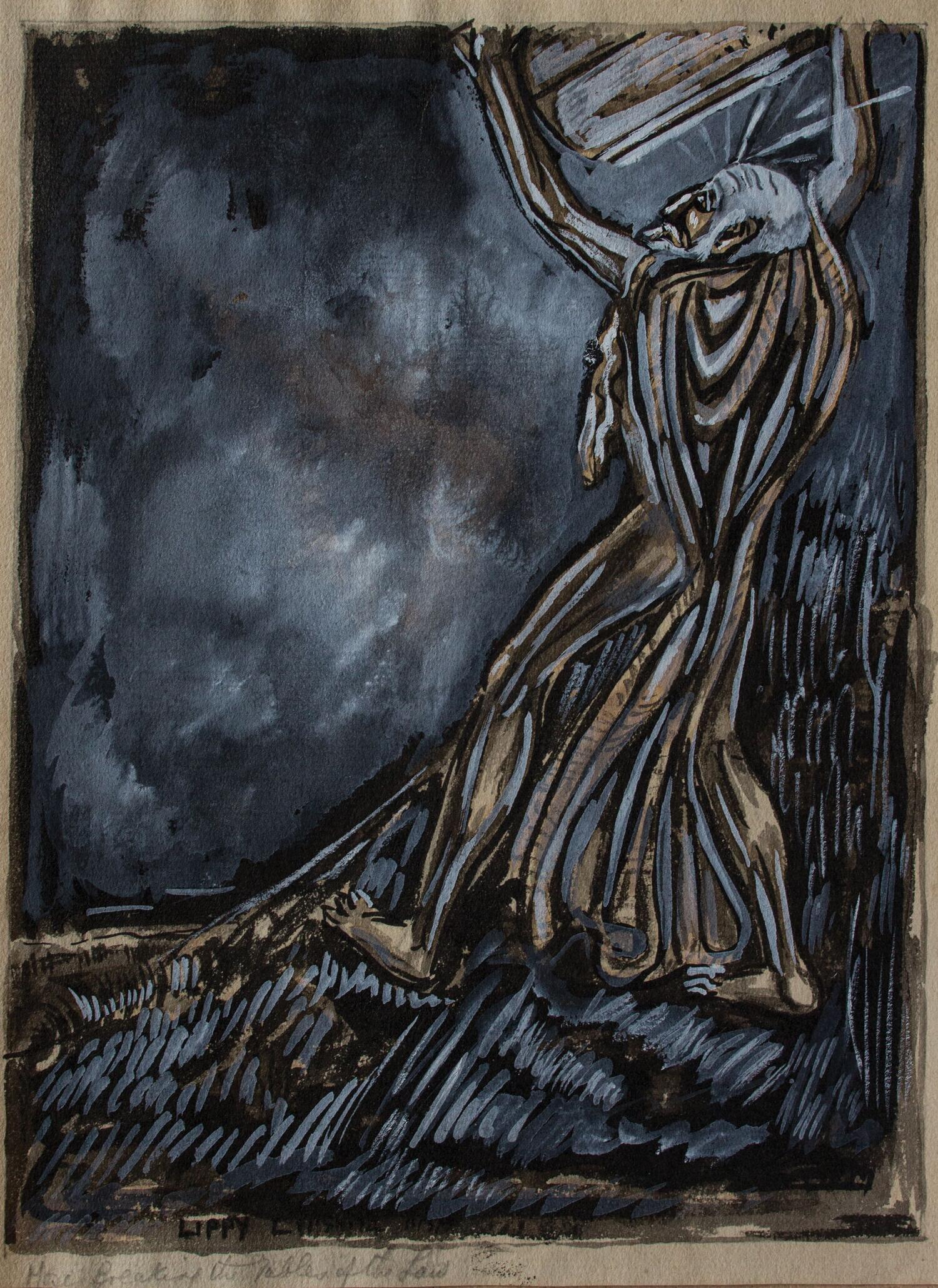

Though Lippy Lipshitz was best known as a sculptor, he produced a small body of paintings, including this watercolor. Its dark palette is similar to that of other pictures he made in the 1940s, including monotypes and woodcuts. Here Moses is drawn in a way that suggests the three-dimensionality of a sculpted figure.
We’re sorry. The Posen Library’s licensing agreements prevent this image from being printed or downloaded.
Credits
Private collection. © Estate of Israel-Isaac (Lippy) Lipshitz.
Published in: The Posen Library of Jewish Culture and Civilization, vol. 9.
You may also like

Midtown Manhattan
In this photograph, Rebecca Lepkoff, known for her many photographs of the Lower East Side, turned her lens on a street scene in midtown Manhattan. As befitting her background in modern dance, there…

Ha-Shomer ha-Tsa‘ir Poster to Honor the 30th Anniversary of the October Revolution
This poster in honor of the thirtieth anniversary of the October revolution of 1917 in Russia calls on all who seek peace, progress, and socialism to support the “first workers’ state,” the Soviet…

Imaginary Wall in My Studio
This “imaginary wall” in Raphael Soyer’s studio features (clockwise, from top left) a self-portrait; portraits of the artists Nicolai Cikovsky, Moses Soyer, and Chaim Gross. In the center is the…

Lower Eastside Façade
Erika Stone’s photography frequently features odd juxtapositions. Here, the face of a woman on a huge advertisement painted on the brick wall of a tenement building provides a striking contrast with…

Troops Marching, Israel
Many of Robert Capa’s war photographs are of solitary soldiers or small groups of fighters (such as this one, of Israeli troops during Israel’s War of Independence) rather than scenes of heroism on…

Yorkville Swastika
The Photo League was notable for the large number of women who participated in it; about one-third of its members were women. Vivian Cherry’s work was influential in shaping the style and iconography…
You may also like
Midtown Manhattan
In this photograph, Rebecca Lepkoff, known for her many photographs of the Lower East Side, turned her lens on a street scene in midtown Manhattan. As befitting her background in modern dance, there…
Ha-Shomer ha-Tsa‘ir Poster to Honor the 30th Anniversary of the October Revolution
This poster in honor of the thirtieth anniversary of the October revolution of 1917 in Russia calls on all who seek peace, progress, and socialism to support the “first workers’ state,” the Soviet…
Imaginary Wall in My Studio
This “imaginary wall” in Raphael Soyer’s studio features (clockwise, from top left) a self-portrait; portraits of the artists Nicolai Cikovsky, Moses Soyer, and Chaim Gross. In the center is the…
Lower Eastside Façade
Erika Stone’s photography frequently features odd juxtapositions. Here, the face of a woman on a huge advertisement painted on the brick wall of a tenement building provides a striking contrast with…
Troops Marching, Israel
Many of Robert Capa’s war photographs are of solitary soldiers or small groups of fighters (such as this one, of Israeli troops during Israel’s War of Independence) rather than scenes of heroism on…
Yorkville Swastika
The Photo League was notable for the large number of women who participated in it; about one-third of its members were women. Vivian Cherry’s work was influential in shaping the style and iconography…