

Notebook
About This Entry
Menaḥem Ibn Sarūq was the main Andalusi proponent of the theory, later abandoned, that Hebrew roots could have one, two, or three root consonants. He thought that a root consonant must by definition be necessary to a word and must therefore appear in all forms of that word; if it is dropped in any instance, then it cannot be considered a root letter. Dunash ben Labraṭ, Menaḥem’s student, rejected this idea and instead distinguished between strong and weak roots, arguing that those with weak roots can drop a root consonant in certain situations. The first excerpts here are from the introduction; they are followed by several examples illustrating his methodology.
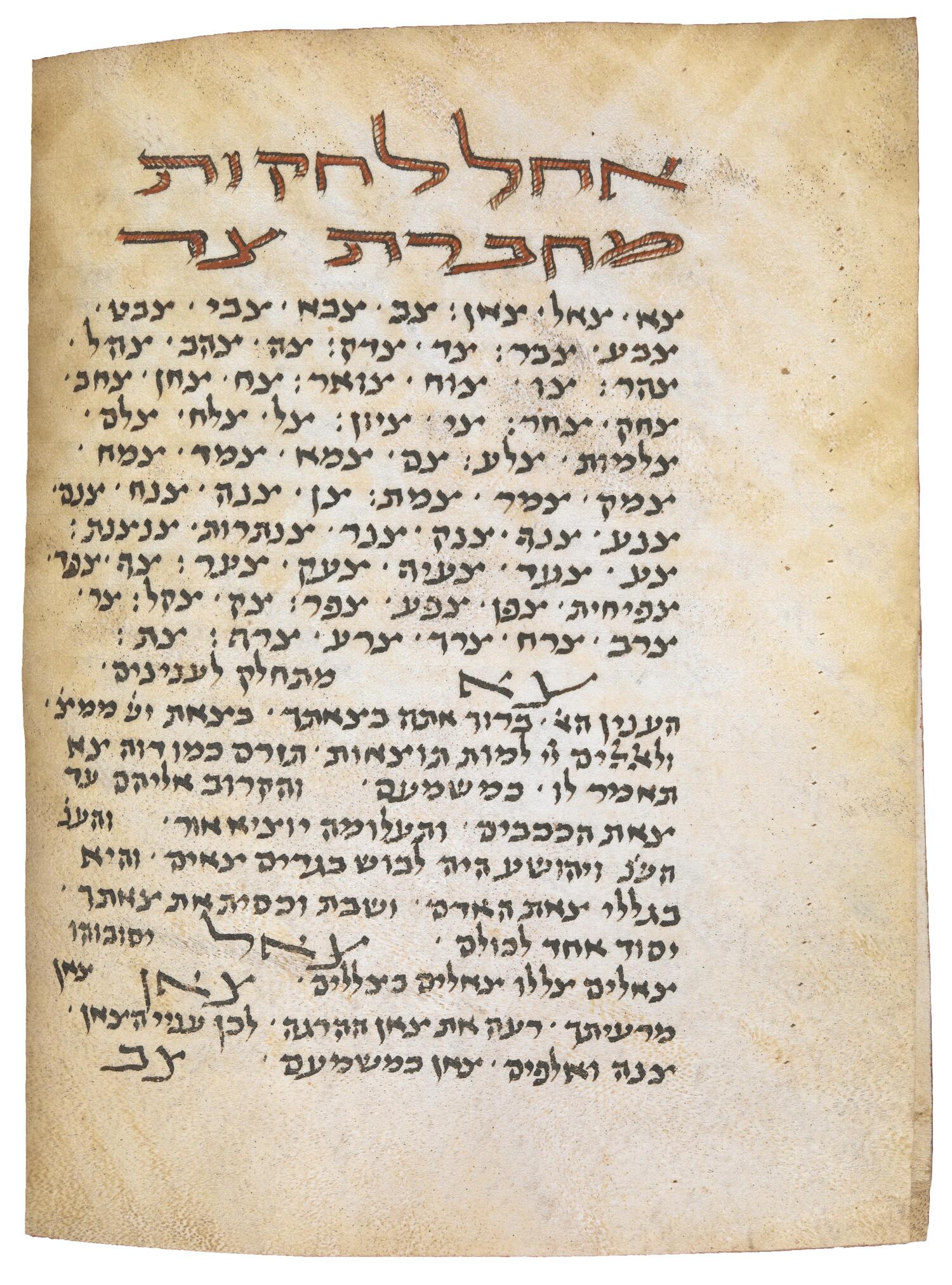

I sought, as best as I could with my limited intellectual capacity, to clarify the Jewish language in its foundational principles and basic roots, to position correctly the scales of the intellect and the plumb line of the learned tongue, to clarify its categories and explain its various forms and subdivisions, to present the form of a word in accordance with its specific meaning, and to show which letters are part of the root and which are inserted into a root in the middle of a word [infixes] or at one of its two ends [affixes]. The entire Hebrew language is included [here] in its different modes of expression. Men of understanding should accept instruction and walk along the path of the intellect by following those who comprehend these matters, to know the arrangements of the letters and the particulars of their constructs, so they can learn which are root letters and which are [just] appended to them.
Now, there are twenty-two letters in the holy tongue [Hebrew]. Eleven of them are root letters, while the other eleven are servile. These can be divided into eleven groups, not considering their derivatives. Each of these groups follows its own logic, so that a clever person can untangle them and discern their true form. The function of these letters, in their various subdivisions, is as follows:
Eleven of them are root letters; they form part of roots and are used exclusively in this capacity. These are: ḥet, tet, samekh, peh, resh, gimel, zayin, ‘ayin, tsadi, dalet, and kof.1
There are five groups of some of these letters, which are founded and rooted in words, while they attach to the word in different ways and initially appear as full roots of the word but sometimes as an accident that occurs to the words.
You should know that every triliteral word, constructed from three-letter roots, retains its form, and no letters will be attached to it, as it is firm enough on its own. However, when a word is derived from two letters, with another letter appended to it, it requires attached letters due to the brevity of its inflection, as such a short word cannot stand without additions either before or after it. However, there are in this language [Hebrew] a very small number of words of this kind of short inflection, but that stand [even] without servile letters; they are strong enough despite their brevity.
The other eleven letters, which can serve as attachments, can also be split into two subdivisions: those that attach to letters and then subsequently perform other functions and become part of the essence of the word, and the other half, which are merely attached, but which render the form of the language precise. They are as follows: shin, mem, lamed, alef, kaf, tav, vav, bet, yod, nun, and heh.2 [ . . . ]
Gimel-lamed-bet
Ta‘ar ha-galavim [a barber’s razor, Ezekiel 5:1]. There are no other similar words in the Bible, but this can be understood from its context. There are words that appear only once in the Bible, although their meaning can be worked out from their context. Were it not for the fact that they are part of a passage and that they depend on their surrounding words, we would not know their meanings. These include: ivḥat ḥarev [the point of a sword, Ezekiel 21:20]; etun mitsrayim [the yarn of Egypt, Proverbs 7:16].3 [ . . . ]
Nun-vav-heh
A habitation [naveh] abandoned and forsaken (Isaiah 27:10); against the strong habitation [naveh] (Jeremiah 49:19); and she who tarries [u-nevat] at home divides the spoil (Psalms 68:13). These mean “habitation.”
Nun-vav-lamed-yod
Shall be made a dunghill [nevali] (Daniel 2:5). This means befouled and refers to privies.
Nun-zayin-mem
And it came to pass, when he saw the ring [ha-nezem] (Genesis 24:30); the nose-jewels [nizme ha-af] (Isaiah 3:21); as a ring [nezem] of gold in a swine’s snout (Proverbs 11:22). These refer to rings.
Notes
[These letters are arranged here in the form of the mnemonic ḥat sefer geza‘ tsedek, meaning “he composed a book about the correct roots,” or “sealed is the book of the righteous sprout.”—Trans.]
[This group, the formative letters, is arranged in the form of the mnemonic she-melakhto binah, meaning “whose work is understanding.”—Trans.]
[The entry continues with a long list of such words.—Trans.]
Published in: The Posen Library of Jewish Culture and Civilization, vol. 3: Encountering Christianity and Islam.
You may also like

Book of the Seventy Isolated Biblical Words
Kitāb al-sab‘īn lafẓa al-mufrada

An Early Manuscript Copy of the Notebook (Maḥberet)
Against Menaḥem Ibn Sarūq’s Maḥberet: Introduction
Book of Responses
Sefer teshuvot
Responsum: On Grammar
Book on Verbs That Contain Weak and Lengthening Letters
Kitāb al-af‘āl dhawāt ḥurūf al-līn
You may also like
Book of the Seventy Isolated Biblical Words
Kitāb al-sab‘īn lafẓa al-mufrada
An Early Manuscript Copy of the Notebook (Maḥberet)
Against Menaḥem Ibn Sarūq’s Maḥberet: Introduction
Book of Responses
Sefer teshuvot
Responsum: On Grammar
Book on Verbs That Contain Weak and Lengthening Letters
Kitāb al-af‘āl dhawāt ḥurūf al-līn