

Portrait of Shabbetai Tzvi
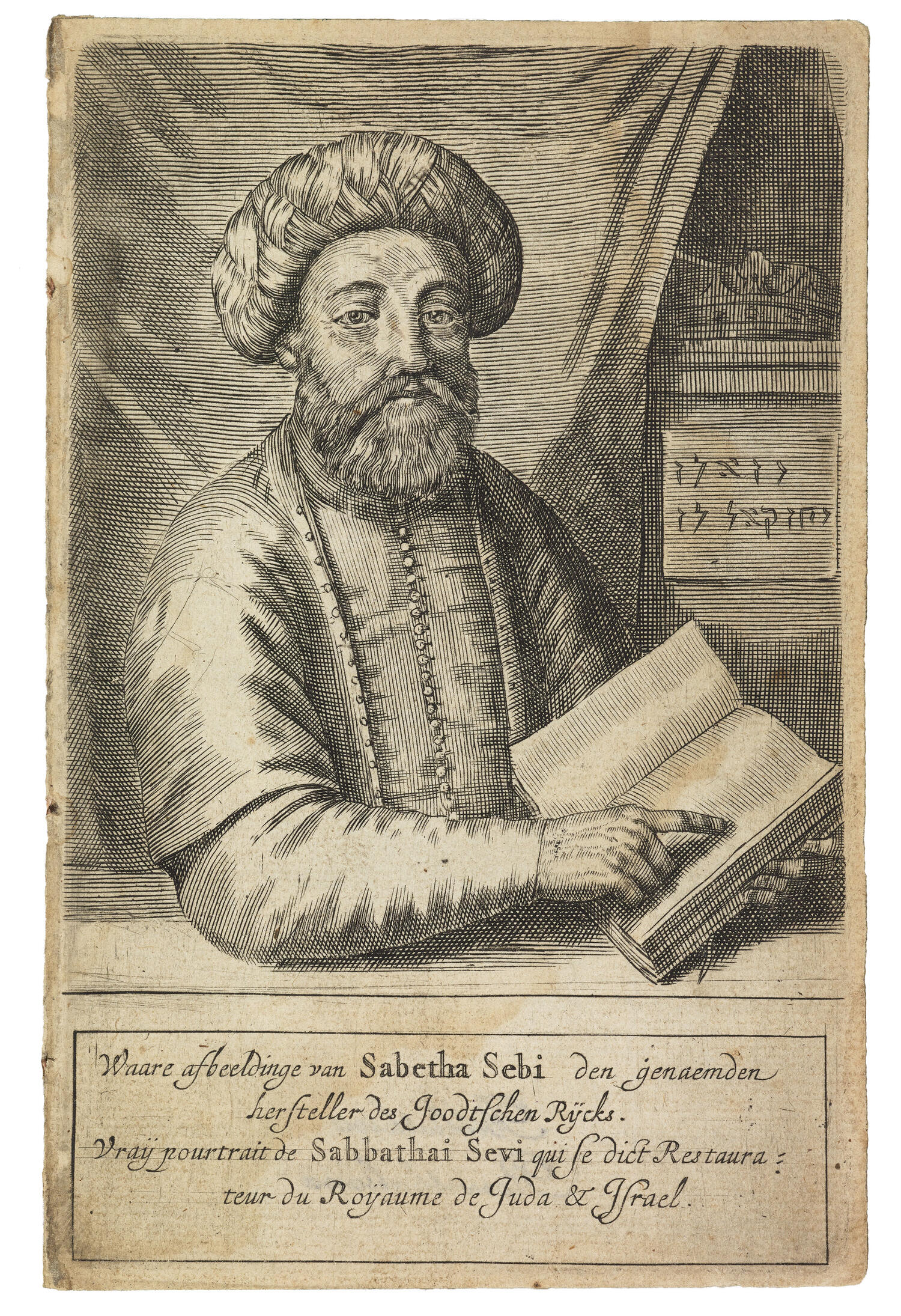

Shabbetai Tzvi was the central figure of a messianic movement that swept the Jewish world in the mid-seventeenth century. Born in Izmir (Smyrna), as an adolescent Shabbetai Tzvi embarked on the study of kabbalah. He behaved strangely, which at first aroused compassion, but he was eventually banished from his hometown and subsequently from other communities. In 1648, he declared himself to be the Messiah. In 1662, he settled in Jerusalem, later traveling to meet Nathan of Gaza, who encouraged him to declare himself again to be the Messiah. The news reached almost every country with a Jewish community and he quickly amassed followers throughout North Africa and Europe. It was widely believed that 1666 would be the apocalyptic year. However, in that same year, Shabbetai Tzvi was arrested by the Ottoman authorities and, threatened with death, converted to Islam. He was abandoned by all but his most faithful followers. This engraving appears in Thomas Coenen's book about Shabbetai Tzvi, Ydele verwachtinger Joden (Vain Hopes of the Jews). The inscription at the bottom of the portrait claims, in Dutch and in French, that it is “a true portrait of Sabetha Sebi/Sabbethai Sevi who calls himself the Messiah of the Kingdom of Judah and Israel.”
Credits
Published in: The Posen Library of Jewish Culture and Civilization, vol. 5.
You may also like

Letter of Conversion

Tikun keriyah le-kol laylah ve-yom (Supplications for Every Day and Night)

Letter about the Coming of the Messiah
Derush boker de-Avraham (Sermon: Morning of Abraham)
Letter about the Validity of the Messiah
Chronicle of Events in Adrianople

Related Guide
Early Modern Rabbis and Intellectuals on the Move
Carrying books and knowledge, itinerant rabbis and scholars traveled between communities, facilitating cultural exchange.

Related Guide
Early Modern Spiritual Ideologies
Early modern Jewish spiritual life encompassed diverse elements, including theology, ethics, liturgy, and messianism.
You may also like
Letter of Conversion