

Razor
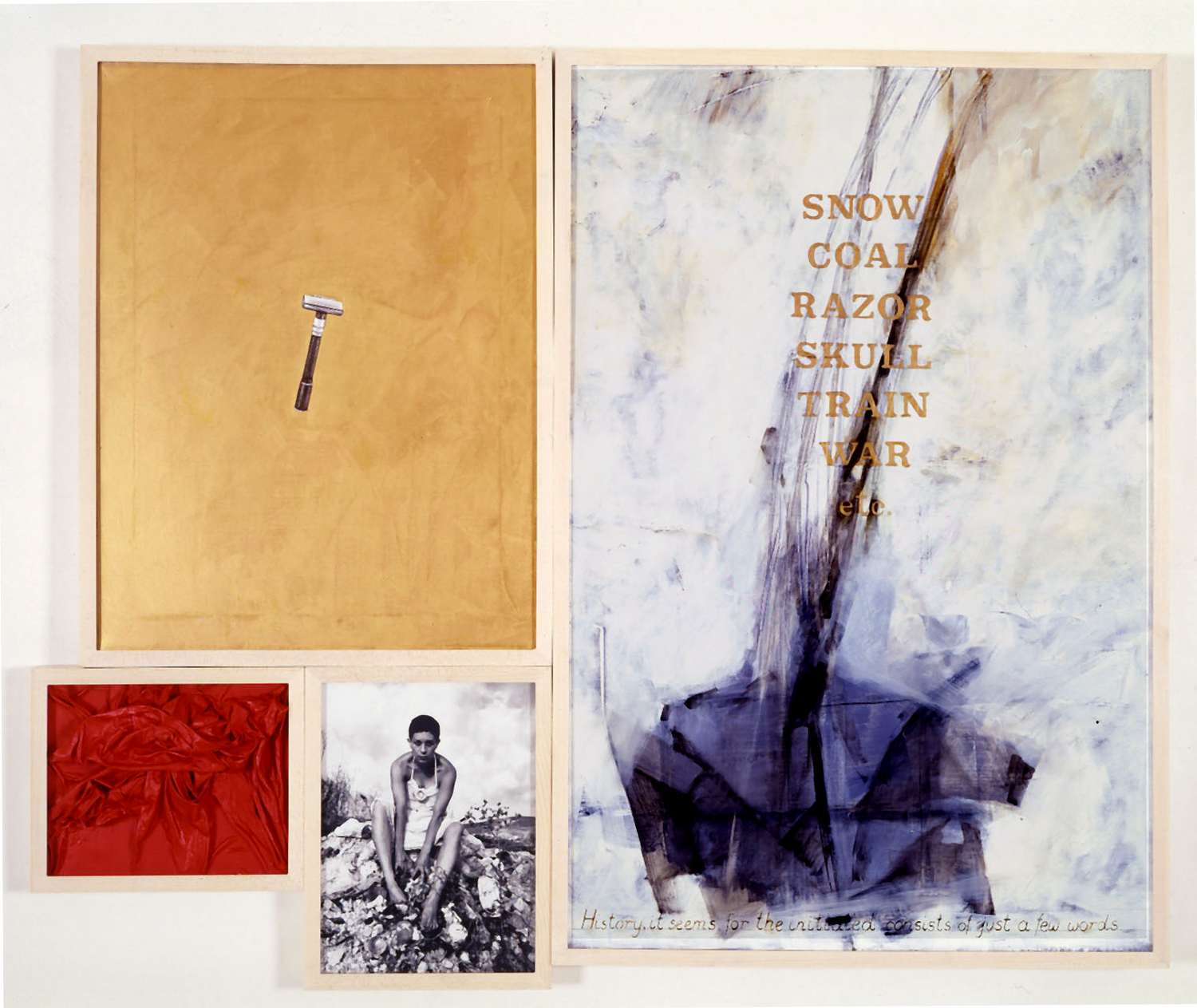

Weinfeld, the daughter of Holocaust survivors, produced artworks addressing the question of who she would have been if she had herself been a prisoner in a concentration camp? Would she have been, like most inmates, a murdered victim of brutality and starvation—or a kapo, a prisoner put in charge of other prisoners, reviled as a traitor? Some women received better food than other prisoners in exchange for serving as kapos and/or providing sex to guards. After liberation, women who had slept with Germans sometimes had their heads shaved as punishment. In this artwork, Weinfeld focuses on women who suffered abuse and sexual violence during the Holocaust. One panel has a razor. On another are superimposed the words: “Snow Coal Razor Skull Train War.” The photograph is of Weinfeld as a teenager sitting atop what looks like a pile of garbage.
We’re sorry. The Posen Library’s licensing agreements prevent this image from being printed or downloaded.
Credits
Photograph by Steven Kasher. Photograph within the work by Dr. David Darom. Courtesy of the artist.
Published in: The Posen Library of Jewish Culture and Civilization, vol. 10.
You may also like

Jamma’in II
In Tevet’s deconstructionist wall sculpture, Jamma’in II, painted boxes and other shapes, some of which look like tables and chairs, are arranged around a yellow ring. All the objects seem to be in…

On the Way from Assembly Point Atzdemeriam to Transit Camp in Teda, Ethiopia
In 1991, Israel launched Operation Solomon, a covert military operation to airlift Ethiopian Jews (Beta Israel) to Israel. Fourteen thousand men, women, and children were transported to Israel over…

The Empty Chair
The empty chair was a recurrent image in the work of Israeli artists. Because of its associations with the (fallen) throne of the biblical King David, it was sometimes used to represent a fallen…

Outside #3
In one of her early photography projects, Rovner took Polaroids of an abandoned Bedouin shack in the desert and reprinted them in different ways. Here the shack appears blurred, ghostly, as if seen…

Indoor Sukkah
This art installation depicts an upside-down sukkah, with boxes planted with grass below the table and chairs.

Cell No. 1
The “Cellules,” or Cells, were six tiny all-white living spaces that Absalon planned to install in Tokyo, Paris, Zurich, New York, Tel Aviv, and Frankfurt. He intended to live in them, so they were…
You may also like
Jamma’in II
In Tevet’s deconstructionist wall sculpture, Jamma’in II, painted boxes and other shapes, some of which look like tables and chairs, are arranged around a yellow ring. All the objects seem to be in…
On the Way from Assembly Point Atzdemeriam to Transit Camp in Teda, Ethiopia
In 1991, Israel launched Operation Solomon, a covert military operation to airlift Ethiopian Jews (Beta Israel) to Israel. Fourteen thousand men, women, and children were transported to Israel over…
The Empty Chair
The empty chair was a recurrent image in the work of Israeli artists. Because of its associations with the (fallen) throne of the biblical King David, it was sometimes used to represent a fallen…
Outside #3
In one of her early photography projects, Rovner took Polaroids of an abandoned Bedouin shack in the desert and reprinted them in different ways. Here the shack appears blurred, ghostly, as if seen…
Indoor Sukkah
This art installation depicts an upside-down sukkah, with boxes planted with grass below the table and chairs.
Cell No. 1
The “Cellules,” or Cells, were six tiny all-white living spaces that Absalon planned to install in Tokyo, Paris, Zurich, New York, Tel Aviv, and Frankfurt. He intended to live in them, so they were…