

Redressing Sepharad: Moroccan Jews, Colonial Modernity, and the Afterlives of al-Andalus
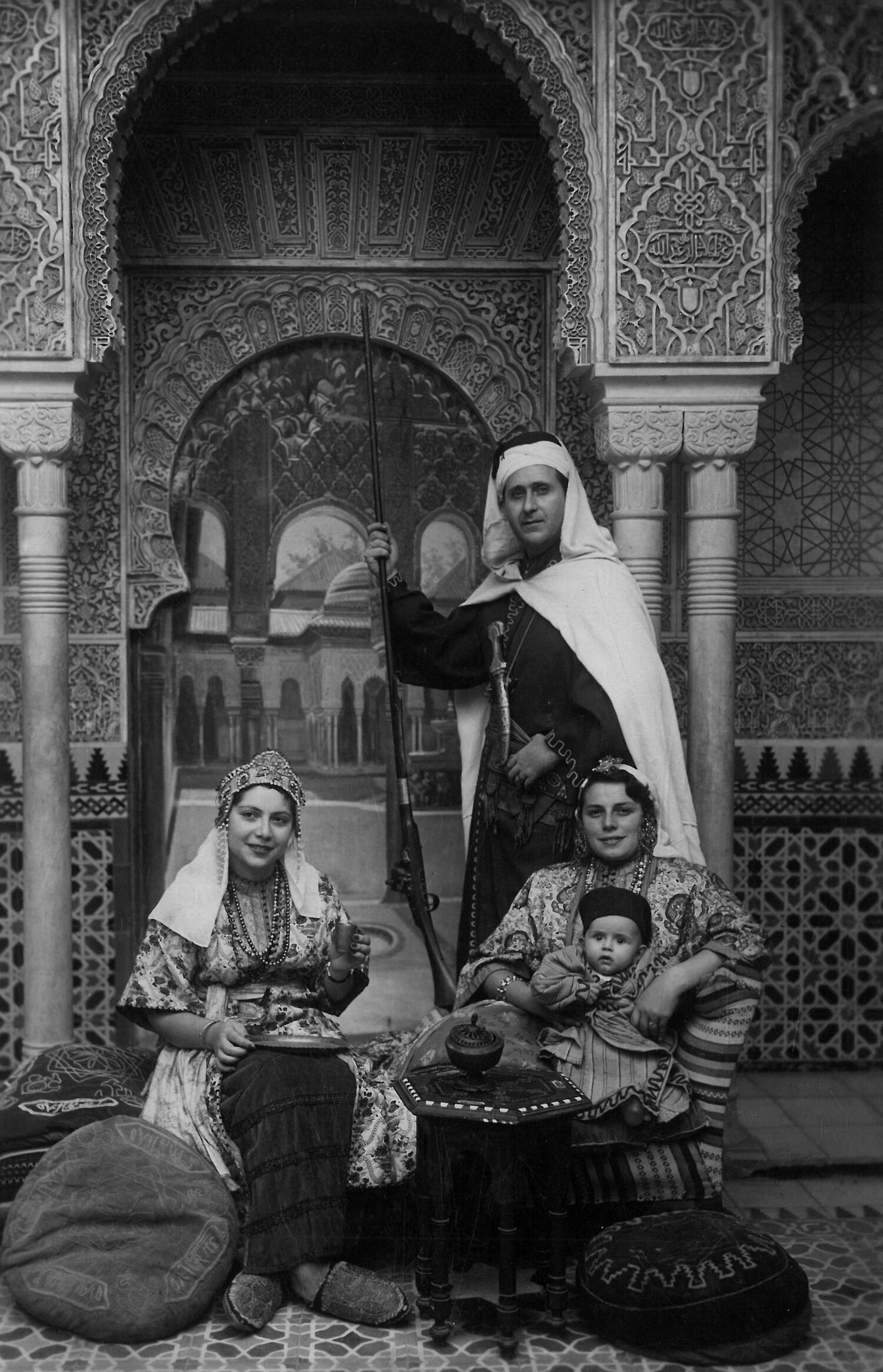

Centuries after Catholic kingdoms conquered the Iberian Arab Islamic states of al-Andalus and expelled all Muslims and Jews, the Jewish exiles, known as Sephardic Jews, still celebrated ties to Sepharad (medieval Spain) and many spoke Judeo-Spanish dialects. Spanish colonialism in northern Morocco (1912–1956) uniquely put a local Jewish population under a colonial regime whose language was close to their own, giving their link to Sepharad a new meaning. Here, a family dresses in the garb of al-Andalus while visiting Spain’s Alhambra compound. What appears to be a timeless portrait was in fact a modern, touristic performance that reveals how this community inhabited multiple worlds: Moroccan, Jewish, Sephardi, Spanish, and diasporic all at once. The image captures not inheritance alone but also the active, modern re-making of Sephardi identity.
Credits
Property of Aviad Moreno.
Discussion Questions
What was your first impression of this image? Where and when might you have imagined it was from?
In its portrayal of minorities in a colonized land, what does this image imply to you about how some Jews connected to the colonial ruling class?
Why do people reenact the past? What kinds of claims do they try to make in doing so?
You may also like

Class 2: Jews, Empire, and Modernity in the Middle East and North Africa
European colonial expansion reshaped Jewish life across the Middle East and North Africa, from the protégé system to the Alliance schools.
You may also like
Class 2: Jews, Empire, and Modernity in the Middle East and North Africa
European colonial expansion reshaped Jewish life across the Middle East and North Africa, from the protégé system to the Alliance schools.