

Responsum: On Praying in Aramaic
About This Entry
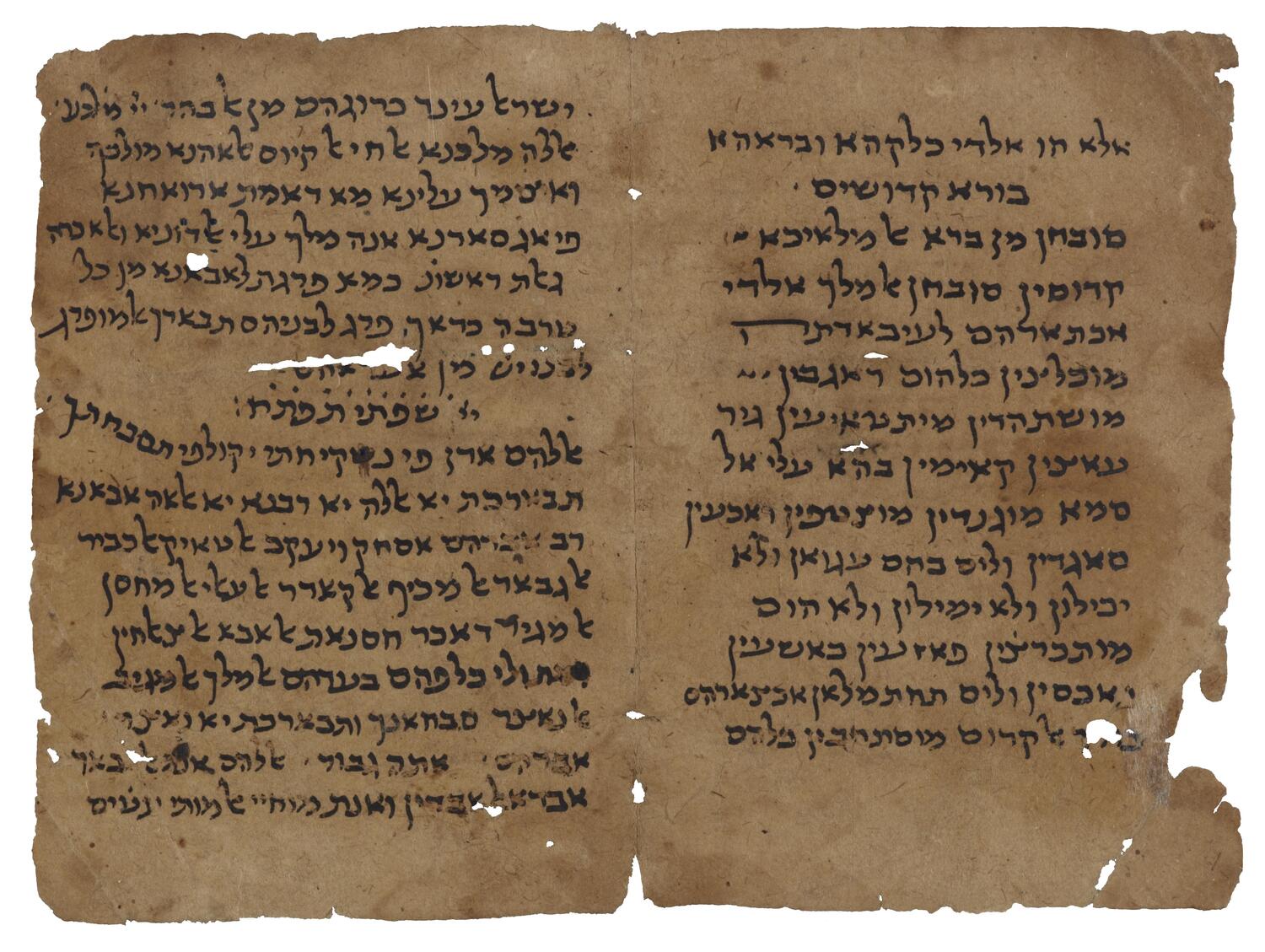
This anonymous geonic responsum was included in a series of responsa sent from Baghdad to the Jewish community in Qayrawān, Tunisia. The Babylonian Talmud (b. Sabbath 12b) recommends against praying in Aramaic because such prayers cannot be understood by the angels. The questioner wonders why so many prayers are nevertheless recited in Aramaic. The gaon responds by offering some broad theological and ritual context and ultimately rejects the premise that angels do not know Aramaic.
Question: You asked regarding the statement of R. Judah in the name of Rav: A person should never request his needs in the Aramaic language. As R. Yoḥanan said: If anyone requests his needs in the Aramaic language, the ministering angels pay no attention to him. The rabbis did not object except to say that a sick person is different, as the divine presence is with him [b. Shabbat 12b]. Thus, no ordinary people should issue a request in Aramaic. However, all the supplications and petitions we received from our ancestors, from the two holy academies [Sura and Pumbedita], are in Aramaic. It might be suggested that this statement applies only to the Ten Days of Repentance [from Rosh Hashanah to Yom Kippur], since the divine presence is close to us in this period. But we can see that on fast days, and in all times of trouble, we do pray in Aramaic. Indeed, most of the blessings which the geonim wrote, whether for individuals or the congregation, are in this language. May the master teach the reason why the ministering angels pay no attention to them?
Answer: It seems correct to me that Rav said the following: If a person is asking for something from the ministering angels, he should not do it in Aramaic, and R. Yoḥanan explained that this is because they are not familiar with the Aramaic language. However, if one is requesting something from his Creator, he may do so in any language. And this is what the Gemara means when it states that “a sick person is different,” as R. Eleazar was requesting on his behalf from the Merciful One, as he said, “May the Merciful One remember you for peace.” With regard to the reason given by the Gemara (“as the divine presence is with him”) there are certain matters that the angels can take care of as they see fit, without having to receive permission from God. This is why we write amulets and enunciate names of angels, so that they should assist us in such cases. Thus, Jacob said: may the angel who redeemed me [from all evil bless the lads] (Genesis 48:16), and Isaiah stated: and the angel of His presence saved them (Isaiah 63:9), and this referred to the minister of the divine presence, of whom the sages spoke, who is called Metatron [see, e.g., b. Ḥagigah 15a]. [ . . . ]
There are also cases of angels who fulfilled the wishes of prophets and righteous people, as the angel said to Lot: See, I have accepted your request (Genesis 19:21). It can be inferred from here that the angel had the authority to do as he chose. Likewise, the Merciful One said to the Satan, about Job: Behold, he is in your hand (Job 2:6), and Resh Lakish said that this was the Angel of Death [b. Bava Batra 16a].
It was regarding one who submits a request to a ministering angel about such matters that Rav said a person should not request his needs in the Aramaic language, and R. Yoḥanan added that the ministering angels do not know it. But “a sick person is different, as the divine presence is with him,” and therefore the ministering angels cannot affect him in any way, unless they receive permission.
The same applies to all similar statements of the sages. For example, in the first chapter [of Tractate Berakhot], R. Abun bar R. Adda said in the name of R. Isaac that if ten people are praying together, or three are sitting in judgment together, or two are learning Torah, the divine presence is with them [6a]. This is the meaning of that teaching [that the angels have no power when people are in these circumstances].
In any case, it should be noted that in all our experience we have never seen or heard that the rabbis would refrain from submitting their requests in Aramaic. Rather, there is a gate of mercy, which the angels are accustomed to guard. And we still recite in the academy, “Guardians of the gates, open the gates and let the cries of the oppressed Israel be heard,” first in the holy tongue and then the same prayer in Aramaic. There are also statements that we utter specifically in Aramaic, yet they are addressed to the ministering angels, such as: “Please, nimble messenger [i.e., Elijah], who traverses the world in four [flights].”
Likewise, there are stories in the Gemara of sages who would converse with angels in Aramaic. This conclusion can be reached from the story involving R. Seorim, Rava’s brother, who said to the messenger [i.e., the Angel of Death]: Let the master appear to me [in a dream after his death], and Rava indeed appeared to him. R. Seorim said to him, “Did the master experience any pain?” He replied, “[Death was] like the prick of kusilta.” Kusilta refers to the scratches one receives through bloodletting. [ . . . ] We can learn from all of these stories that there are things which the ministering angels have the authority to deal with as they wish, and that they can also express themselves in Aramaic, and the sages could likewise converse with them in that language.
It is also stated there that an angel found R. Ketina wearing a cloak. The angel said to him [in Aramaic], “Ketina, Ketina, if you wear such a cloak in the summer and a coat in the winter, what will become of the ritual fringes? As a result, you will never fulfill the commandment.” R. Ketina responded by asking him whether he punishes people even for failing to observe a positive commandment, to which the angel replied, “At a time when there is divine anger, we do punish” [b. Menaḥot 41a].
It can be inferred from these comments and incidents that none of the sages were concerned about the statement of Rav and R. Yoḥanan, which shows that they disagreed with them. Their opinion is also far from reasonable, as the angels are tasked with inscribing the conversations of men, and, if so, how can they not know Aramaic? Although we do not know the reason for the opinion of Rav and R. Yoḥanan or from where they derived this view, since the early authorities did not take their statements into account, we do not need to either.

Published in: The Posen Library of Jewish Culture and Civilization, vol. 3: Encountering Christianity and Islam.
