

The Sardis, Baram, and Nabratein Synagogues
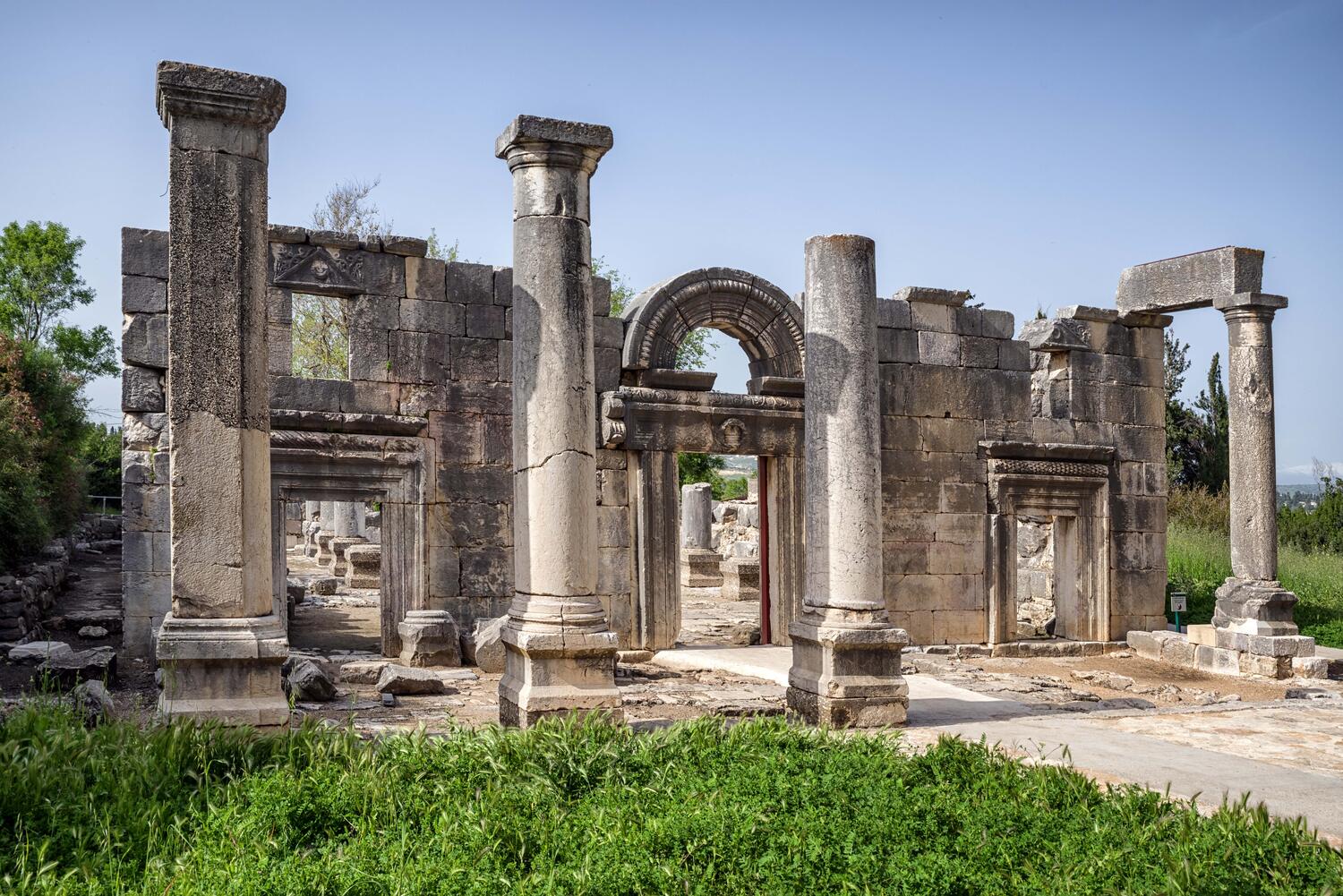

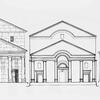
This reconstruction of three Galilean synagogue façades, from Meiron (left), Baram (center), and Nabratein (right), illustrates common synagogue styles in late antiquity. Some synagogues, as the ones pictured here, were fronted by a porch. Most synagogues had one or three openings at the front, often decorated with an arched window. Windows on the sides and upper part of the façade allowed more light to enter the interior. A gabled roof, made of a wooden framework covered in pitch and ceramic tiles, topped these buildings.
The fifth-century façade at Baram is decorated with a so-called Syrian gable: a pediment with its base curved into an arch. It also features a decorated lintel and a semicircular window above the door. Such an arched window, which would have allowed more light to come into the main hall, is seldom found in other buildings, leading some to posit it as unique to synagogue architecture. In the center of the door lintel there is a wreath, which was originally flanked on both sides by a representation of Nike, the Greco-Roman goddess of victory. The images were later blotted out. It is notable that the site of the building pictured is not a reconstruction: the ample remains of the synagogue have been standing since antiquity.
Credits
-
© Oksana Belikova / Shutterstock.
-
Courtesy of the Meiron Excavation Project, Duke University, Eric & Carol Meyers.
Published in: The Posen Library of Jewish Culture and Civilization, vol. 2: Emerging Judaism.
You may also like


Nabratein Synagogue Details

The Ḥammat Tiberias Synagogues

The Capernaum Synagogue

Katzrin Synagogue Entrance

The Eshtemoa Synagogue

Ḥammat Gader Synagogue Chancel Screen
You may also like
Nabratein Synagogue Details
The Ḥammat Tiberias Synagogues
The Capernaum Synagogue
Katzrin Synagogue Entrance
The Eshtemoa Synagogue