

The Scholar, the Laborer, and the Toiler of the Soil
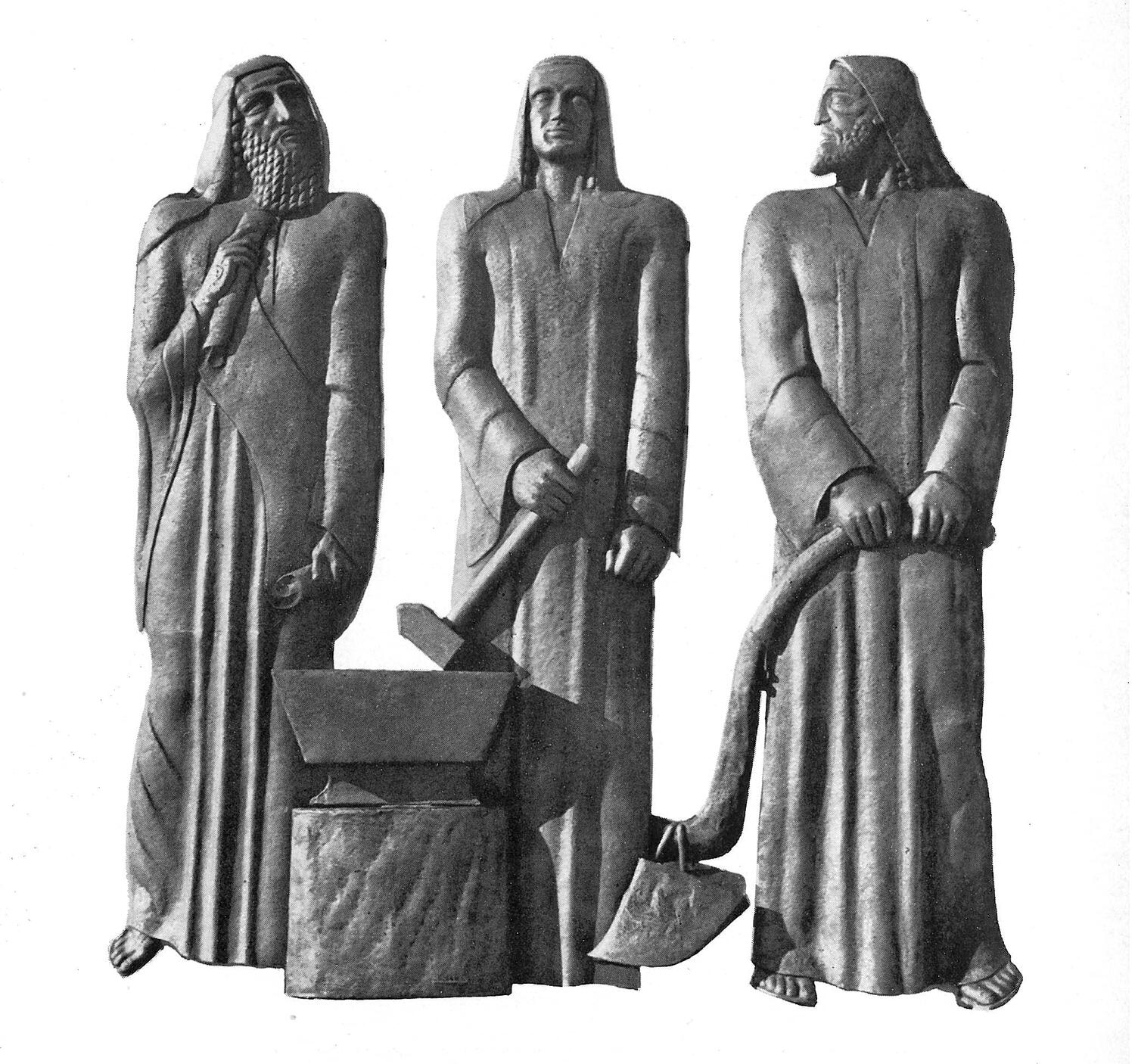

Maurice Ascalon, sometimes called the father of modern Israeli decorative arts, was commissioned to create this sculpture for the façade of the Palestine Pavilion of the 1939 New York World’s Fair. The fourteen-foot-tall hammered repoussé copper-relief sculpture shows three figures, representing scholarship, industry, and agriculture, all necessary elements of a modern society. While the emphasis in the Palestine Pavilion was on the evolving nature of Jewish life in Palestine, the archaic dress of the figures was intended to assert the centuries-old connection of the Jewish people with the biblical land of Israel.
We’re sorry. The Posen Library’s licensing agreements prevent this image from being printed or downloaded.
Credits
From Palestine Book, ed. Meyer W. Weisgal (New York: Pavilion Publications, Inc., for the American Committee for Jewish Palestine Participation at the New York’s World’s Fair, 1939). Photo courtesy Spertus Institute.
Published in: The Posen Library of Jewish Culture and Civilization, vol. 9.
You may also like


Detective Comics, May 1939: The Amazing and Unique Adventures of the Batman, cover
Batman is one of the longest-running comic series in the world, in continuous publication since 1939. When it made its debut, it was unique in featuring a hero who was an ordinary man without…

Figures in the Nisko Camp, Poland
As a prisoner in the Nisko labor camp in Poland in 1939 and 1940, Leo Haas painted portraits of SS men in exchange for extra food rations and art supplies. He also documented the daily lives of…

Les Hitlériques, cover
Les Hitlériques was a collection of anti-Hitler verses that Knafo composed in Mogador, Morocco in September and October 1939. This courageous and biting publication was very different from his…

Immigrants aboard the Parita Ship
Walter Zadek took this picture of exhausted refugees on the deck of the SS Parita in late August 1939 after the ship was run onto the beach at Tel Aviv by its crew. Aboard the ship were about 850 Jews…

Muslim Woman in Veil
In the 1930s, Lotte Errell and her husband, also a photographer, traveled the world, visiting countries in Africa, Asia, and the Middle East. The outbreak of war in 1939 found the now divorced and…
You may also like
Detective Comics, May 1939: The Amazing and Unique Adventures of the Batman, cover
Batman is one of the longest-running comic series in the world, in continuous publication since 1939. When it made its debut, it was unique in featuring a hero who was an ordinary man without…
Figures in the Nisko Camp, Poland
As a prisoner in the Nisko labor camp in Poland in 1939 and 1940, Leo Haas painted portraits of SS men in exchange for extra food rations and art supplies. He also documented the daily lives of…
Les Hitlériques, cover
Les Hitlériques was a collection of anti-Hitler verses that Knafo composed in Mogador, Morocco in September and October 1939. This courageous and biting publication was very different from his…
Immigrants aboard the Parita Ship
Walter Zadek took this picture of exhausted refugees on the deck of the SS Parita in late August 1939 after the ship was run onto the beach at Tel Aviv by its crew. Aboard the ship were about 850 Jews…
Muslim Woman in Veil
In the 1930s, Lotte Errell and her husband, also a photographer, traveled the world, visiting countries in Africa, Asia, and the Middle East. The outbreak of war in 1939 found the now divorced and…