

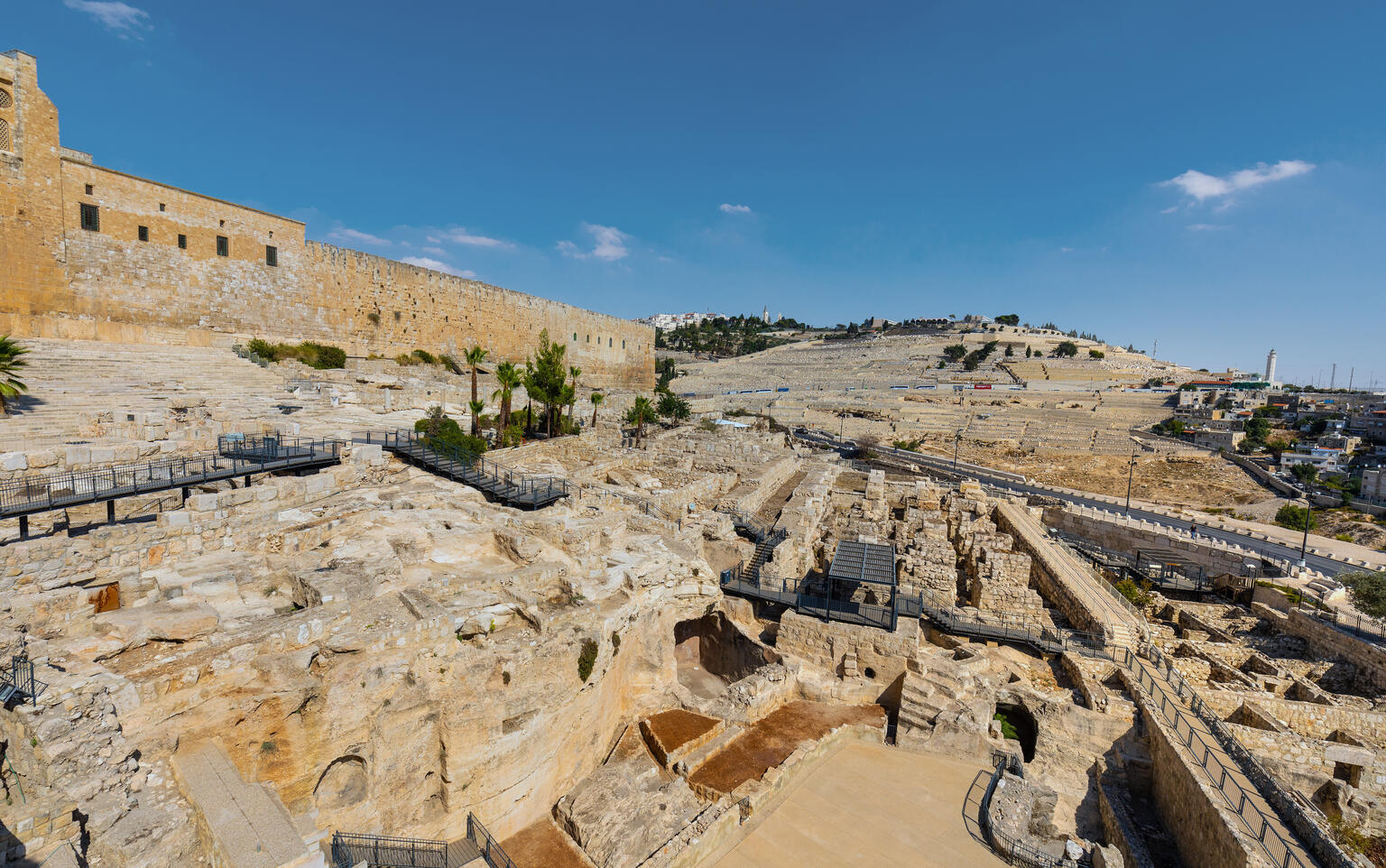
The Southern Staircase
Image
Please login or register for free access to Posen Library
Already have an account?
Engage with this Source


Related Guide
The Jerusalem Temple
4th Century BCE–6th Century CE
Ancient descriptions of the Temple and its material culture indicate that the Jerusalem Temple was the central site of Jewish sacrificial worship.
You may also like

Robinson’s Arch
These are the remains of an arch that supported a Herodian-era monumental staircase from the street up to the Temple Mount.
Wilson’s Arch
The remains of Wilson’s arch can be seen in the roofed area immediately to the northeast of the Western Wall. The arch supported the last part of a bridge built on a series of arches that traversed…

The Double Gate
The Double Gate together with the Triple Gate, known as the Huldah Gates, provided entry to the Temple esplanade from the south side of the mount via subterranean ramps. The Double Gate, which…

Temple Warning Inscription
A Temple inscription, also referred to as the Temple balustrade inscription or the soreg inscription, warns gentiles not to cross the balustrade (soreg) around the Temple, as doing so was considered a…

“To the Place of Trumpeting” Inscription
This inscription, written in square Hebrew, refers “to the place of trumpeting,” possibly attesting to a nearby structure from which priests blew the shofar to announce the oncoming Sabbath. The stone…

Mikvaot in the Temple Complex
The Siloam Pool was a massive stepped pool located at the southern edge of Jerusalem, at the beginning of the pilgrim’s road that led to the Temple Mount. It was first built by King Hezekiah in the…