

Jewish Language Project: Multilingual Omer Counter
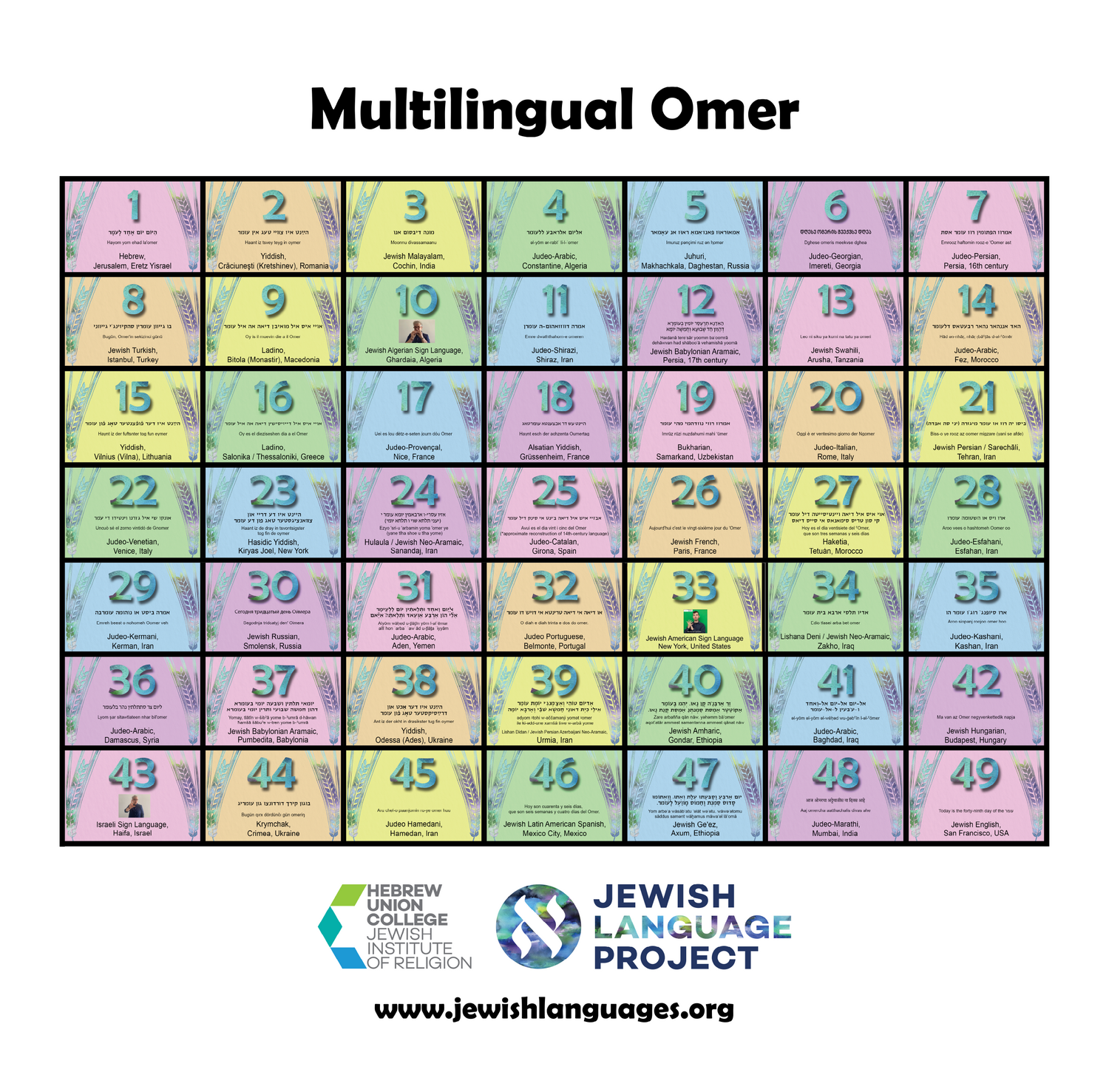

The omer is a seven-week period between the Jewish holidays of Passover and Shavuot. Jews traditionally count each of the forty-nine days with a blessing and statement in the sacred language, Hebrew, such as this:
Ha-yom shnem asar yom she-hem shavua eḥad va-ḥamishah yamim la-omer.
Today is the twelfth day, which is one week and five days of the omer.
But when Jews have spoken informally about their daily counts, they have generally used their vernacular. In most places, this has been a Judaized version of the local language, such as Judeo-Italian or Judeo-Persian, but in some cases, Jews spoke a completely different language from their non-Jewish neighbors, such as Ladino or Yiddish. Diversity can also be found within languages, as each has had multiple geographically based dialects. Many of these languages and dialects are now endangered. The HUC Jewish Language Project (run by Sarah Bunin Benor) raises awareness of this linguistic diversity, in part through multilingual graphics. One of these graphics is this omer counter, which includes forty-nine of the many language varieties used by Jews. Some of the sentences in this omer counter are based on historical documentation, such as those in Ladino and Jewish Babylonian Aramaic. But most are from scholars and native speakers the Jewish Language Project’s staff reached out to, asking for the count for the particular day.
Credits
Jewish Language Project, “Multilingual Omer Counter,” Jewish Languages Website, ed. Sarah Bunin Benor, HUC Jewish Language Project, Los Angeles, accessed December 2, 2025, https://www.jewishlanguages.org/omer. Licensed under (CC BY-SA 4.0).
Discussion Questions
What can you conclude about the commonality and diversity of the Jewish people based on this omer counter?
Most of the forty-nine squares have one Hebrew word in common, pronounced in different ways: omer. Why do you think Jewish languages around the world would share a Hebrew word?
What purpose does creating such a multilingual graphic serve in an era when most of these languages are endangered?
You may also like

Class 1: Jewish Languages: Hebrew, Yiddish, Ladino, and Beyond
Jewish languages, from Hebrew to Judeo-Arabic, Yiddish, Ladino, Bukharian, and Yeshivish, have been shaped by migration and cultural contact.
You may also like
Class 1: Jewish Languages: Hebrew, Yiddish, Ladino, and Beyond
Jewish languages, from Hebrew to Judeo-Arabic, Yiddish, Ladino, Bukharian, and Yeshivish, have been shaped by migration and cultural contact.