

Mishneh Torah, Book of Love: On Writing Scrolls
About This Entry
In this brief excerpt from the Book of Love (Sefer ahavah), which covers the laws of prayer and the writing of sacred texts, Maimonides reports that he had seen many discrepancies in the practice of copying Torah scrolls. Different authorities preserved different traditions for composing “closed” and “open” sections, that is, when a break is either closed by a word at the end of a line or is left open with no word at the end. Most scholars today believe that the codex he mentions is the same as what is now known as the Aleppo Codex, which was brought to Aleppo by one of Maimonides’ descendants in about 1375. Evidently, the codex was used as a model for copying Torah scrolls.
Laws of Tefillin, Mezuzah, and Sefer Torah, 8:4–5
As in all the scrolls I have seen, I noticed serious incorrectness in these regards, while authorities on the Masorah, who write treatises and compilations with the aim of pointing out the sections that are closed and those that are open, differ according to the variations in the scrolls on which they rely, I deemed it fit to write here a list of the sections which are closed and those which are open, as also the forms in which the songs of the Pentateuch are written so that all the scrolls may be corrected from and compared with them. The copy on which I relied is the well-known Egyptian codex which contains the twenty-four books of the scriptures and which had been in Jerusalem for several years—used as the standard text for the examination of scrolls. Everyone relied upon it because it had been examined by Ben Asher, who closely studied it for many years and examined it again whenever it was being copied. This codex was the text upon which I relied in the scroll of the Law that I wrote according to the rules.
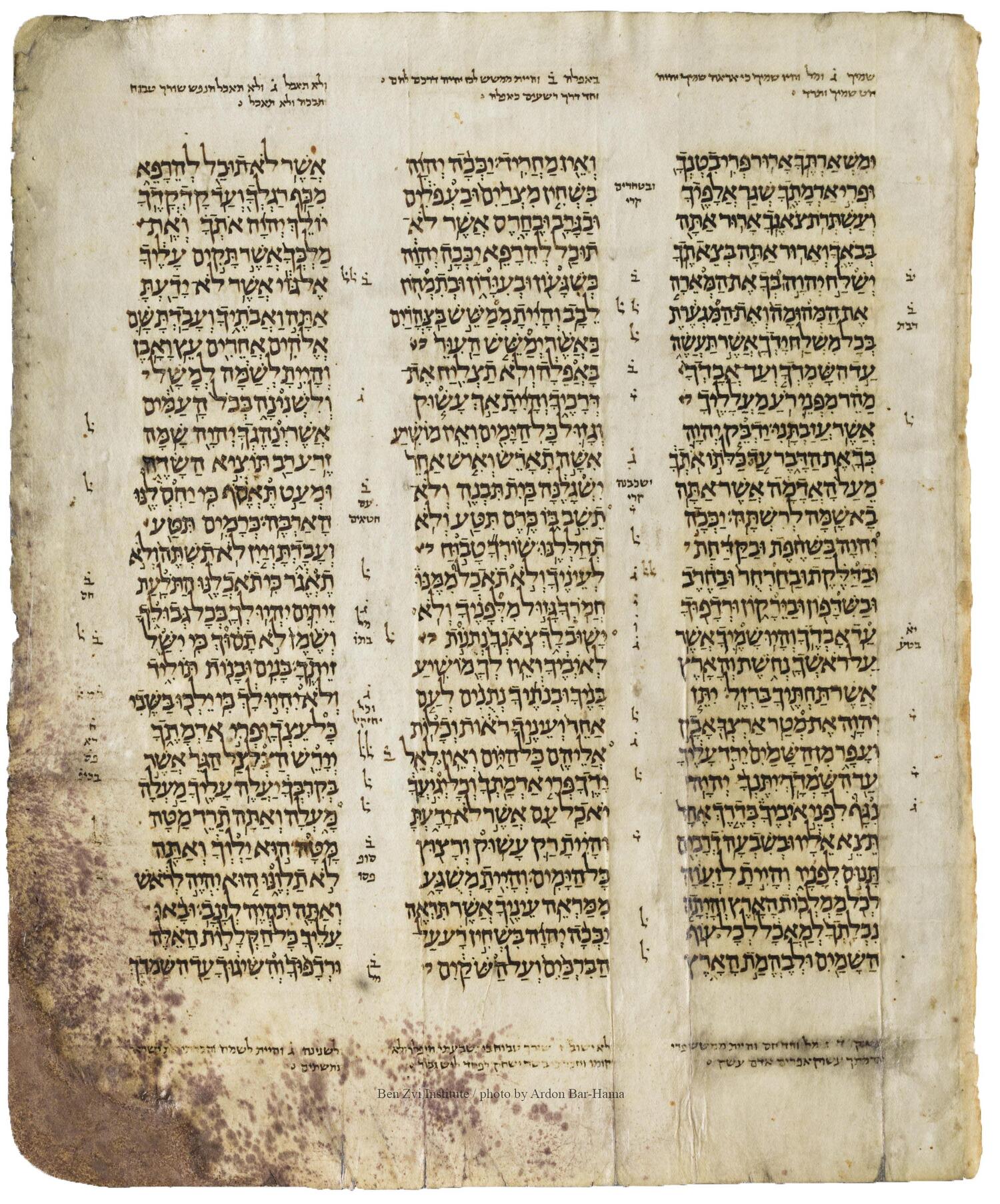

Published in: The Posen Library of Jewish Culture and Civilization, vol. 3: Encountering Christianity and Islam.
You may also like

Fundamentals of Grammar
Yesod dikduk, Introduction
Book of Clear Speech
Sefer safah berurah
Grammar
Dayyakut
Notes on Nathan ben Yeḥiel’s ‘Arukh
Jonah Ibn Janāḥ’s The Book of [Hebrew] Roots: Translator’s Comment
Sefer ha-shorashim
You may also like
Fundamentals of Grammar
Yesod dikduk, Introduction
Book of Clear Speech
Sefer safah berurah
Grammar
Dayyakut
Notes on Nathan ben Yeḥiel’s ‘Arukh
Jonah Ibn Janāḥ’s The Book of [Hebrew] Roots: Translator’s Comment
Sefer ha-shorashim