

Responsum: On Death Practices
About This Entry
This excerpt from a longer Hebrew responsum addresses what seems to have been the practice of Andalusi Jews of burying their dead within their own house, which could be an issue for those observing the seven days of mourning, who needed to say prayers at home. The unnamed questioner reports that Yose (Joseph) Ibn al-Shāmī (lit., “son of the Palestinian”), a little-known Andalusi poet and halakhist, suggested building a small partition between the burial place and the mourners.
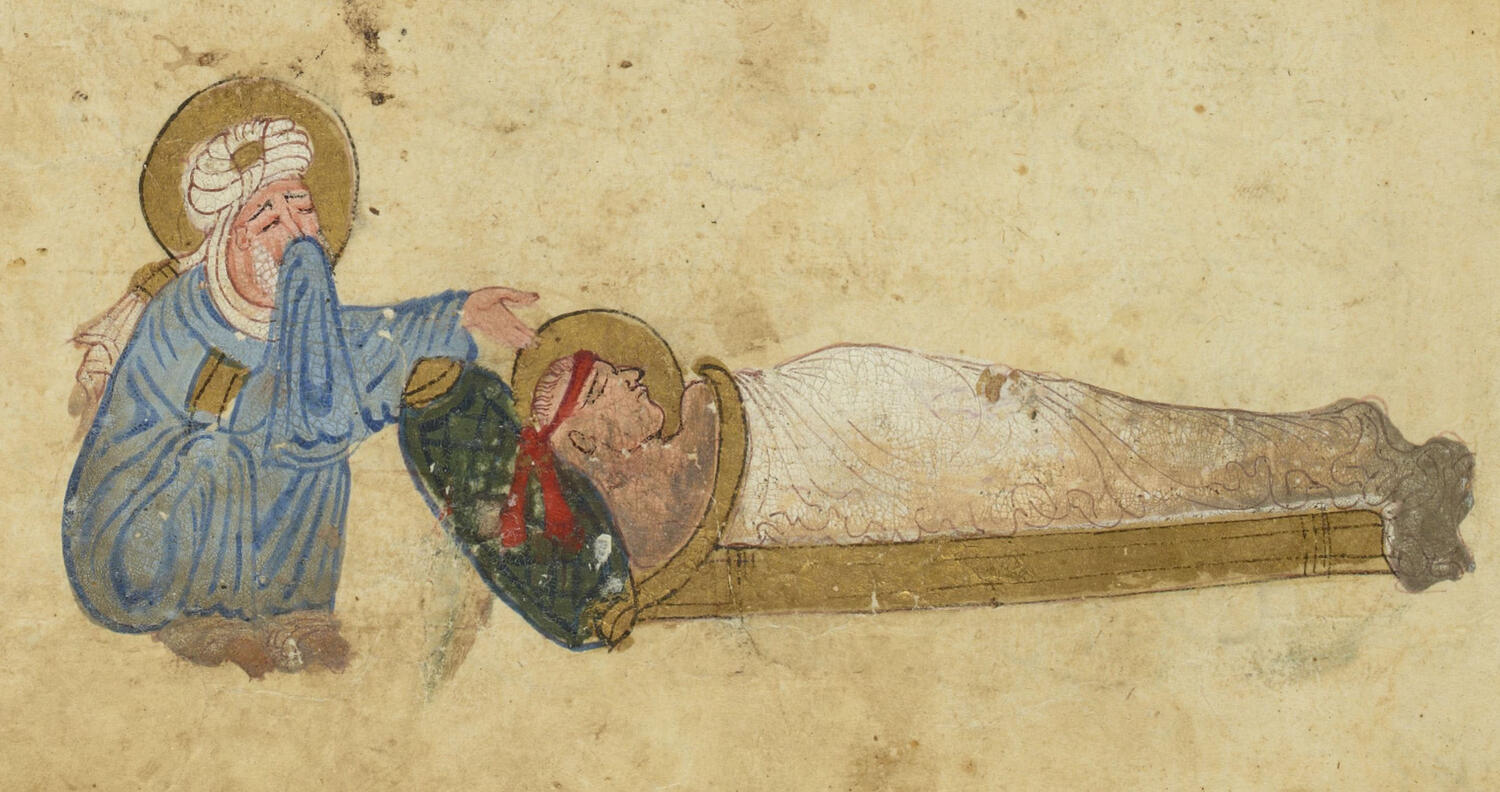

Question: People have adopted the custom in this country of burying their dead in their houses, and they recite their prayers in their houses during the seven-day mourning period and do not distance themselves from the grave even to the slightest degree. R. Yose Ibn al-Shāmī protested at their action and instructed them to erect a partition [at least] ten [handbreadths] in height—even out of reeds, and even if there were a space of less than three [handbreadths] between one reed and the next, which would [still] enjoy the [halakhic] status of a solid, united partition. And now a certain individual of this country has died, and they wished to pray in the house without distancing themselves at all from the grave, and they were prevented from doing this, but they are relying upon the statement of the sages: “And they paid honor to him at his death” [b. Bava Kamma 16b], and so they have established a place of study over his grave. Please instruct us as to your view concerning this matter. [ . . . ]
Answer: It is not permitted to recite the Amidah or to read the Shema‘ in a graveyard unless one has distanced oneself by four cubits from the graves, or unless one has erected a partition of at least ten handbreadths [in height], on account of the verse: He who mocks a poor man blasphemes his Creator (Proverbs 17:5). And the sages have already declared: A dead person is deemed to occupy an area of four cubits for the purposes of conferring ritual defilement [b. Berakhot 18a], and likewise for prohibiting the recitation of the Shema‘ [within that area]; and they furthermore declared, with regard to the issue of guarding the corpse:
Ben Azzai says: If people were traveling on a ship [with a corpse], they must leave it in one corner and recite their prayers in another corner. [b. Berakhot 18a]
From this it appears that it is not permitted for a person to pray unless he has distanced himself by at least four cubits [from the corpse]. And indeed, regarding what you have mentioned [in the part of the query not included here] about a priest [kohen] entering a graveyard, this is a straightforward biblical teaching: And whoever, in the open field, touches one who has been slain with a sword . . . or a grave, etc. (Numbers 19:16). And since the verse states: He shall be ritually unclean, priests may not enter there, as they are admonished in regard to ritual impurity. And [the sages] have already stated:
And you shall disregard it (Deuteronomy 22:1): There are occasions when you may disregard it [i.e., refrain from returning a lost object to its owner]. In what circumstances? A priest, where the lost object is located within a cemetery. [b. Bava Meẓi’a 30a]
And there are countless similar instances [to be found] in the Mishnah and the Talmud. In conclusion, this is manifestly plain and requires no [further] proof.
Credits
Published in: The Posen Library of Jewish Culture and Civilization, vol. 3: Encountering Christianity and Islam.
