

Arabic-Hebrew Glossary
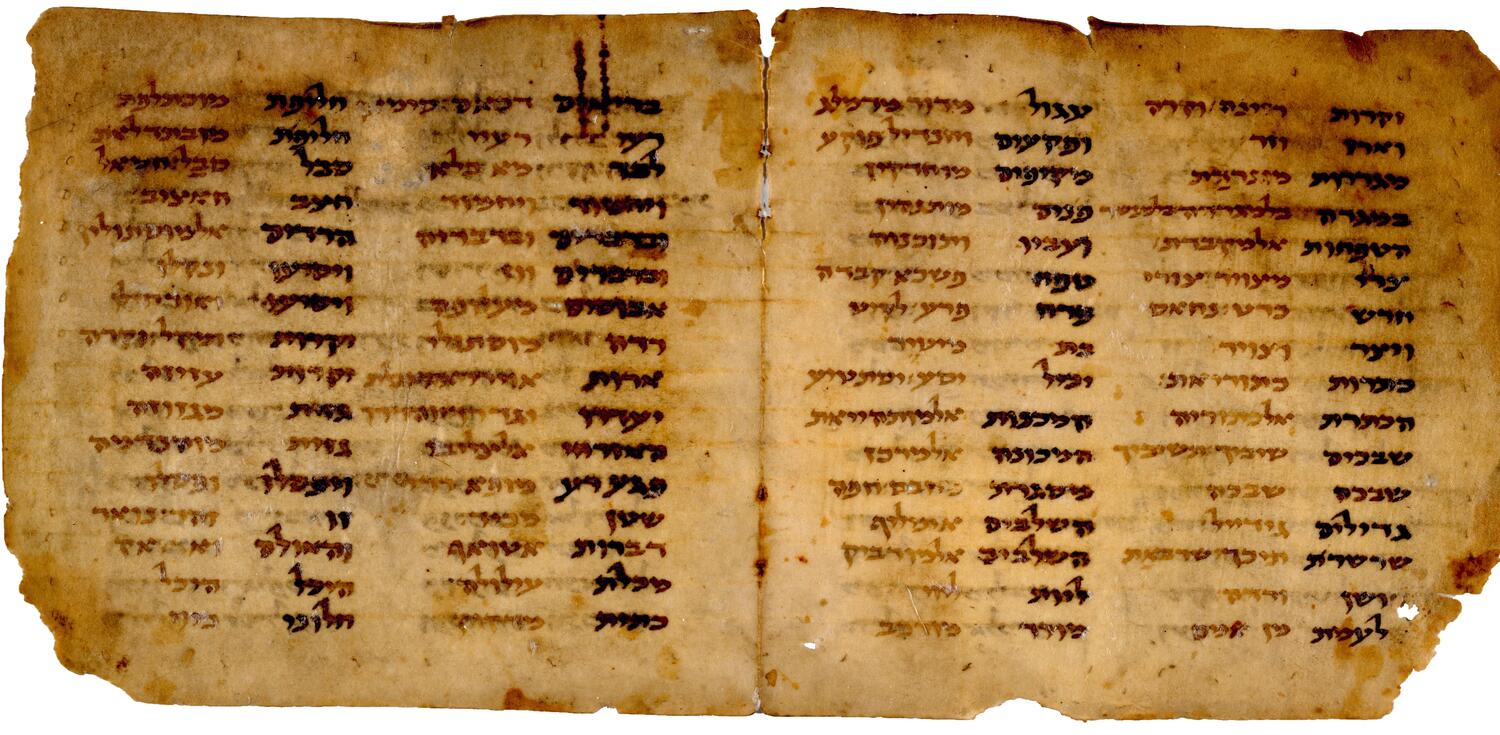

This fragment is from a Arabic-Hebrew glossary (list of word equivalents) found in the Cairo Geniza. The text is arranged in two columns and lists the uncommon words from 1 Kings 5:3–7:29. One column has the words in Hebrew, and the other gives their one-word definitions in Arabic (written in Hebrew characters). Not all words have an Arabic definition, and others are listed twice, following the biblical text.
We’re sorry. The Posen Library’s licensing agreements prevent this image from being printed or downloaded.
Credits
Halper 68, fol. 1v. University of Pennsylvania, Center for Advanced Judaic Studies Library, Cairo Genizah Collection.
Published in: The Posen Library of Jewish Culture and Civilization, vol. 3: Encountering Christianity and Islam.
You may also like

The Book of Rules Regarding the Grammatical Inflection of the Hebrew Language
Kitāb al-‘uqūd fī taṣārīf al-lugha al-‘ibrāniyya, Chapters 2, 3 (selections)
Take note that rational beings examined such sounds as the creaking of a door, the noise of a bird, and others. Then they extracted…

A Manuscript Page from a Greek-Hebrew Glossary
This image is of a glossary (a list of word equivalents) of mishnaic Hebrew and Greek. The Greek words (written in Hebrew characters) are vocalized to help with pronunciation, suggesting Greek was…
The Book of Conversation and Discussion
Kitāb al-muḥāḍara wa-’l-mudhākara
A book—the best of the friends; its riddles will amuse you. And if you wish, its admonitions will occupy your mind, for it will include the least and the most, the present and the absent, the lofty…

A Manuscript Page from The Book of the Differences
This work summarizes the divergent views between Aaron Ben Asher and Moses Ben Naphtali, two leading Masoretes, who disagreed about vocalization and other small details in the text of the Hebrew Bible…
Order (‘Arukh)
Peh-samekh-kof
[This root appears] in Chapter “Even though,” when it says [b. Ketubbot 63a]: “This master did not eat the concluding [meal] [afsik] before Yom Kippur, and that master did not eat the…
Fundamentals of Grammar
Yesod dikduk, Introduction
At the beginning of every thought of the heart and at the first expression of every lip, I will ascribe power to Him who teaches man knowledge (Psalms 94:10) to think thoughts, to Him who creates the…
You may also like
The Book of Rules Regarding the Grammatical Inflection of the Hebrew Language
Kitāb al-‘uqūd fī taṣārīf al-lugha al-‘ibrāniyya, Chapters 2, 3 (selections)
Take note that rational beings examined such sounds as the creaking of a door, the noise of a bird, and others. Then they extracted…
A Manuscript Page from a Greek-Hebrew Glossary
This image is of a glossary (a list of word equivalents) of mishnaic Hebrew and Greek. The Greek words (written in Hebrew characters) are vocalized to help with pronunciation, suggesting Greek was…
The Book of Conversation and Discussion
Kitāb al-muḥāḍara wa-’l-mudhākara
A book—the best of the friends; its riddles will amuse you. And if you wish, its admonitions will occupy your mind, for it will include the least and the most, the present and the absent, the lofty…
A Manuscript Page from The Book of the Differences
This work summarizes the divergent views between Aaron Ben Asher and Moses Ben Naphtali, two leading Masoretes, who disagreed about vocalization and other small details in the text of the Hebrew Bible…
Order (‘Arukh)
Peh-samekh-kof
[This root appears] in Chapter “Even though,” when it says [b. Ketubbot 63a]: “This master did not eat the concluding [meal] [afsik] before Yom Kippur, and that master did not eat the…
Fundamentals of Grammar
Yesod dikduk, Introduction
At the beginning of every thought of the heart and at the first expression of every lip, I will ascribe power to Him who teaches man knowledge (Psalms 94:10) to think thoughts, to Him who creates the…