

Eternal Wanderers
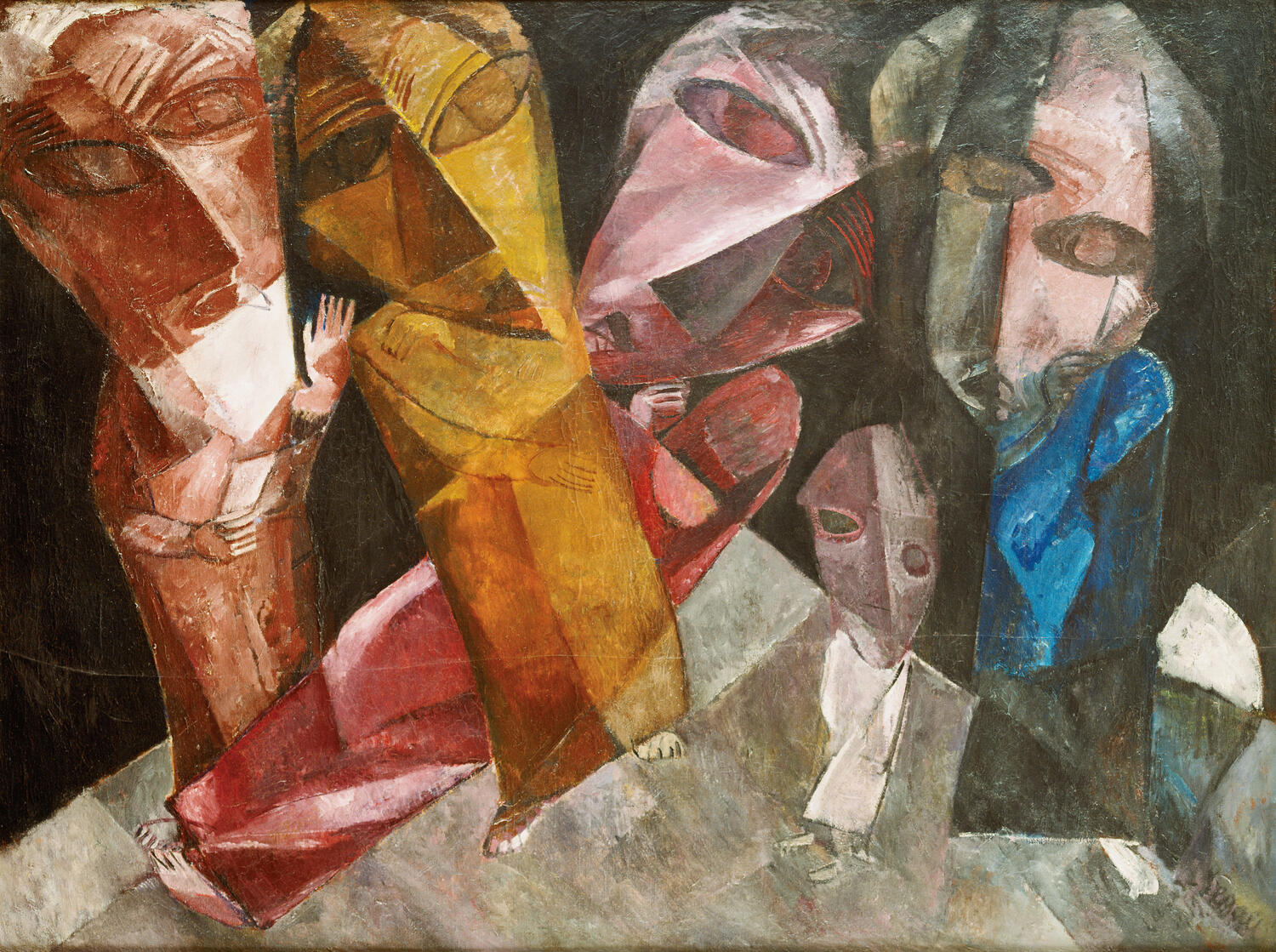

At first Eternal Wanderers seems like an abstract assemblage of colorful shapes. A closer look, however, reveals a group of people, young and old, with mask-like faces, teetering on tilting ground. This cubist and expressionist painting is one of a series of works that Segall made about victims of war in the aftermath of World War I. The painting itself has a peripatetic history. It was confiscated by the Nazis from a museum in Dresden, exhibited in the 1937 traveling “Degenerate Art” show, and later hidden with other looted art in France. It was eventually recovered after World War II and sold to the artist’s widow in Brazil in 1958.
Credits
Published in: The Posen Library of Jewish Culture and Civilization, vol. 8.
You may also like

The Prophet

Sabbath

Shtetl

The Shohet (from Had Gadya)
The violence of the Passover song “Had Gadya” (“Who Knows One”) clearly spoke to this illustrator’s sense of horror following World War I.

Ghetto Theatre

Woodcut no. 1
You may also like
The Prophet
Sabbath
Shtetl
The Shohet (from Had Gadya)
The violence of the Passover song “Had Gadya” (“Who Knows One”) clearly spoke to this illustrator’s sense of horror following World War I.
Ghetto Theatre