

Sephardic Women of Tangier: A Portrait
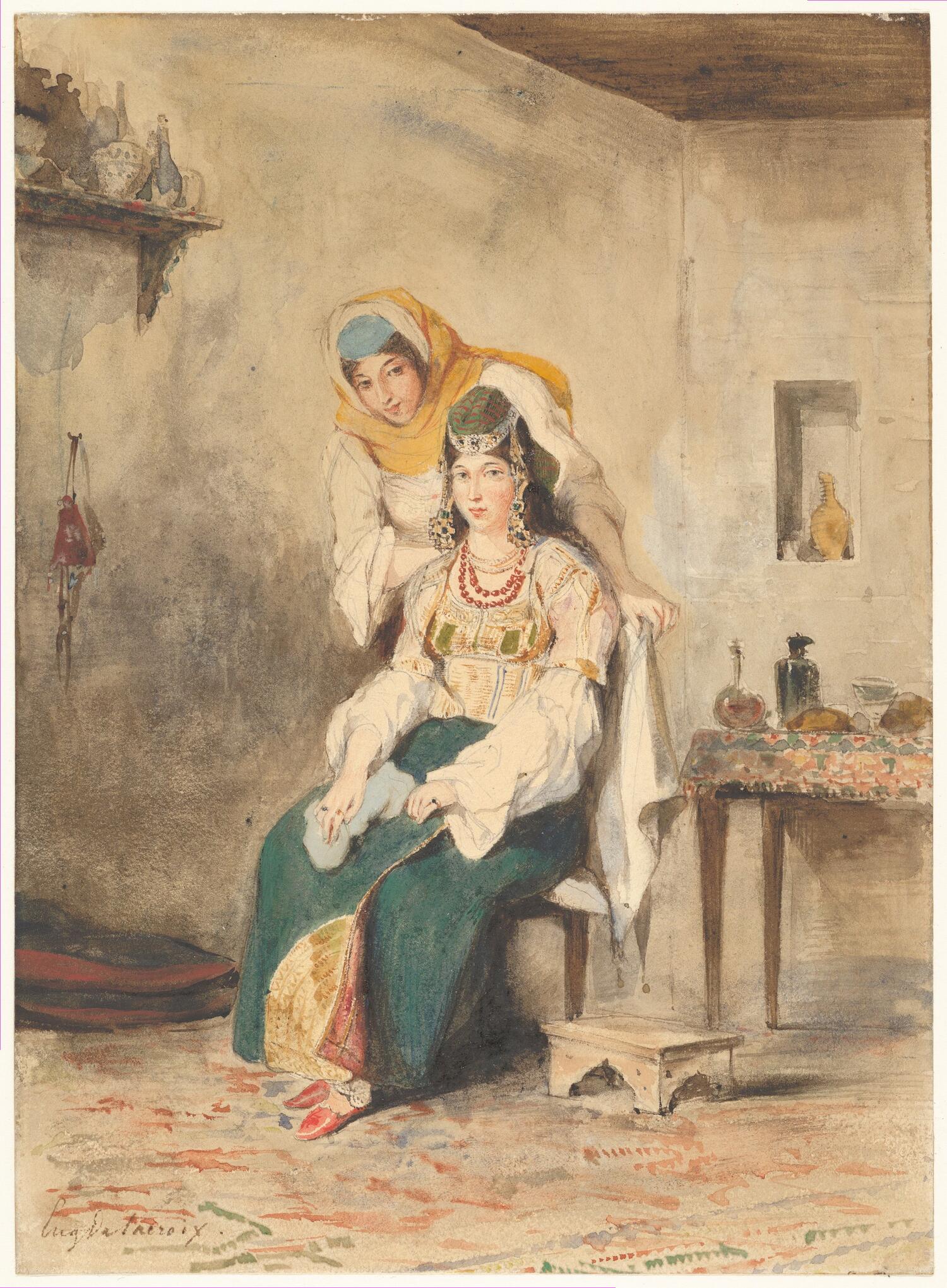

In 1832, just two years after the French conquest of Algeria, French artist Eugène Delacroix (1798–1863) traveled to North Africa, creating a series of paintings and drawings that exoticized scenes of daily life in Algeria and Morocco. At the time, the Western world was swept up in a fascination with what they called "Oriental" culture, encompassing Asian, Mediterranean, and North African styles of dress, decor, and customs. While in Tangier, his delegation was accompanied by Abraham Benchimol (Ben-Chimol), a translator with the French consulate who also acted as a guide and adviser to Delacroix. Benchimol introduced the artist to Tangier’s Sephardic culture, taking him to a synagogue and a Jewish wedding. Delacroix painted this portrait of Benchimol’s wife, Saada, and his daughter, Préciada, on the day of Préciada’s marriage.
Credits
The Metropolitan Museum of Art, bequest of Walter C. Baker, 1971.
Discussion Questions
How does the color palette that Delacroix chose for his painting of the Jewish women from Tangier influence the way we see them?
Do you think Moroccan Jewish women wore clothes like these on a daily basis in the early 1800s? How might their dress have distinguished them from their Muslim neighbors?
What indicators of economic class and status do you read in this painting?
Published in: The Posen Library of Jewish Culture and Civilization, vol. 6.
You may also like

Class 1: Sephardic Women and the 19th Century Struggle for Equality
Sephardic women from Beirut to London shaped nineteenth-century debates on gender, rights, and Jewish identity through literature and reform.

Feuchtwanger Cent

Chart of Gems from A Popular Treatise on Gems

Wedding Sofa

Shiviti

Medal Honoring Moses Montefiore: The 1840 Damascus Affair
This Berlin-struck medal commemorates Moses Montefiore and Adolphe Crémieux’s 1840 mission, which freed Jews falsely accused in the Damascus Affair.
You may also like
Class 1: Sephardic Women and the 19th Century Struggle for Equality
Sephardic women from Beirut to London shaped nineteenth-century debates on gender, rights, and Jewish identity through literature and reform.
Feuchtwanger Cent
Chart of Gems from A Popular Treatise on Gems
Wedding Sofa
Shiviti
Medal Honoring Moses Montefiore: The 1840 Damascus Affair
This Berlin-struck medal commemorates Moses Montefiore and Adolphe Crémieux’s 1840 mission, which freed Jews falsely accused in the Damascus Affair.