

Torah Binder (Rechnitz)
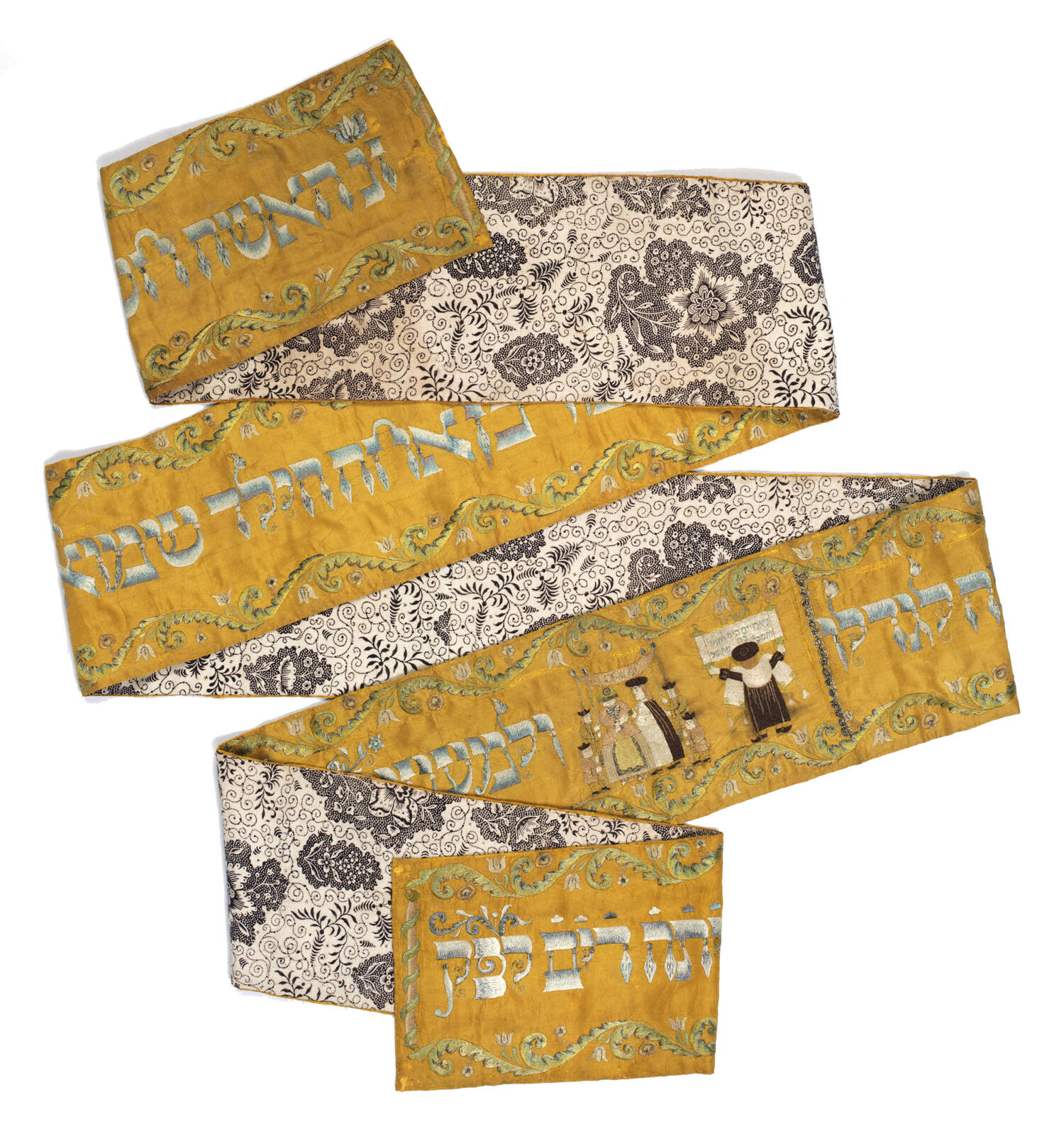

This richly decorated Torah binder is thought to be from Rechnitz, based on its dedication as a gift from Gitl bat Samuel for Samuel ben Leib of Rechnitz in 1750. The Torah binder (also known as a wimpel) was intended to accompany the male child through his lifetime, through the stages of his circumcision, bar mitzvah, and wedding. The associated Hebrew blessing is spelled out on the binder itself, with the bar mitzvah and wedding ceremonies graphically embroidered in silk and metal thread. A figure holds up a Torah scroll with the verse: “She [the Torah] is a tree of life to those who hold fast to her, and whoever holds on to her is happy” (Proverbs 3:18), while to his left a couple stands under a huppah, a wedding canopy, supported by four men.
We’re sorry. The Posen Library’s licensing agreements prevent this image from being printed or downloaded.
Credits
With permission of the Jewish Museum in Prague.
Published in: The Posen Library of Jewish Culture and Civilization, vol. 5.
You may also like

Torah Crown (Poland)
This partially gilt-silver Torah crown from Poland is studded with semi-precious stones. Its two-tiered base is typical of Torah crowns from Eastern Europe. It is inscribed in Hebrew with the words,…

Hanukkah Lamp (New York)
This brass Hanukkah menorah is thought to have been used in the First Mill Street Synagogue of Congregation Shearith Israel, which opened in New York in 1730 and was located on present-day South…

Torah Ark Curtain (Istanbul)
The embroidered structure in the center of this silk Torah ark curtain is thought to be a loose representation of the Blue Mosque in Istanbul, with its six minarets and entryway stairs. A somewhat…

Torah Mantles (Netherlands)
These Torah mantles, thought to be created in the Netherlands, are embroidered and have fringed borders. The mantle on the right is sumptuously adorned with brightly colored flowers, along with panels…

Torah Finials (Morocco)
Inscriptions on the stems of these silver Torah finials indicate that they were made by Joseph Arvatz and Chaim Maman in Morocco, and inscriptions on their rims state that they were owned by Rabbi…

Torah Finials (Iraq)
These gilt-silver finials—which bear the Hebrew calendar year of 5502 (1742)—are considered the earliest dated finials from Iraq. On top of each finial is a miniature ḥamsa, a charm in the shape of a…
Engage with this Source

Related Guide
Early Modern Visual and Material Culture
1500–1750
Early modern Jewish visual culture flourished, with illuminated manuscripts, ornate synagogues, and portraiture alongside increasing non-Jewish interest in Jewish customs and greater Jewish self-representation.
You may also like
Torah Crown (Poland)
This partially gilt-silver Torah crown from Poland is studded with semi-precious stones. Its two-tiered base is typical of Torah crowns from Eastern Europe. It is inscribed in Hebrew with the words,…
Hanukkah Lamp (New York)
This brass Hanukkah menorah is thought to have been used in the First Mill Street Synagogue of Congregation Shearith Israel, which opened in New York in 1730 and was located on present-day South…
Torah Ark Curtain (Istanbul)
The embroidered structure in the center of this silk Torah ark curtain is thought to be a loose representation of the Blue Mosque in Istanbul, with its six minarets and entryway stairs. A somewhat…
Torah Mantles (Netherlands)
These Torah mantles, thought to be created in the Netherlands, are embroidered and have fringed borders. The mantle on the right is sumptuously adorned with brightly colored flowers, along with panels…
Torah Finials (Morocco)
Inscriptions on the stems of these silver Torah finials indicate that they were made by Joseph Arvatz and Chaim Maman in Morocco, and inscriptions on their rims state that they were owned by Rabbi…
Torah Finials (Iraq)
These gilt-silver finials—which bear the Hebrew calendar year of 5502 (1742)—are considered the earliest dated finials from Iraq. On top of each finial is a miniature ḥamsa, a charm in the shape of a…