

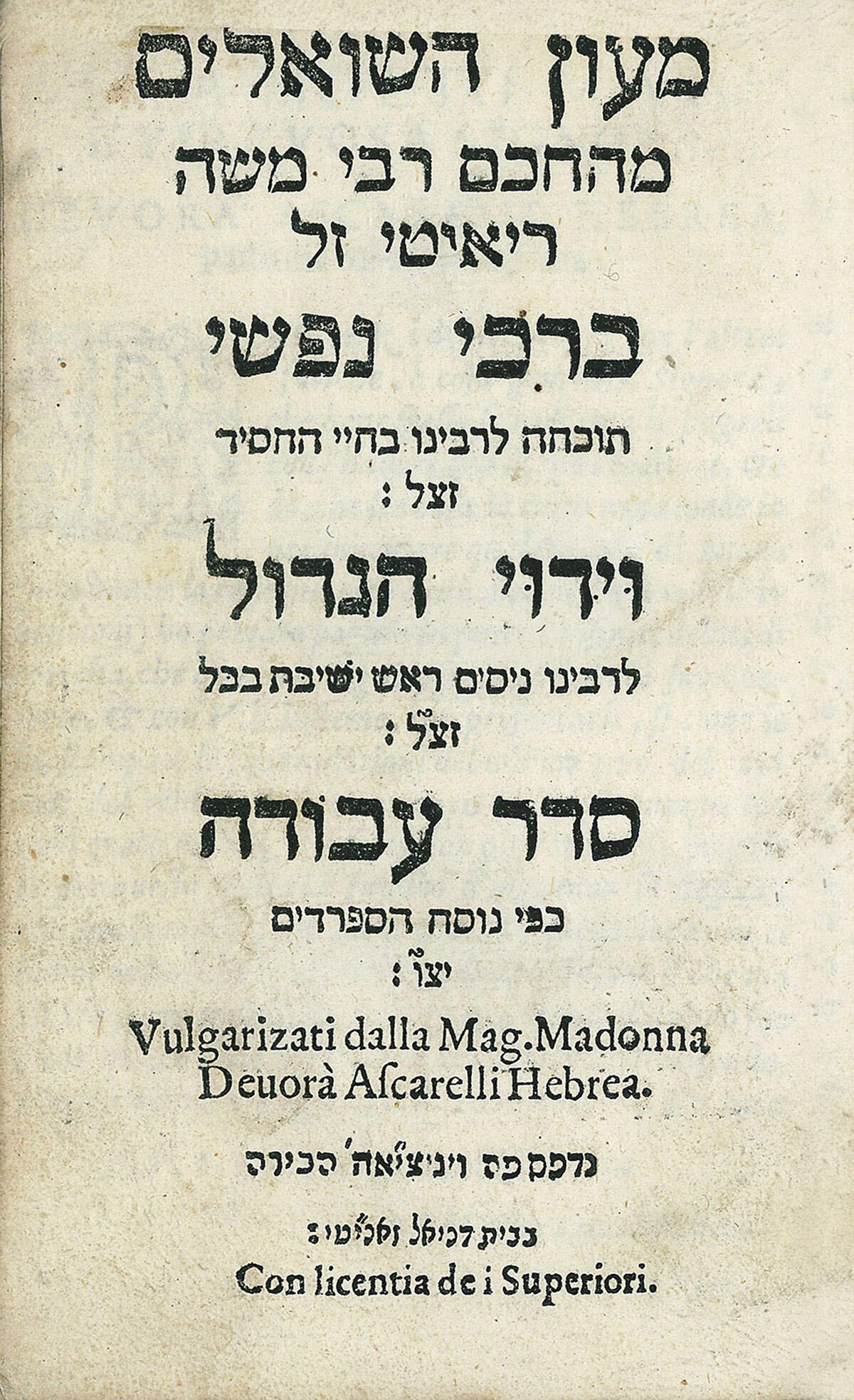
Me‘on ha-sho’alim (Abode of the Supplicants)
Image
Please login or register for free access to Posen Library
Already have an account?
Engage with this Source


Related Guide
Jewish Printing and Book Culture
1500–1750
Jewish printing unified far-flung communities by standardizing religious texts, created textual uniformity, and enabled vernacular translations, and facilitated the spread of Jewish texts and knowledge.

Related Guide
Early Modern Italy: Where East and West Meet
1500–1750
Ashkenazim, Sephardim, and Marranos encountered each other in Italian cities, developing community structures that later influenced Jewish communal organization throughout the western world.
You may also like

The Book of Expurgation
Sefer ha-zikuk
1. Whenever the term idolaters appears, and it is not clearly referring…
Editor’s Apology: She’elot u-teshuvot Maharil
Thus said the editor [megihah], who bursts forth [megi’aḥ] in prostration from his place, and offers his greeting of peace with a bow and while kneeling. His labor is for all those who are wise of…
Approbation for a Prayer Book
This 1617 letter from the Council of the Four Lands in Poland provided the first authorized status for a prayer book, protecting it from plagiarism and competition.
Proofreader’s Preface: Seder tefilot ke-minhag kahal kadosh Sefarad (The Order of the Prayers of the Holy Congregation of Spain)
Menasseh ben Joseph ben Israel, seeing the Bomberg types worn out, and since nothing can be imperfect for the Holy Work, arose from within the community and went out, and came to the house of an…

Technical Diagram from Joseph Delmedigo’s Elim
This is a technical diagram from Joseph Delmedigo’s Sefer Elim (Book of Elim), a scientific and philosophical work published by Menasseh Ben Israel.

Catalogo dos Libros que Semuel Ben Israel Soeiro Vende (Catalogue of Books for Sale by Samuel Ben Israel Soeiro)
These three pages come from a catalogue of books listed for sale by Samuel Ben Israel Soeiro, a bookseller in Amsterdam. It lists first the Hebrew books and then the ones in Spanish. He printed the…