

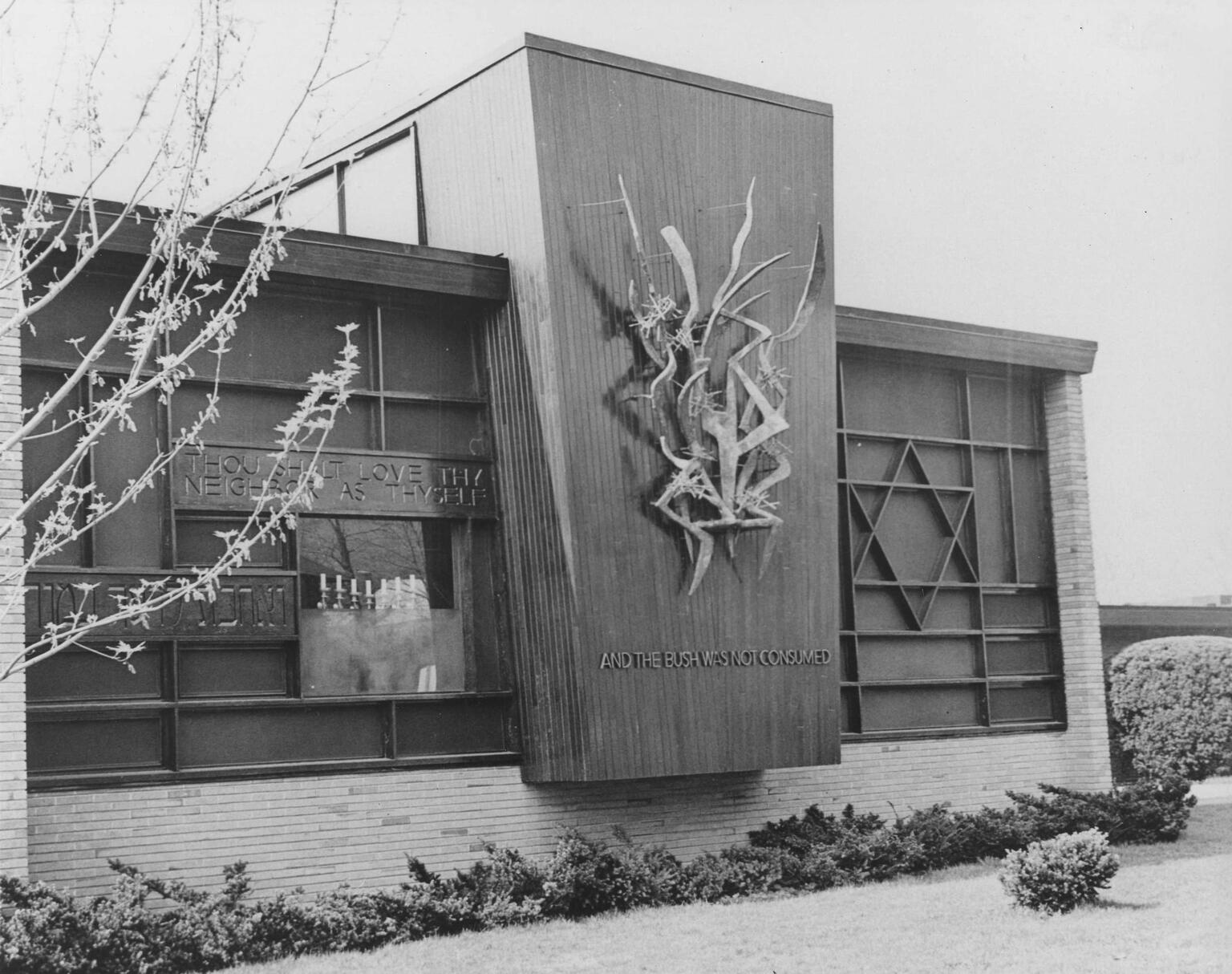
B’nai Israel (Millburn, New Jersey)
Image
Please login or register for free access to Posen Library
Already have an account?
You may also like


The Young Lovers, Festival Garden, London, UK
The young couple depicted here are in the act of embracing one another, their cheeks touching. They are one of the best-known examples of Georg Ehrlich’s representational bronze sculptures, which…

Coming to America
In this photograph, Holocaust survivors sit on the deck of a ship heading to the United States.

Yehiam (Life in a Kibbutz)
Yosef Zaritsky was a founder of the New Horizons art group, which, beginning in 1942, sought to break away from the artistic conventions established by the Bezalel School of Arts and Crafts. He…

And the Bush Was Not Consumed
Herbert Ferber’s twelve-foot-high sculpture was originally commissioned to adorn the façade of Congregation B’nai Israel in Milburn, New Jersey. Percival Goodman, the new building’s architect…

The Binding of Isaac
The Binding of Isaac was painted at a time when Aharon Kahana was developing a new style that favored abstract forms divided by thick lines. His paintings were both an embrace of modern European art…

Symphonie Vitale
Like most of Henry Valensi’s other “Symphony” paintings, Symphonie Vitale does not refer to a specific piece of music, but instead reflects the principles of Musicalism, the art movement founded by…