

Book of the Laws: On the Babylonian Talmud, Tractate Berakhot
About This Entry
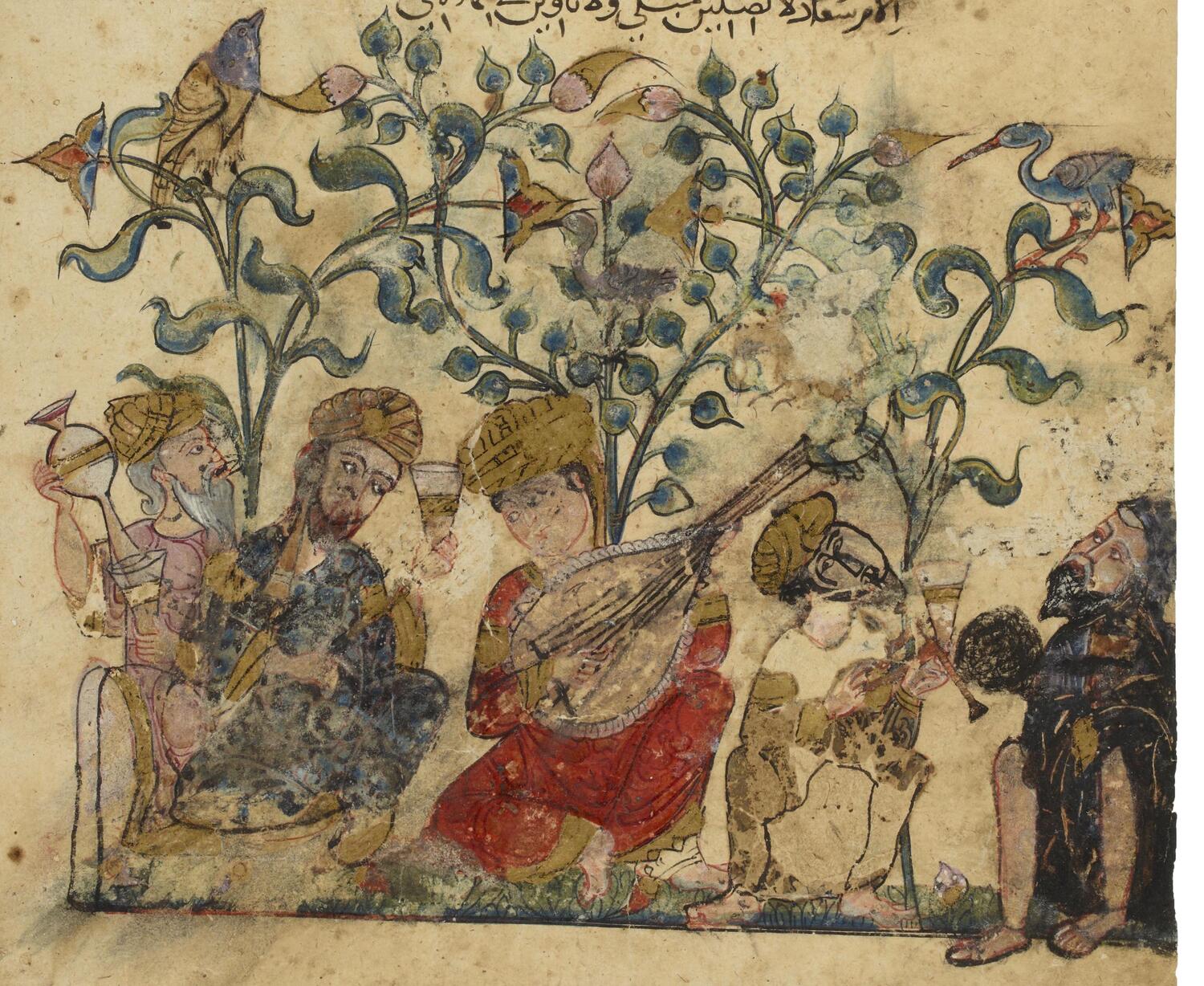
Isaac al-Fāsī comments here on a line in the Talmud that suggests that prayer should be done in a state of reverent fear and trembling. He collects various passages—from elsewhere in the Talmud and from a ruling of Hayya Ga’on—that consider the question of the general permissibility of song and music, distinguishing between instrumental and vocal, liturgical and nonliturgical.

Mishnah: One may only stand to pray with reverence. The early pious ones would wait an hour and [then] pray, to focus their hearts on the Omnipresent. Even if a king greets one, one should not respond. Even if a snake is twined around one’s heel, one should not stop.Gemara: [ . . . ] From where is this derived? R. Naḥman bar Isaac said [in the name of Rav], the verse states: Serve the Lord in fear and rejoice with trembling (Psalms 2:11). [b. Berakhot 30b]
al-Fāsī
We learned in the first chapter of tractate Gittin [7a]:
They sent to Mar Ukva: “From where do we learn that song is prohibited?” He scored [on a parchment] and wrote to them: Rejoice not, Israel, to exultation like the peoples (Hosea 9:1). But he could have sent to them his response from here: [Stilled is the merriment of hand-drums, ended the clamor of revelers, stilled the merriment of lyres.] They do not drink wine with a song; strong drink is bitter to them who drink it (Isaiah 24:9). If he had quoted that verse, I might have said that it is only instrumental music [zimra be-mana] that is prohibited, whereas vocal song [be-fuma] is permitted. He therefore teaches us that it is also prohibited.
Ravina found Mar bar Rav Ashi braiding a garland for his daughter. He said to him: Doesn’t the master maintain that since it is stated: the mitre shall be removed and the garland taken off (Ezekiel 21:31), the law is that when the mitre is on the head of the high priest, a garland may be on the head of every man, but when the mitre has been removed from the head of the high priest, the garland must be removed from the head of every man? He replied: This applies only to a case similar to that of a high priest, meaning for men, but not for women.
We learned at the end of tractate Sotah [48a]:
Rav said: The ear that hears song should be torn out. Rava said: If there is song in a house, there will be destruction on the threshold, as it is stated: Voices shall sing in the windows; desolation shall be in the doorposts (Zephaniah 2:14). R. Joseph said: “When men sing and women respond, it is licentiousness. When women sing and men respond, it is like setting fire to kindling.” What is the practical difference? To abolish one before the other. R. Yoḥanan said: Whoever drinks wine accompanied by four types of instruments brings five types of retribution to the world, as it is stated: Woe to them who rise early in the morning, that they may follow strong drink; who tarry late into the night, until wine inflames them. And the harp and the psaltery, the drum and the pipe and wine, are at their feasts, etc. (Isaiah 5:11–12). What is written afterward? Therefore, My people have gone into captivity, for want of knowledge, and their honorable men are famished, and their multitude are parched with thirst, etc. (Isaiah 5:13).
[Hayya] Ga’on explained: When we say that vocal song [zimra be-fuma] is prohibited, this is referring, for example, to songs of a person’s love for his friend and to chanting fine praises for his beauty, which are called ash’ār by the Ishmaelites. However, no Jew need refrain from words of song and praise for the Holy One or recollections of His kindnesses. It is the custom of all Israel to recite these in the houses of bridegrooms and at feasts, with melodies and joyful tones, and we have not seen anyone object to this.
We learned in the eleventh chapter of tractate Sanhedrin [101a]:
The rabbis taught that one who reads a verse from Song of Songs, rendering it a type of a song [zemer], and one who reads a verse at a feast, not at its proper time, brings evil to the world. For the Torah girds itself with sackcloth and stands before the Holy One and declares, “Master of the Universe, Your children have rendered me like a harp on which non-Jews play.” The Holy One replies, “My daughter, if so, what should my children do when they are eating and drinking?” She said before Him, “Master of the Universe, if they know the Bible, they should engage in the Torah, Prophets, and Writings. If they know the Mishnah, they should engage in the Mishnah, in laws, and in aggadot. And if they know the Talmud, they should engage in the laws of Passover on Passover, in the laws of Shavuot on Shavuot, and in the laws of Sukkot on Sukkot. R. Simeon ben Eleazar testified in the name of R. Joshua ben Hananiah: Whoever reads one verse at its proper time brings good into the world, as it is stated: And a word in its season, how good is it (Proverbs 15:23).
Credits
Bibliothèque nationale de France, Department of Manuscripts, Arabe 6094, fol. 75v, detail.
Published in: The Posen Library of Jewish Culture and Civilization, vol. 3: Encountering Christianity and Islam.
You may also like

Laws of Passover
Hilkhot pesaḥ

Critical Notes

Responsum: On a Book Thief
The Book of Contracts
Sefer ha-shetarot, 26
Commentary: On the Babylonian Talmud, Tractate Beẓah
Commentary on b. Beẓah 24b–25a

Commentary: On the Babylonian Talmud, Tractate Rosh Hashanah
Commentary on b. Rosh Hashanah 20b
You may also like
Laws of Passover
Hilkhot pesaḥ
Critical Notes
Responsum: On a Book Thief
The Book of Contracts
Sefer ha-shetarot, 26
Commentary: On the Babylonian Talmud, Tractate Beẓah
Commentary on b. Beẓah 24b–25a
Commentary: On the Babylonian Talmud, Tractate Rosh Hashanah
Commentary on b. Rosh Hashanah 20b