

The Book of Travels: Baghdad
About This Entry
In The Book of Travels (Sefer ha-masa‘ot), written in Hebrew, Benjamin describes his journey through Jewish communities across Europe and the Near East. The motives for Benjamin’s journey and the reasons for its preservation in writing are unknown. His account leads the reader from Tudela, in northern Spain, through Girona, Provence, Italy, Greece, Turkey, Palestine, Syria, Iraq, and Egypt. Benjamin even recounts details about Jewish communities in lands further east, including India and China. He also includes stories about the twelfth-century messianic claimant David Alroy of Iraq. This account achieved immense popularity, was printed and translated many times, and has attracted a great deal of scholarly attention. Despite embellishments in some sections of his account, the excerpt presented here seems relatively reliable in its depiction of Jews and Muslims in Baghdad.
Thence it is two days to Baghdad, the great city and the royal residence of the Caliph Amīr al-Mu’minīn al-‘Abbāsī of the family of Muḥammad. He is at the head of the Muslim religion, and all the kings of Islam obey him; he occupies a similar position to that held by the pope over the Christians. He has a palace in Baghdad three miles in extent, wherein is a great park with all varieties of trees, fruit-bearing and otherwise, and all manner of animals. The whole is surrounded by a wall, and in the park, there is a lake whose waters are fed by the river Hiddekel. Whenever the king desires to indulge in recreation and to rejoice and feast, his servants catch all manner of birds, game, and fish, and he goes to his palace with his counsellors and princes. There, the great king, al-‘Abbāsī the caliph [Hafiz] holds his court, and he is kind to Israel, and many belonging to the people of Israel are his attendants; he knows all languages and is well versed in the law of Israel. He reads and writes the holy language [Hebrew].
In Baghdad, there are about 40,000 Jews, and they dwell in security, prosperity, and honor under the great caliph, and among them are great sages, the heads of academies engaged in the study of the law. In this city, there are ten academies. At the head of the great academy is the chief rabbi R. Samuel, the son of Eli. He is the head of the academy of Ga’on Jacob. He is a Levite and traces his pedigree back to Moses our teacher. The head of the second academy is R. Ḥananiah, his brother, warden of the Levites; R. Daniel is the head of the third academy; R. Elazar the scholar is the head of the fourth academy; and R. Elazar, the son of Tsemaḥ, is the head of the order, and his pedigree reaches to Samuel the prophet, the Korahite. He and his brethren know how to chant the melodies as did the singers at the time when the Temple was standing. He is head of the fifth academy. R. Ḥisdai, the glory of the scholars, is head of the sixth academy. R. Haggai is head of the seventh academy. R. Ezra is the head of the eighth academy. R. Abraham, who is called Abū Tāhir, is the head of the ninth academy. R. Zakkai, the son of Bustanay the nasi, is the head of the Siyum. These are the ten Batlanim,1 and they do not engage in any other work than communal administration; and all the days of the week they judge the Jews their countrymen, except on the second day of the week, when they all appear before the chief rabbi Samuel, the head of the academy of Ga’on [Jacob], who, in conjunction with the other Batlanim, judges all those that appear before him.
And at the head of them all is Daniel the son of Ḥisdai, who is styled “Our lord the Head of the Captivity of all Israel.” He possesses a book of pedigrees going back as far as David, king of Israel. The Jews call him “Our lord, Head of the Captivity,” and the Muslims call him “Sayyidnā ibn Dā’ūd,” and he has been invested with authority over all the congregations of Israel at the hands of the Amīr al-Mu’minīn, the Lord of Islam. For thus Muḥammad commanded concerning him and his descendants; and he granted him a seal of office over all the congregations that dwell under his rule, and ordered that every one, whether Muslim or Jew, or belonging to any other nation in his dominion, should rise up before him [the exilarch] and salute him, and that anyone who should refuse to rise up should receive one hundred stripes.
And every fifth day when he goes to pay a visit to the great caliph, horsemen, non-Jews as well as Jews, escort him, and heralds proclaim in advance, “Make way before our lord, the son of David, as is due unto him,” the Arabic words being “‘Amilū tarīq li-sayyidnā ibn Dā’ūd.” [ . . . ] In respect of all these countries, the head of the captivity [exilarch] gives the communities power to appoint teachers and ministers who come to him to be consecrated and to receive his authority. They bring him offerings and gifts from the ends of the earth. He owns hospices, gardens, and plantations in Babylon, and much land inherited from his fathers, and no one can take his possessions from him by force. He has a fixed weekly revenue arising from the hospices of the Jews, the markets, and the merchants, apart from that which is brought to him from far-off lands. The man is very rich, and wise in the scriptures as well as in the Talmud, and many Israelites dine at his table every day. [ . . . ]
In Baghdad, there are twenty-eight Jewish synagogues, situated either in the city itself or in al-Karkh on the other side of the Tigris; for the river divides the metropolis into two parts. The great synagogue of the head of the captivity has columns of marble of various colors overlaid with silver and gold, and on these columns are sentences of the Psalms in golden letters. And in front of the ark are about ten steps of marble; on the topmost step are the seats of the head of the captivity and of the princes of the House of David. The city of Baghdad is twenty miles in circumference, situated in a land of palms, gardens and plantations, the like of which is not to be found in the whole land of Shinar. People come thither with merchandise from all lands. Wise men live there, philosophers who know all manner of wisdom, and magicians expert in all manner of witchcraft.
Notes
Words in brackets appear in the original translation.
This appellation is applied in the Talmud to scholars who uninterruptedly apply themselves to communal work.
Published in: The Posen Library of Jewish Culture and Civilization, vol. 3: Encountering Christianity and Islam.
You may also like
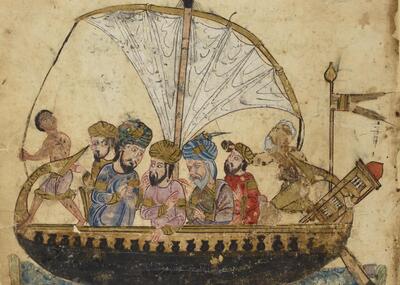

Migration and Mobility in the Early Medieval Period
Medieval societies can sometimes be seen as static and isolated. Yet medieval people of all sorts moved from one place to another, for a variety of reasons: for economic opportunity and trade, driven by wars and forced displacement, and more. Western Europe and the Mediterranean, the Middle East, and even the Far East were connected by the migration of people, merchandise, and ideas.

Mishneh Torah, The Book of Knowledge: On the Rise of Idolatry
Book of Knowledge, Laws Concerning Idolatry and the Ordinances of the Heathens, Chapter 1 (selections)
The Travels of R. Petaḥiah of Regensburg
Sibuv R. Petaḥyah mi-Regensburg
Travel Account
The Cure of Souls: On Forced Conversion
Ṭibb al-nufūs, Chapter 4 (selections)
The Scroll of Zuta
Megilat Zuta
You may also like
Migration and Mobility in the Early Medieval Period
Medieval societies can sometimes be seen as static and isolated. Yet medieval people of all sorts moved from one place to another, for a variety of reasons: for economic opportunity and trade, driven by wars and forced displacement, and more. Western Europe and the Mediterranean, the Middle East, and even the Far East were connected by the migration of people, merchandise, and ideas.
Mishneh Torah, The Book of Knowledge: On the Rise of Idolatry
Book of Knowledge, Laws Concerning Idolatry and the Ordinances of the Heathens, Chapter 1 (selections)
The Travels of R. Petaḥiah of Regensburg
Sibuv R. Petaḥyah mi-Regensburg
Travel Account
The Cure of Souls: On Forced Conversion
Ṭibb al-nufūs, Chapter 4 (selections)
The Scroll of Zuta
Megilat Zuta