

Mishneh Torah, The Book of Knowledge: On the Rise of Idolatry
About This Entry
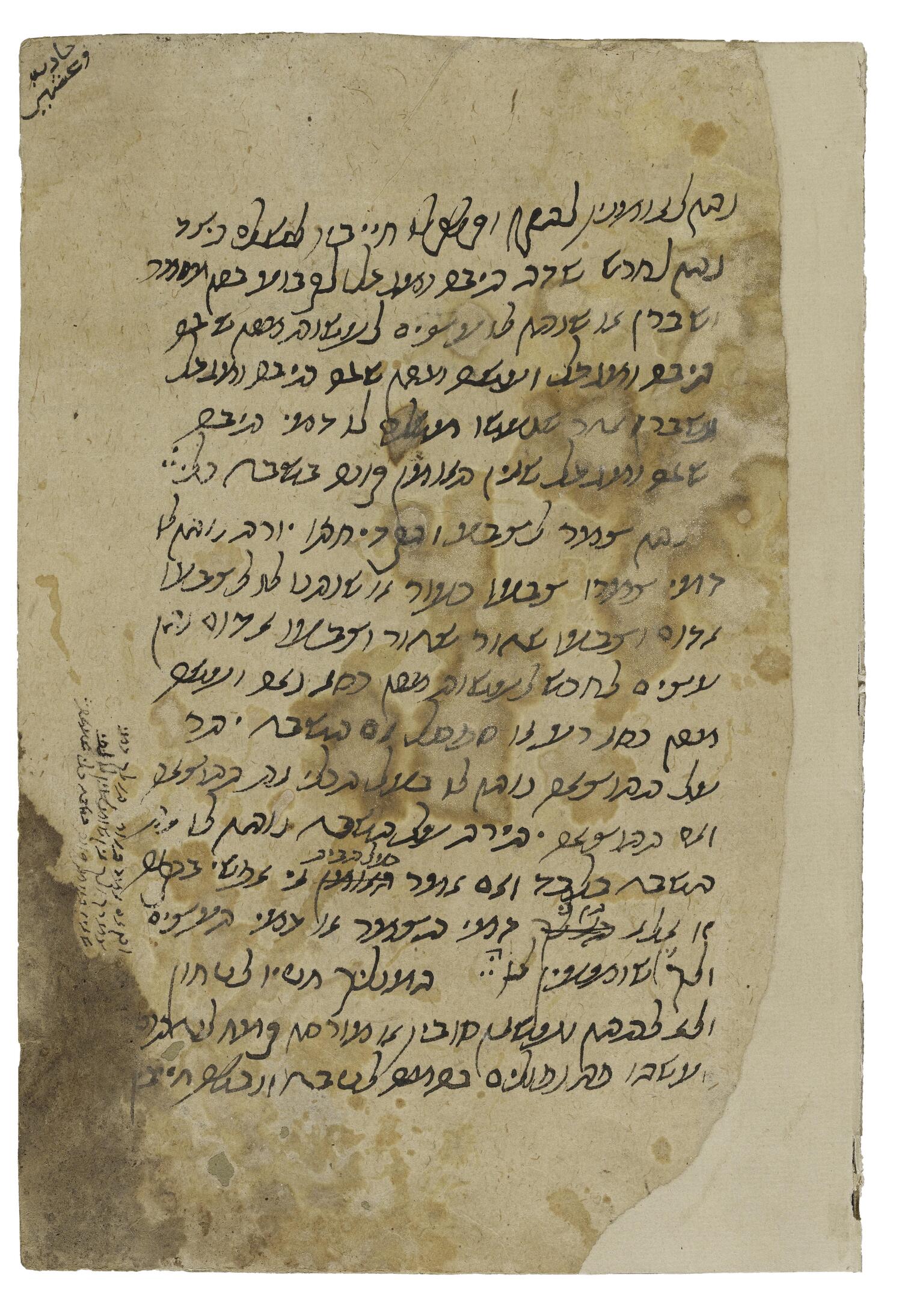
At the beginning of his section on the Laws of Idolatrous Worship in the Mishneh Torah, Moses Maimonides provides a lengthy account of how humanity forgot the monotheism of Adam and his family. This narrative, sharply inflected with Maimonides’ favorable view of philosophy and negative view of astrology, expands on biblical and rabbinic sources. Maimonides sees Abraham as a campaigner on behalf of the divine, while also insisting that Abraham maintained his isolation from those around him to ensure his steadfast commitment to God. Finally, Maimonides depicts the Levites as teachers, reflecting his view that Jewish leaders have an important pedagogic role.
In the days of Enosh, the people fell into gross error, and the counsel of the wise men of the generation became foolish. Enosh himself was among those who erred. Their error was as follows: “Since God,” they said, “created these stars and spheres to guide the world, set them on high and allotted unto them honor, and since they are ministers who minister before Him, they deserve to be praised and glorified, and honor should be rendered them; and it is the will of God, blessed be He, that men should aggrandize and honor those whom He aggrandized and honored—just as a king desires that respect should be shown to the officers who stand before Him, and thus honor is shown to the king.” When this idea arose in their minds, they began to erect temples to the stars, offered up sacrifices to them, praised and glorified them in speech, and prostrated themselves before them—their purpose, according to their perverse notions, being to obtain the Creator’s favor. This was the root of idolatry, and this was what the idolaters, who knew its fundamentals, said. They did not however maintain that there was no God except the particular star [which was the object of their worship]. [ . . . ]
In the course of time, there arose among men false prophets who asserted that God had commanded and expressly told them, “Worship that particular star, or worship all the stars. Offer up to it such and such sacrifices. Pour out to it such and such libations. Erect a temple to it. Make a figure of it, to which all the people—the women, children, and the rest of the folk—shall bow down.” [ . . . ] And then they began to make figures in temples, under the trees, on the mountain-tops and the hills. There they would assemble, bow down to the figures, and tell all the people that this particular figure conferred benefits and inflicted injuries, and that it was proper to worship and fear it. [ . . . ] So gradually the custom spread throughout the world of worshipping figures with various modes of worship, such as offering up sacrifices to them, and bowing down to them.
As time passed, the honored and revered Name of God was forgotten by mankind, vanished from their lips and hearts, and was no longer known to them. All the common people and the women and children knew only the figure of wood and stone, and the temple edifice in which they had, from their childhood, been trained to prostrate themselves to the figure, worship it, and swear by its name. Even their wise men, such as priests and men of similar standing, also fancied that there was no other god but the stars and spheres, for whose sake and in whose similitude these figures had been made. But the Creator of the Universe was known to none, and recognized by none, save a few solitary individuals, such as Enosh, Methuselah, Noah, Shem, and Eber.
The world moved on in this fashion, until that pillar of the world, the patriarch Abraham, was born. After he was weaned, while still an infant, his mind began to reflect. By day and by night he was thinking and wondering: “How is it possible that this [celestial] sphere should continuously be guiding the world and have no one to guide it and cause it to turn round; for it cannot be that it turns round of itself.” He had no teacher, no one to instruct him in aught. He was submerged, in Ur of the Chaldees, among silly idolaters. His father and mother and the entire population worshipped idols, and he worshipped with them. But his mind was busily working and reflecting until he had attained the way of truth, apprehended the correct line of thought, and knew that there is One God, that He guides the celestial sphere and created everything, and that among all that exist, there is no god beside Him. [ . . . ]
When he had prevailed over them with his arguments, the king [of the country] sought to slay him. He was miraculously saved and emigrated to Haran. He then began to proclaim to the whole world with great power and to instruct the people that the entire universe had but one Creator and that Him it was right to worship. He went from city to city and from kingdom to kingdom, calling and gathering together the inhabitants, until he arrived in the land of Canaan. There too, he proclaimed his message, as it is said: And he called there on the name of the Lord, God of the Universe (Genesis 21:33). When the people flocked to him and questioned him regarding his assertions, he would instruct each one according to his capacity until he had brought him to the way of truth, and thus thousands and tens of thousands joined him. These were the persons referred to in the phrase, “men of the house of Abraham.” He implanted in their hearts this great doctrine, composed books on it, and taught it to Isaac, his son. Isaac settled down, instructing and exhorting. He imparted the doctrine to Jacob and ordained him to teach it. He, too, settled down, taught, and morally strengthened all who joined him. The patriarch Jacob instructed all his sons, set apart Levi, appointed him head [teacher] and placed him in a college to teach the way of God and keep the charge of Abraham. He charged his sons to appoint from the tribe of Levi one instructor after another, in uninterrupted succession, so that the doctrine might never be forgotten. And so it went on with ever increasing vigor among Jacob’s children and their adherents until they became a people that knew God. When the Israelites had stayed a long while in Egypt, they relapsed, learned the practices of their neighbors, and, like them, worshipped idols, with the exception of the tribe of Levi, which steadfastly kept the charge of the patriarch. This tribe of Levi never practiced idolatry.

Notes
Words in brackets appear in the original translation.
Published in: The Posen Library of Jewish Culture and Civilization, vol. 3: Encountering Christianity and Islam.
You may also like

The Book of Travels: Baghdad
Benjamin's account leads from Tudela, in northern Spain, through Girona, Provence, Italy, Greece, Turkey, Palestine, Syria, Iraq, Egypt, and farther East.

The Travels of R. Petaḥiah of Regensburg
Sibuv R. Petaḥyah mi-Regensburg
Travel Account
The Cure of Souls: On Forced Conversion
Ṭibb al-nufūs, Chapter 4 (selections)
The Scroll of Zuta
Megilat Zuta

Elegy for His Wife, Dolce
In this 12th-century poem for his murdered wife, Eleazar uses the “woman of valor” passage to show how she embodied those qualities as a wife, supporter of the community, businesswoman, and teacher.
You may also like
The Book of Travels: Baghdad
Benjamin's account leads from Tudela, in northern Spain, through Girona, Provence, Italy, Greece, Turkey, Palestine, Syria, Iraq, Egypt, and farther East.
The Travels of R. Petaḥiah of Regensburg
Sibuv R. Petaḥyah mi-Regensburg
Travel Account
The Cure of Souls: On Forced Conversion
Ṭibb al-nufūs, Chapter 4 (selections)
The Scroll of Zuta
Megilat Zuta
Elegy for His Wife, Dolce
In this 12th-century poem for his murdered wife, Eleazar uses the “woman of valor” passage to show how she embodied those qualities as a wife, supporter of the community, businesswoman, and teacher.