

Cholent, Ḥamin, and Adafina: Jewish Sabbath Stews Explained
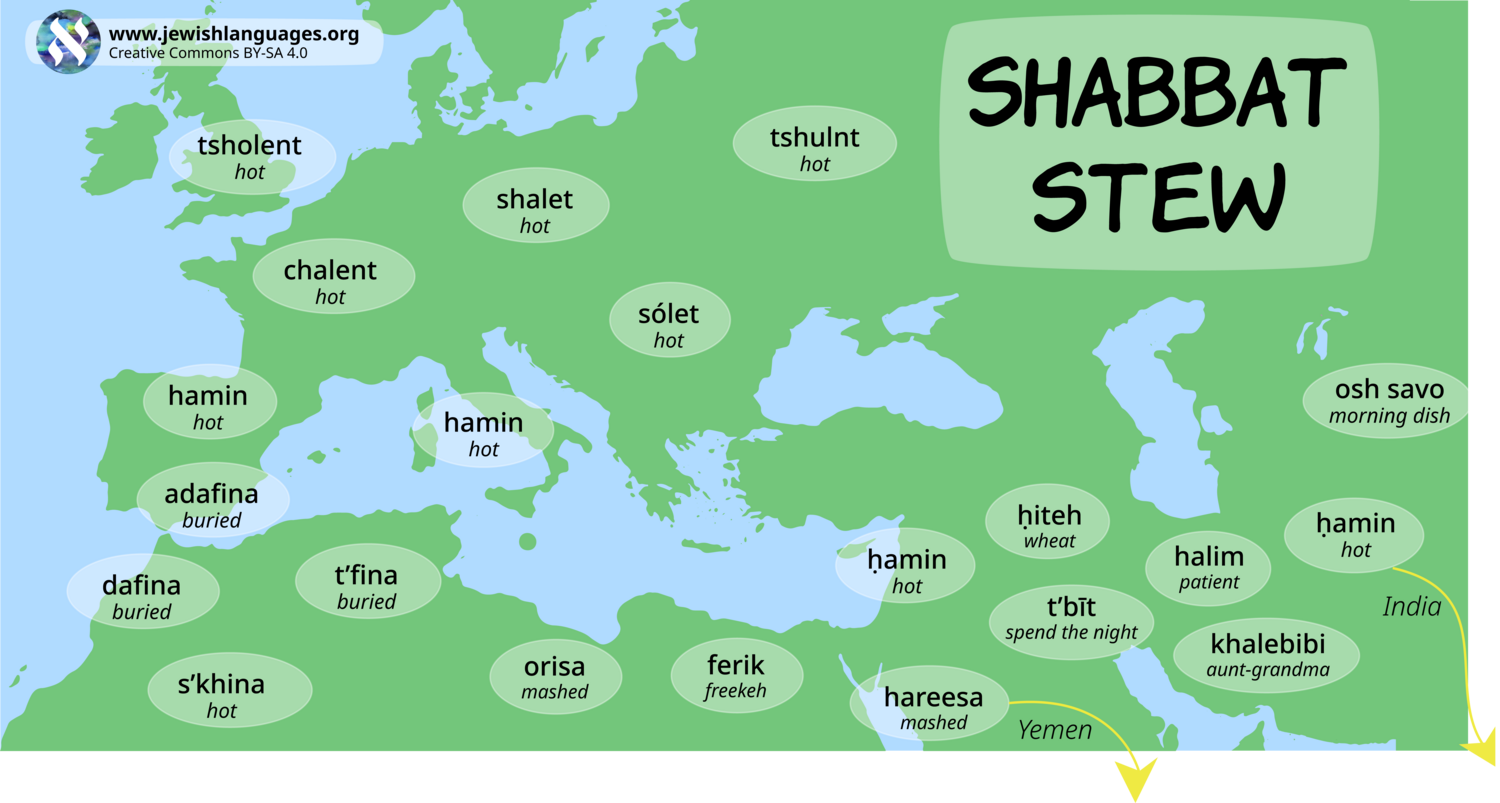

Many Jews prepare slow-cooked stew for the Sabbath. The stew is typically prepared on Friday and left to cook until lunchtime on Saturday, to comply with the prohibition of actively cooking on the Sabbath. Around the world, the stew uses diverse ingredients. It also has diverse names, some of which reflect a line in the Mishnah about food preparation for the Sabbath: tomnin et ha-ḥamin, “[one may] hide/cover/bury the hot [water/food]” [m. Shabbat 2:7]. Some of these names focus on the hot food, such as hamin (used in Ladino, Judeo-Italian, Judeo-Arabic, and Modern Hebrew) and cholent/tsholent (Yiddish and Jewish English, stemming from medieval Judeo-French, spoken by the grandparents of some early Yiddish speakers). Other words emphasize how the food is kept warm: adafina (North African Judeo-Arabic) means “covered”; t’bit (Iraqi Judeo-Arabic) means “spend the night.”
Credits
Courtesy of the Jewish Language Project.
Discussion Questions
For each of the words, discuss whether and how it is related to the line in the Mishnah “[one may] hide/cover/bury the hot [water/food] (ḥamin),” or something else about eating slow-cooked stew.
Most of the words are from surrounding or migrated languages, but we also find the Hebrew word ḥamin. What can we learn about the practice of mixing languages among Jews around the world?
Freekeh, a type of wheat, is the basis for the name of the Shabbat stew in Egypt. Jews in Poland often used barley. Why do you think the ingredients were so different in different Jewish communities?
You may also like

Class 4: Jewish Food Traditions: Global Flavors and Local Adaptations
From Sabbath stew to holiday pastries, Jewish cuisines have been shaped by kosher restrictions, migrations, and cultural exchange.
You may also like
Class 4: Jewish Food Traditions: Global Flavors and Local Adaptations
From Sabbath stew to holiday pastries, Jewish cuisines have been shaped by kosher restrictions, migrations, and cultural exchange.