

Commentary on the Mishnah: Prefatory Poem
About This Entry
This Hebrew poem was composed by Maimonides to introduce his Judeo-Arabic commentary on the Mishnah. The closing words, “May Moses rejoice in his allotted portion,” are taken from the Sabbath morning prayer, where they refer to the biblical Moses, who rejoiced that God had made him His trusted servant. Here, Maimonides applies them to himself.
This book is composed about the Law of Moses,
clarifying its rules and its just law,
in accordance with the law that our elders transmitted,
its builders, who strengthened its construction.
It is the work of a weak man, young in years,
Moses, son of Maymūn, who cries out
to God, to straighten his path;
to make his yearning only for His Torah;
to make his portion be in the Mountain of Understanding;
to eat the Fruit of Wisdom as his only fare.
Then may he see God’s goodness, and then
may Moses rejoice in his allotted portion.
Translated by Gabriel Wasserman.
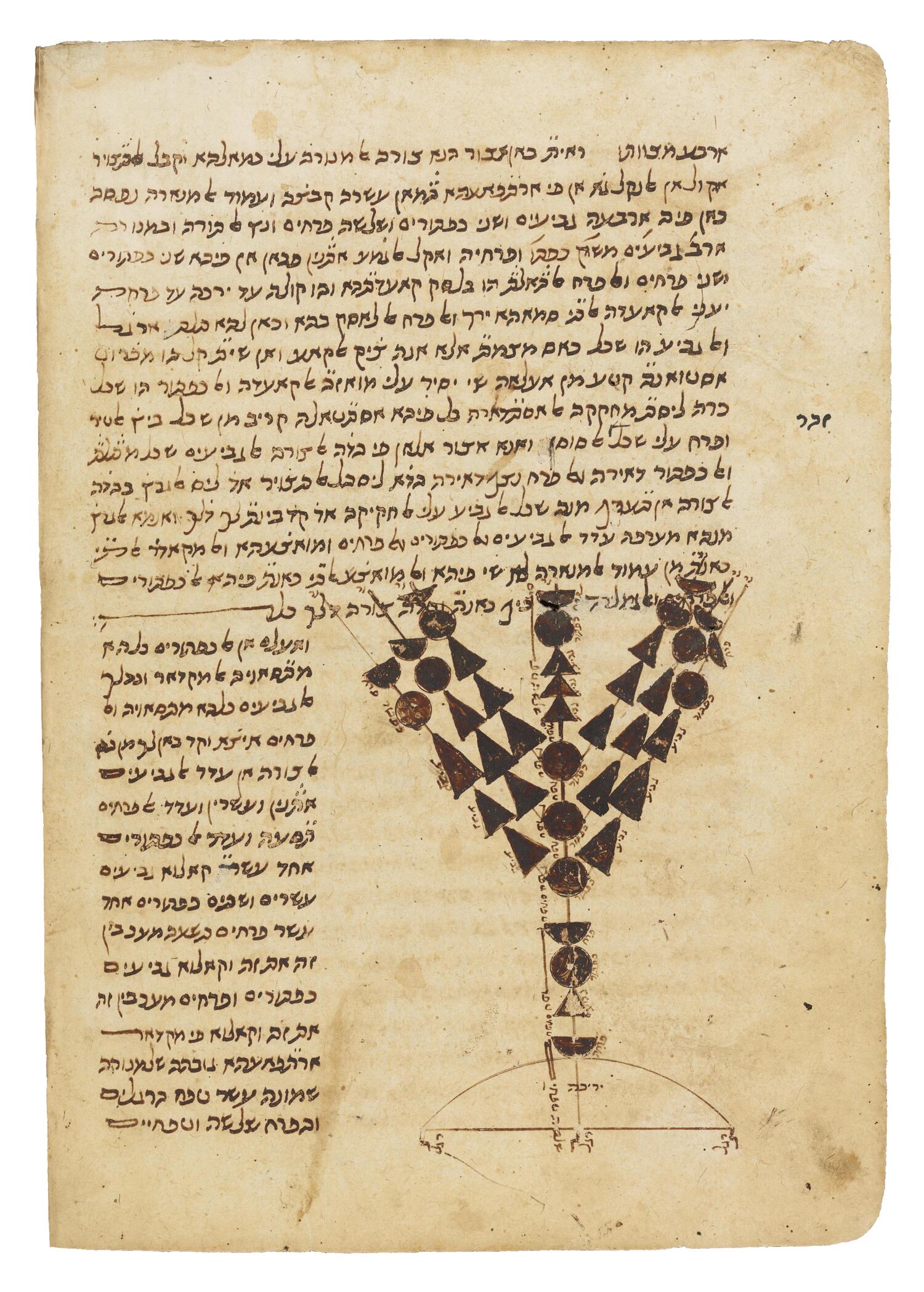

We’re sorry. The Posen Library’s licensing agreements prevent this image from being printed or downloaded.
Published in: The Posen Library of Jewish Culture and Civilization, vol. 3: Encountering Christianity and Islam.
You may also like

Commentary on the Mishnah
Moses Maimonides composed and revised his commentary on the Mishnah over many years. Writing in Judeo-Arabic (aside from the Hebrew poem with which he began the work), he clarified each mishnah in…

Minute Prohibited Substances
Isur mashehu, Chapter 1
R. Joshua ben Levi says: All prohibited [substances] in the Torah [are nullified by mixing them with permitted substances that are] sixty [times their…
Decree on Menstrual Purity
Build up, build up, clear the way! Remove a stumbling block from my people’s way (Isaiah 57:14).
We, the scholars living in Egypt at this time, say: When we were brought together in this region from…

Mishneh Torah
The Mishneh Torah (Repetition of the Law) is a monumental legal compendium, and the most influential rabbinic work of the medieval period. Written in the 1170s in Egypt, the…

Book of God-Fearers
Sefer yere’im, vol. 2, page 6, section 239
You shall fear your God and observe that which He commanded in Parashat Shoftim: There shall not be found among you anyone who passes his son or his daughter through the fire, one who uses…
The Book of Commandments
Sefer ha-mitsvot, Introduction (selections)
The first principle of these, that it is not appropriate to count in this sum commandments which are rabbinic.
Know that this matter should not require noting due to its obviousness, for…
You may also like
Commentary on the Mishnah
Moses Maimonides composed and revised his commentary on the Mishnah over many years. Writing in Judeo-Arabic (aside from the Hebrew poem with which he began the work), he clarified each mishnah in…
Minute Prohibited Substances
Isur mashehu, Chapter 1
R. Joshua ben Levi says: All prohibited [substances] in the Torah [are nullified by mixing them with permitted substances that are] sixty [times their…
Decree on Menstrual Purity
Build up, build up, clear the way! Remove a stumbling block from my people’s way (Isaiah 57:14).
We, the scholars living in Egypt at this time, say: When we were brought together in this region from…
Mishneh Torah
The Mishneh Torah (Repetition of the Law) is a monumental legal compendium, and the most influential rabbinic work of the medieval period. Written in the 1170s in Egypt, the…
Book of God-Fearers
Sefer yere’im, vol. 2, page 6, section 239
You shall fear your God and observe that which He commanded in Parashat Shoftim: There shall not be found among you anyone who passes his son or his daughter through the fire, one who uses…
The Book of Commandments
Sefer ha-mitsvot, Introduction (selections)
The first principle of these, that it is not appropriate to count in this sum commandments which are rabbinic.
Know that this matter should not require noting due to its obviousness, for…