

Critical Notes on the Mishneh Torah
About This Entry
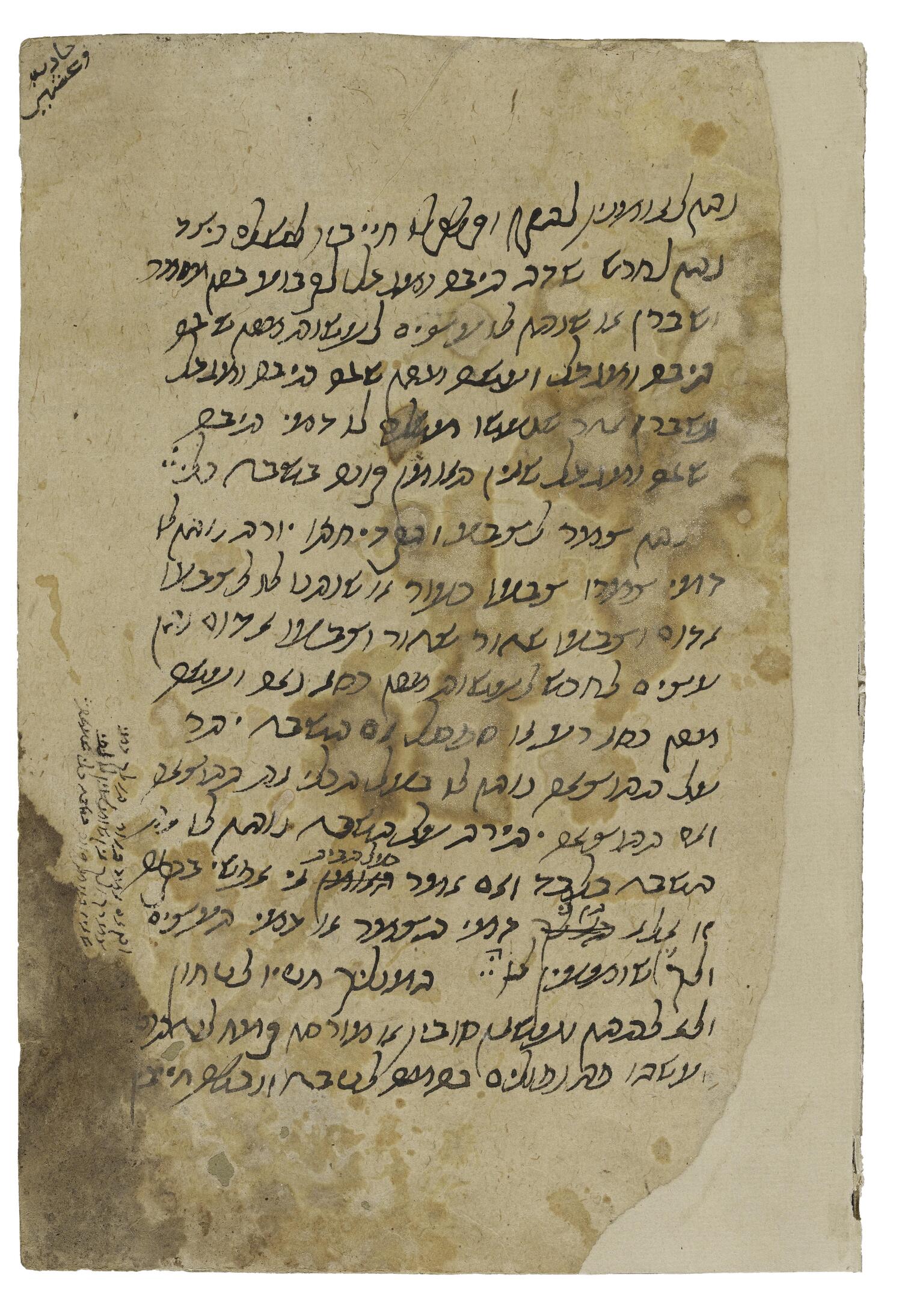
These passages are excerpted from Moses ha-Kohen’s critical comments on the Mishneh Torah of Moses Maimonides (1138–1204). Some of them echo those made by Abraham ben David of Posquières (1125–1198), who may have been Moses ha-Kohen’s teacher or his colleague. Like many Provençal figures of his day, Moses ha-Kohen cited a “corrected version” of the Mishneh Torah, perhaps one copied from a manuscript written in Maimonides’ own hand.
Women who were told by idol worshipers, “Give us one of you, and we will defile her. And if not, we will defile all of you,” let them all be defiled. [ . . . ] However, if they single [someone] out and say: “Give us So-and-so or we will kill all of you,” [ . . . ] if that person is not [otherwise] deserving of death, they should allow themselves all to be killed, and let them not hand over one life from Israel. [Maimonides, Mishneh Torah, Laws of the Principles of the Torah 5:5]
Moses ha-Kohen of Lunel
Even though this is exactly how it appears in the Tosefta, I do not know the reason for this law. The Gemara states that the reason we apply the principle that one must be killed and not transgress the prohibition of bloodshed is due to logical reasoning, namely: Who is to say that your blood is redder [than his, that is, why is your life worth more]? But here that reasoning is inapplicable, since all of them would be killed, including the one whom they singled out. It is therefore better that one alone should be killed rather than all of them. This matter requires further analysis. [ . . . ]
One who prays Musaf [the additional prayer] after seven hours [have elapsed since the Shaḥarit prayer] has fulfilled his duty, even though he has been negligent. [Maimonides, Mishneh Torah, Laws of Prayer and the Priestly Blessing 3:5]
Moses ha-Kohen of Lunel
I do not know why he [Maimonides] calls him “negligent,” when our custom on Yom Kippur is to pray Musaf after seven hours [have passed]. In any case, however, our custom is not quite in keeping with the law, as the prayer leader prolongs the first three blessings of the ‘Amidah prayer with liturgical poems [kerovot] and penitential poems and prayers [seliḥot], and thus he does not complete the Shaḥarit prayer until after midday. Since he is repeating the ‘Amidah prayer in order to fulfill the duty of one who is not an expert in it, he should recite it within four hours, so that he can exempt them within the prescribed time for the prayer. Admittedly, he starts the prayer during the proper time, but he still acts improperly by completing it after its given time, as the daily morning offering in the Temple was sacrificed in its entirety within the four hours. This matter requires further analysis. [ . . . ]
We likewise learned by tradition that it is prohibited to wash on this day, or to anoint oneself, or to wear shoes, or to engage in sexual relations, as it states: A Sabbath of solemn rest (Leviticus 23:32). Sabbath refers to eating, and solemn rest refers to these other categories. [Maimonides, Mishneh Torah, Laws of Rest on the Tenth of Tishre (Yom Kippur) 1:5]

Moses ha-Kohen of Lunel
He [Maimonides] apparently rules in accordance with the teaching of R. Joseph, that scripture includes washing and anointing [which thus would be biblically prohibited]. But this does not appear to be correct, for if so, the sages would not have permitted these [activities] to a king and a bride [m. Yoma 8:1], or to one who is going to visit his rabbi, or to guards of fruit, or to one who has scabs on his head [b. Yoma 77b]. Rather, it seems that R. Joseph himself was not of the opinion that these categories are prohibited by biblical law, nor by a tradition, as otherwise he would be contradicted by the mishnah which permits them to a king and a bride. My teachers too explained that all of these categories, apart from eating and drinking, are prohibited by rabbinic law [and not by biblical law]. This matter requires further analysis. [ . . . ]
On the six [festival] days on which scripture prohibited the performance of labor, all labors of work are forbidden, except for labor that is for the purpose of eating, as it states: Only that which every man must eat, [that alone may be done by you] (Exodus 12:16). [Maimonides, Mishneh Torah, Laws of Rest on a Holiday 1:1]
Moses ha-Kohen of Lunel
His statement is puzzling, as [in the seventh month, on the first day of the month . . . you shall do no] labors of work (Leviticus 23:24–25) implies that all labors are prohibited on the first day of the seventh month, which is Rosh Hashanah. But from where did our sages derive that one may perform labor that is for [preparing] one’s food on this day? Granted, in the cases of Shavuot and Sukkot, one can say that they are similar to Passover, regarding which it does state: Only that which every man must eat. However, when it comes to Rosh Hashanah, regarding which it does not state only that which every man must eat, from where did our sages derive that it is permitted on this day to perform labor that is for one’s food?
I would say in response that labors of work refers only to working the land and similar activities, which involve great exertion. Now, R. Eliezer of Metz went to great effort to resolve this matter. He answered by noting that the Mekhilta [a work of legal midrash on the book of Exodus] derives the permission to perform labor that is for one’s food from the Passover that was observed in Egypt, by means of a verbal analogy. It states here, regarding the Passover that is for all generations: a holy convocation (Leviticus 23:7), and it states there, regarding the Passover in Egypt: a holy convocation (Exodus 12:16). Just as in the case of the holy convocation stated with regard to the Passover in Egypt, God permitted labor that is for one’s food on that day, so too He permitted labor that is for one’s food on the Passover that is for all generations. Consequently, we likewise permit labor that is for one’s food on Rosh Hashanah, as it is also called a holy convocation (Leviticus 23:24), for we apply a similar verbal analogy. But this answer requires further analysis, as one may not apply a verbal analogy of his own accord.1 [ . . . ]
One who betroths a woman by means of intercourse, this is betrothal by biblical law, but betrothal through money is from the rabbis, etc. [Maimonides, Mishneh Torah, Laws of Marriage 3:20]
Moses ha-Kohen of Lunel
I wrote above that betrothal through money is effective by biblical law, and the law implies likewise. The rabbi’s statement therefore requires further study. Indeed, the rabbi [later] retracted and edited it, so that it reads, “and all three of them apply by biblical law.”
Notes
[In other words, one must have a tradition from his rabbis as to when a verbal analogy serves to teach a halakhah. Otherwise, verbal analogies could be applied indiscriminately.—Trans.]
Published in: The Posen Library of Jewish Culture and Civilization, vol. 3: Encountering Christianity and Islam.
You may also like

Responsum: On Listening to Music

Notes from a Class on al-Fāsī: On the Babylonian Talmud, Tractate Bava Kamma
Notes from a Class: On the Babylonian Talmud, Tractate Bava Meẓ‘ia

Responsum: On the Rebellious Wife
A 9th-century discussion of the enactment concerning a “rebellious wife,” a woman who refuses to fulfill her household duties or to maintain a sexual relationship with her husband.
On the Babylonian Talmud, Tractate Avodah Zarah
Responsum: On Excommunication
You may also like
Responsum: On Listening to Music
Notes from a Class on al-Fāsī: On the Babylonian Talmud, Tractate Bava Kamma
Notes from a Class: On the Babylonian Talmud, Tractate Bava Meẓ‘ia
Responsum: On the Rebellious Wife
A 9th-century discussion of the enactment concerning a “rebellious wife,” a woman who refuses to fulfill her household duties or to maintain a sexual relationship with her husband.