

Responsum: On Listening to Music
About This Entry
This Judeo-Arabic responsum, attributed to Moses Maimonides, addresses the propriety of listening to music. It lists five different prohibitions that may factor into determining whether a particular type of music is permitted. While some interpreters understand this as a sweeping prohibition against all music, others construe the rulings much more narrowly.
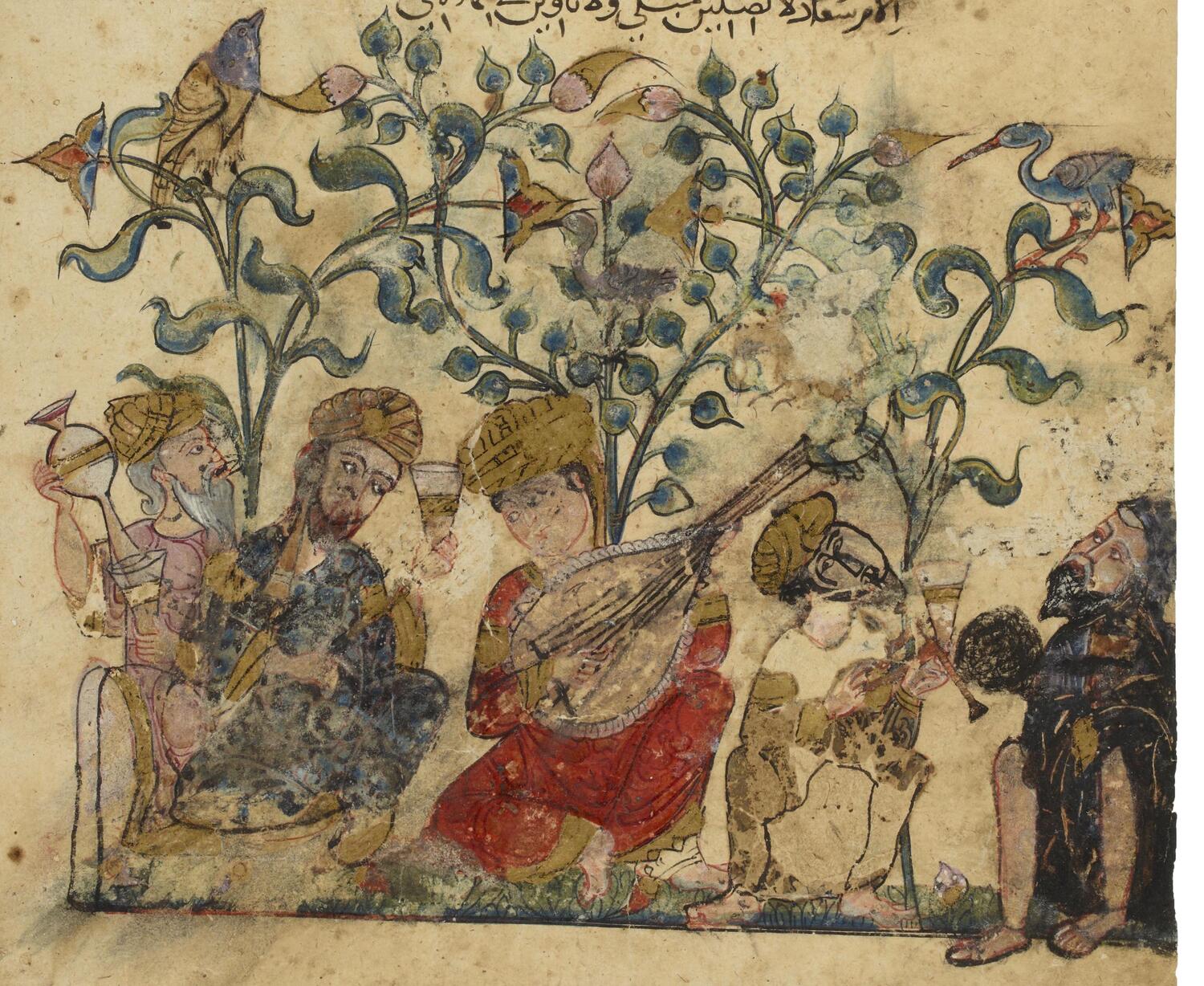

It is well known that the playing of wind instruments and [musical] rhythms are forbidden in and of themselves, regardless of whether they are accompanied by words, as [the sages], of blessed memory, have said: “The ear that listens to music should be cut off” [b. Sotah 48a]. And the Talmud [see b. Gittin 7a] has made clear that there is no difference between listening to pipes, playing string instruments, or singing a melody without accompaniment—anything that leads to the amusement of the soul and its entertainment is forbidden, as they observed, citing as support the prophet’s warning: Rejoice not, O Israel, to exultation, like the peoples (Hosea 9:1). And the reason for this is very clear, for it is appropriate that the appetitive faculty should be subdued and curbed and its reins held tightly, and that it not be set free or revived. And one should not pay heed to that unique individual, hardly to be found, in whom this [i.e., music] leads to the immortality of the soul and the keen receptivity necessary for apprehending an intelligible or submitting to a religious duty, for the laws of the Torah were written with regard to the majority [of people] and the most likely circumstances, [as the Talmud says]: “The sages addressed the existing reality” [b. Shabbat 68a]. And the prophets explained it to us, expressing their disapproval of using musical instruments for listening as part of worship, as they said: They pluck the lute, and like David they create for themselves instruments of music (Amos 6:5).
And we have explained in the Commentary on Avot [1:16] that there is no difference between utterances in Hebrew and in Arabic. Rather, this is prohibited or permitted according to the meaning contained in those utterances. In truth, it is prohibited to listen to folly, even if it is spoken without musical accompaniment. And if it is sung with instruments there are three prohibitions: the prohibition of listening to folly and foolishness of the tongue; the prohibition of listening to song, namely, zimra be-fuma [Aramaic; “song of the mouth”; see al-Fāsī on b. Berakhot 21a–22a]; and the prohibition of listening to musical instruments [lit., strings]. And if it was in a place of drinking [alcohol], there is a fourth prohibition, as He said: Who at their banquets have lyre and lute, timbrel, flute, and wine; [but who never give a thought to the plan of the Lord] (Isaiah 5:12). And if the singer is a woman, there is a fifth prohibition, in accordance with their statement: “The voice of a woman is licentiousness” [b. Berakhot 24a]—and all the more so if she is singing.
The truth has been demonstratively proven, namely, that our purpose is to be a holy nation, and there should be no action and no utterance on our part other than for the attainment of perfection or that which will lead to perfection—[and] not for the stirring of the faculties that prevent the attainment of all that is good, nor for abandoning ourselves to entertainment and amusement.
And we have explained this goal sufficiently, in the last part of the Guide, with statements that will be clear to the virtuous. And that which the geonim mentioned [as permitted] is setting to music words of song and praise [i.e., prayer] as was the author of the Laws [Isaac al-Fāsī]. As for mentioning [as permitted setting to music secular] songs, God forbid, such a thing has never been heard in Israel, neither from a gaon nor from a commoner.
I am surprised at your mentioning “the company of pious ones,” for in my view pious ones do not attend places where there is drinking of intoxicating beverages. This, too, we have already explained sufficiently in the Guide. And all the more so, if they add listening to musical instruments to this.
And in truth these Muslims are no farther from avodah zarah [idolatry], as you mentioned, than a one-day-old baby, about whom Rav said that [even] he may make wine [into] a libation [by touching it] [b. Avodah Zarah 57a], and the law is in accordance with him. And the extent of what all the geonim permitted with regard to their wine is that it is permitted to benefit from it and nothing else, but as for drinking it, such a thing has not been permitted by any of the sages. And this is how the matter stands according to all the sages of the west. If a Muslim comes into contact with our wine, in a manner that would impart the status of libation wine, they [the sages] prohibit drinking it but permit selling it, in accordance with the law of the Muslims themselves. And if it should happen that a non-Jew or a Muslim should enter the presence of people drinking wine, they [the Jewish drinkers] should hasten to mix a little honey in the wine before them and thus [they may] drink with him, saying, it is rendered unfit for the altar and has become like all other forms of alcoholic beverage. And the principle is that only wine fit for offering on the altar is offered as a libation for idolatry. Thus our teacher Joseph ha-Levi, of blessed memory, taught, and thus too did he practice, as a decided law [halakhah le-ma‘aseh], on several occasions, he and all the great sages of al-Andalus.
Credits
Bibliothèque nationale de France, Department of Manuscripts, Arabe 6094, fol. 75v, detail.
Published in: The Posen Library of Jewish Culture and Civilization, vol. 3: Encountering Christianity and Islam.
You may also like

Responsum: On an Accusation of Sexual Harassment

Critical Notes on the Mishneh Torah
Critical Notes on Maimonides, Mishneh Torah, Laws of the Principles of the Torah 5:5, Laws of Prayer and the Priestly Blessing 3:5, Laws of Rest on the Tenth of Tishre (Yom Kippur) 1:5, Laws of Rest on a Holiday 1:1, Laws of Marriage 3:20
Notes from a Class on al-Fāsī: On the Babylonian Talmud, Tractate Bava Kamma
Notes from a Class: On the Babylonian Talmud, Tractate Bava Meẓ‘ia
Responsum: On the Rebellious Wife
A 9th-century discussion of the enactment concerning a “rebellious wife,” a woman who refuses to fulfill her household duties or to maintain a sexual relationship with her husband.
On the Babylonian Talmud, Tractate Avodah Zarah
You may also like
Responsum: On an Accusation of Sexual Harassment
Critical Notes on the Mishneh Torah
Critical Notes on Maimonides, Mishneh Torah, Laws of the Principles of the Torah 5:5, Laws of Prayer and the Priestly Blessing 3:5, Laws of Rest on the Tenth of Tishre (Yom Kippur) 1:5, Laws of Rest on a Holiday 1:1, Laws of Marriage 3:20
Notes from a Class on al-Fāsī: On the Babylonian Talmud, Tractate Bava Kamma
Notes from a Class: On the Babylonian Talmud, Tractate Bava Meẓ‘ia
Responsum: On the Rebellious Wife
A 9th-century discussion of the enactment concerning a “rebellious wife,” a woman who refuses to fulfill her household duties or to maintain a sexual relationship with her husband.