

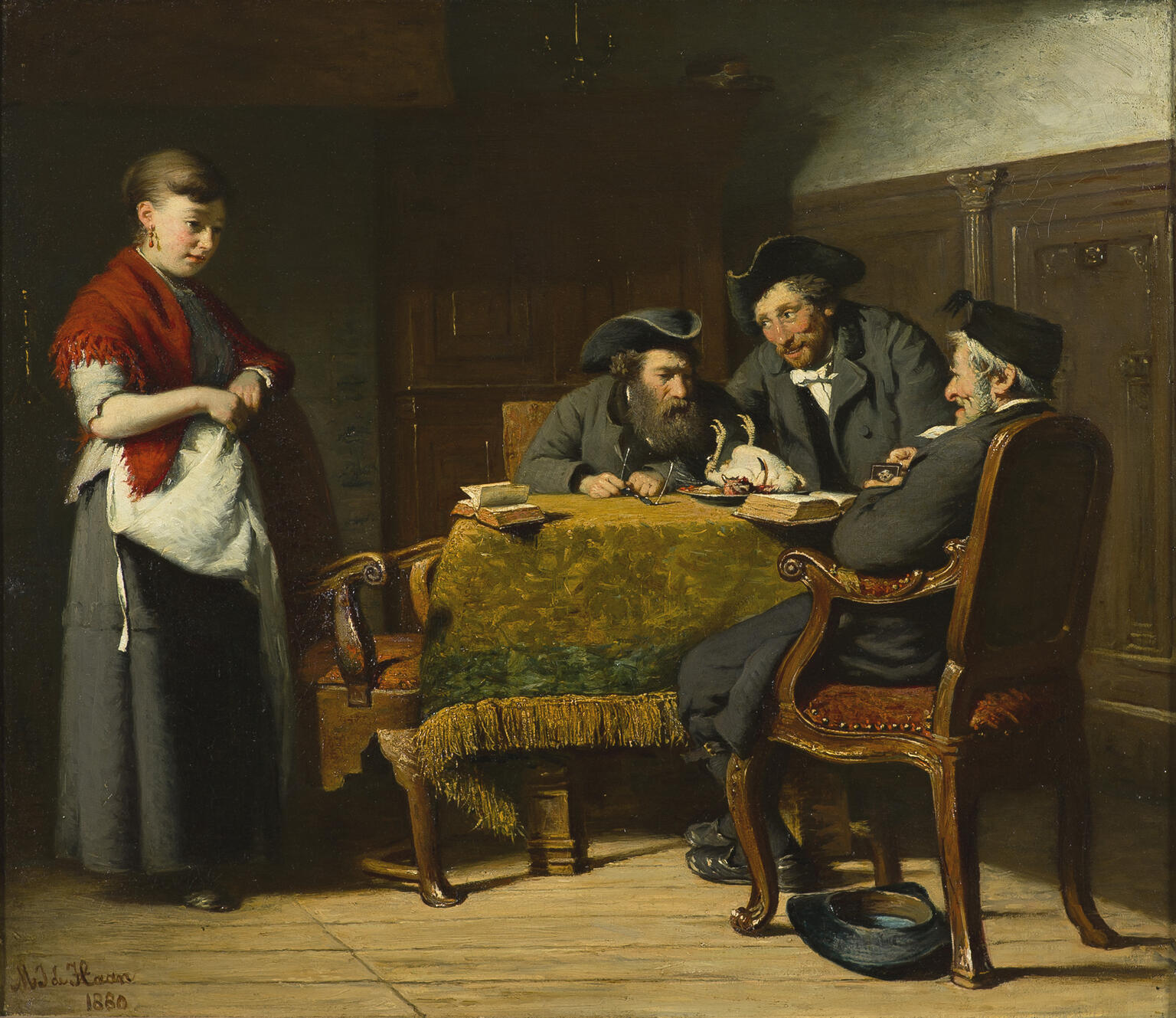
The Difficult Question
Image
Please login or register for free access to Posen Library
Already have an account?
You may also like


A Son of the Ancient Race
A Son of the Ancient Race is one of the few paintings with Jewish themes made by Jozef Israëls. It is from a series of paintings and drawings of secondhand clothing peddlers in Amsterdam’s Jewish…

The Captive
This bronze statue, The Captive, also known as The Slave, is one of the allegorical sculptures for which Maria Dillon is best known. It depicts a woman, whose hands are bound behind her back, bowing…

Above Eternal Peace
Above Eternal Peace is Isaak Levitan’s most famous painting, a revered example of the “mood landscapes” popular in Russia at the end of the nineteenth century. The artist painted the view from a cliff…

The Moon and Sleep
Simeon Solomon’s The Moon and Sleep was inspired by the Greek story of Endymion, a beautiful youth beloved of Selene, the goddess of the moon. In some versions of the myth, Zeus grants Endymion…

Sukkoth
Leopold Pilichowski began painting pictures with Jewish themes shortly after moving to the Polish industrial city of Łódź around 1894. He depicted the everyday life of impoverished Jews and Jewish…

The Night before the Exam
Leonid Pasternak painted young men of the Moscow intelligentsia in student accommodations engaged in an evening study session fueled by tobacco and tea, with a bed depicted on the left and a samovar…