

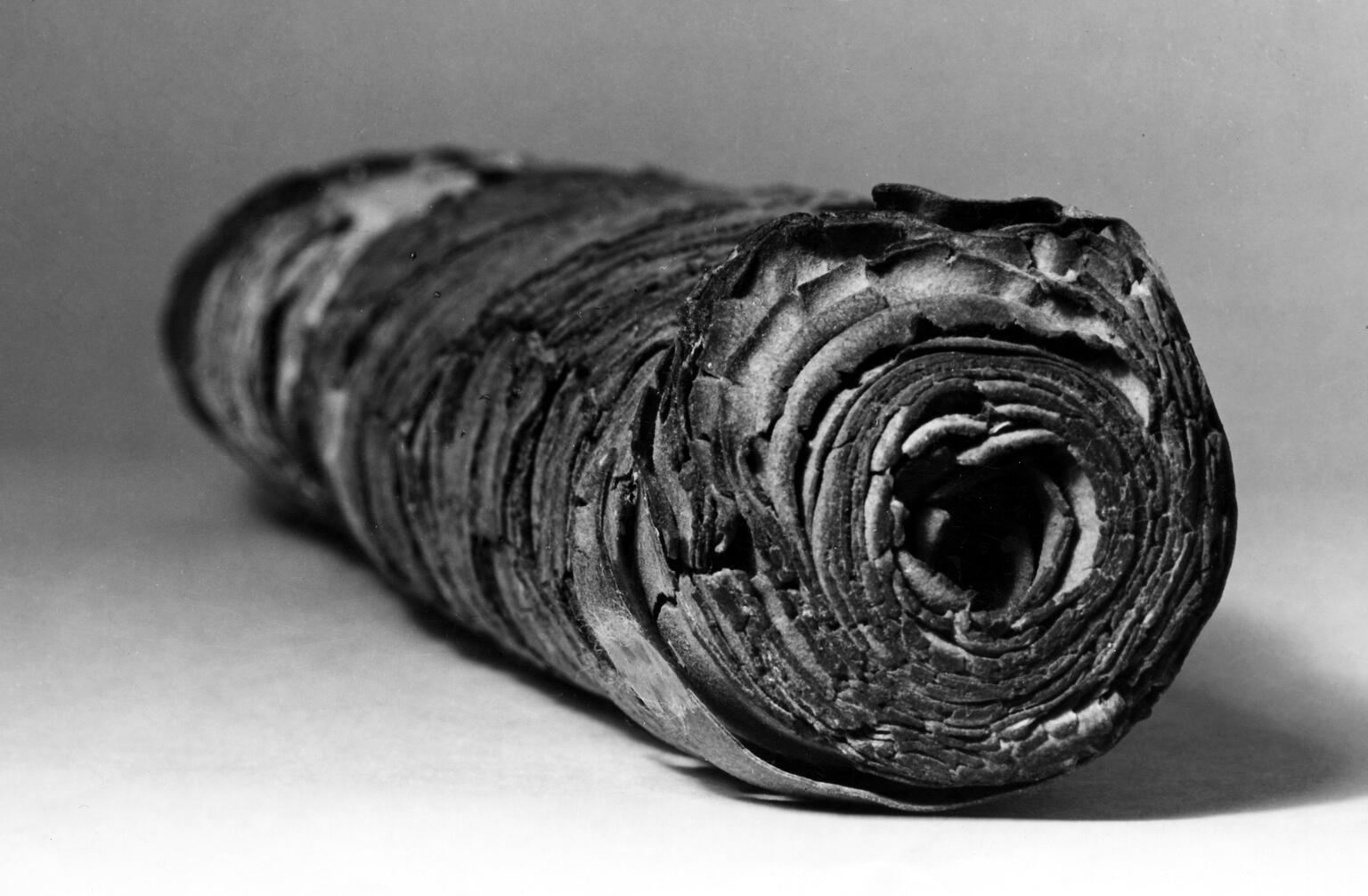
Genesis Apocryphon Scroll
Image
Please login or register for free access to Posen Library
Already have an account?
You may also like

Dividing, Combining, and Binding Scrolls
b. Bava Batra 13b–14a
Abaye said to R. Joseph: That [statement] of R. Judah is [actually the opinion] of Samuel, [his teacher,] as we learned [in the Mishnah]: But [in the case of] sacred writings, [i.e., a scroll of any…
Incomplete and Separate Scrolls
b. Gittin 60a
The people of the Galilee sent [a question] to R. Ḥelbo: What is [the halakhah with regard] to reading from ḥumashim, [i.e., scrolls containing only one of the five books of the Torah,] in the…
Torah Scroll Production
y. Megillah 1:11, 71c
It was stated: Rabban Simeon ben Gamaliel says: Even Torah scrolls they only permitted to be written in Greek [and not in other languages]. They investigated and found that the Torah may be correctly…
Torah from Memory
b. Megillah 18b
[It was related that] R. Ḥisda [once] found R. Ḥananel writing [Torah] scrolls, [but he was] not [copying them] from a written text, [as he knew it all by heart]. He said to him: It is fitting [for]…
Sifre Deuteronomy on Spelling in a Torah Scroll
Sifre Deuteronomy 36:1
And inscribe them [ketavtam] (Deuteronomy 6:9)—with perfectly formed letters [ktav shalem]. On this basis they taught: If the copyist of a Torah-scroll wrote alephs as ayins or ayins as alephs; or bet…
The Talmud on Spelling in a Torah Scroll
b. Shabbat 103b
[Similarly, one should not write] bent [letters like kaf and nun found in the middle of a word as] straight [letters like kaf and nun found at the end of a word, nor should one write] straight…