

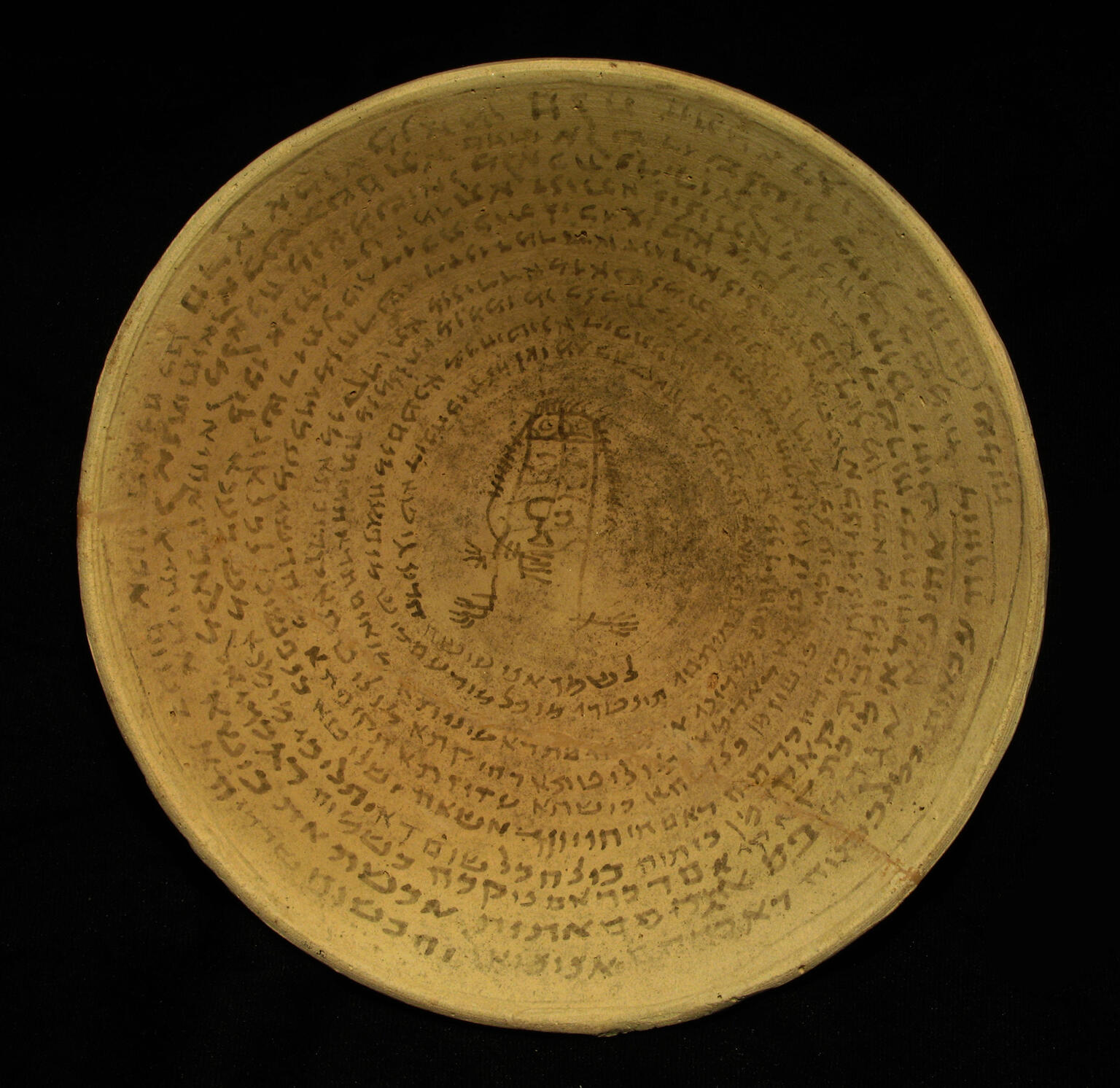
Incantation Bowl for Divorce from a Demon
Image
Please login or register for free access to Posen Library
Already have an account?
You may also like

A Curse Bowl
And let them not restore sleep to her eyes, and let them not restore rest in her body, in her dreams and her visions. And may they terminate her life and not give her life, by Shamish, and Sin, and…
A Curse Bowl from Mesopotamia
Within the central circle:. . . and stars and planetsOutside the circle:. . . and all the vomit(?) and spittle of Judah son of Nanay, that his tongue may dry up in his mouth, that his spittle may…


A Healing Bowl with the Shema‘
This magic bowl is inscribed with a picture of a demon and an Aramaic incantion for healing that includes the Shema‘.
A Jewish Bowl with an Adjuration of Jesus
This press and binding is for the name of Isha son of Ifra Hormiz, that he may be pressed and fall—he, his lot, his destiny, his stars, his bindings, his words and his hateful thoughts—under the feet…
Two Bowls from Nippur, Babylonia
I deposit and si[nk do]wn this bowl and I perform the praxis and it is in the . . . . . of Rabbi Joshua the son of Peraḥia. I am writing divorces for them, for all liliths which appear to them—in this…

Incantation Bowls
Incantation bowls, also known as magic bowls or demon traps, were common in Babylonia in the fifth and sixth centuries. The clay bowls were usually inscribed with a Babylonian Aramaic text in a spiral…