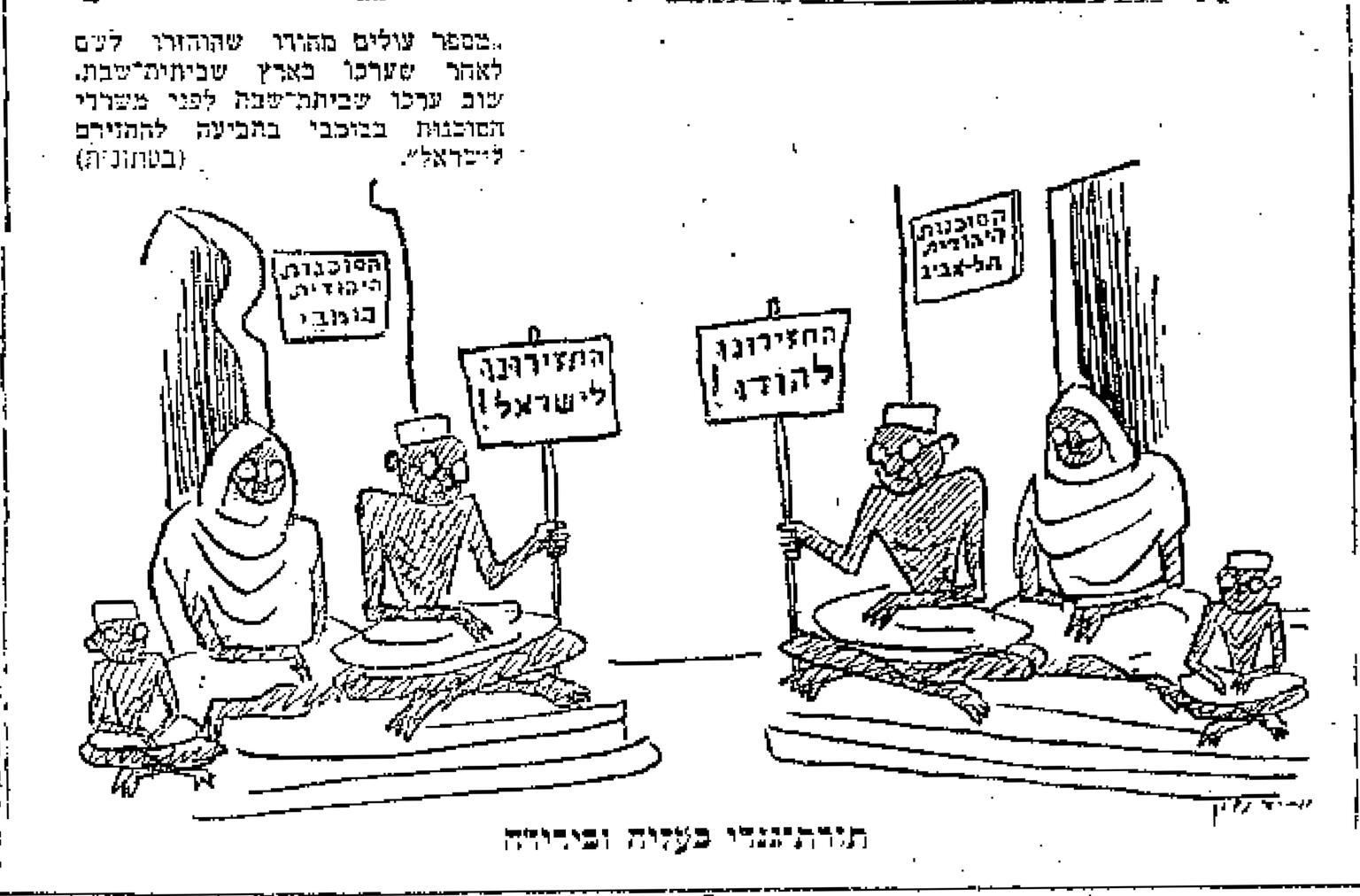
Indian Jews Confront Racism in 1951 Israel
Aryeh Navon
1952
How did the experiences of Indian Jews in early Israel challenge the Zionist narrative of Jewish mass migration as kibbutz galuyot (“the return of the exiles”)?
What message was Aryeh Navon conveying in his cartoon about the 1951–1952 Indian protests? Who was its audience?
How did prior life in India shape the protesters’ sense of rights and citizenship, and how they expressed their demands to the state?
Language:
Places:
Creator Bio
Aryeh Navon
Aryeh (Arieh) Navon was a Russian-Israeli painter, illustrator, set designer, and cartoonist. Navon, whose original name was Aryeh Kligman, was born in Dunaivtsi, in modern-day Ukraine, then part of the Russian Empire, and immigrated to Ottoman Palestine with his family in 1919. Navon studied art at the studio of Yitzhak Frankel in Tel Aviv from 1928 to 1929 and at the Institute d'Esthetique Contemporain in Paris from 1930 to 1932. He went on to become the first cartoonist in the Yishuv (the Zionist community in British Mandate Palestine), working at the newspaper Davar from 1933 to 1964. Navon also illustrated poetry and children’s books and designed theater sets and costumes. He received numerous awards, including the Dizengoff Prize for painting and sculpture (1938, 1939), the Sokolov Prize for journalism (1958), the Meir Margolis Prize for theater art (1978), and the Israel Prize for painting (1996).
You may also like
Chickensouperman from L’il Abner
“Le people juif . . . sur de lui-même et dominateur . . .” (“The Jews, a People Sure of Itself and Domineering, . . .” Charles de Gaulle)
I Was a New Immigrant for a Month: The Aliyah from Yemen and the African Problem
Babylonia to Zion: Salman Shina on Iraqi Jews in Early Israel
Salman Shina’s 1955 memoir recounts how Iraqi Jews adapted to new realities in Israel amid loss, struggle, and renewal.
The Song of the Humble