

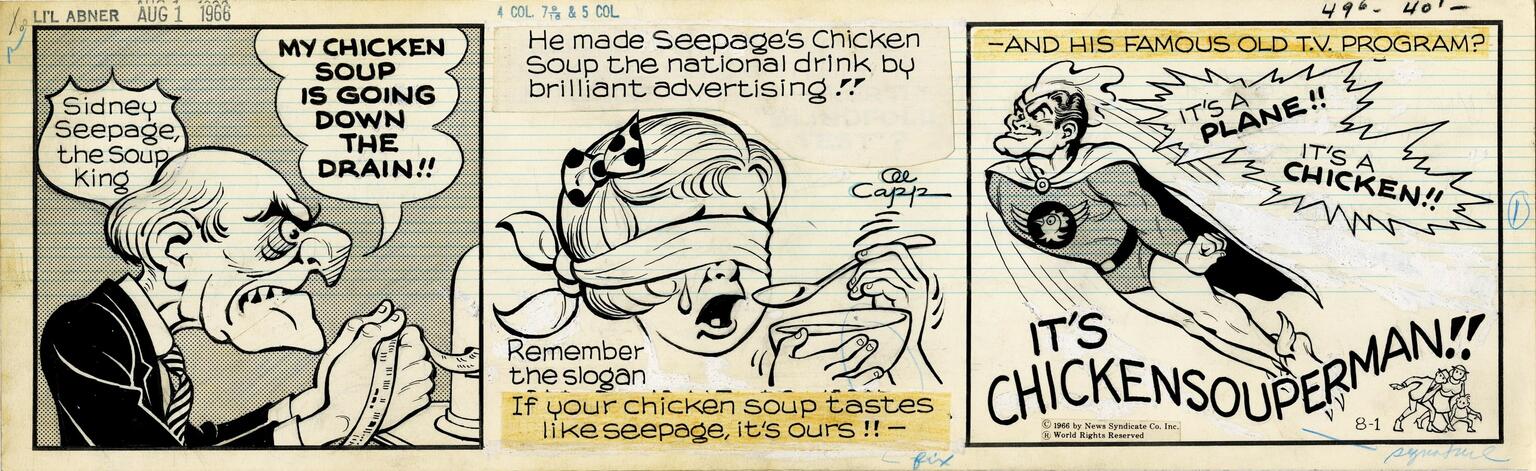
Chickensouperman from L’il Abner
Image
Please login or register for free access to Posen Library
Already have an account?
You may also like


Holocaust and Rebirth (Kibbutz Nezer Sereni, Israel)
Kibbutz Netzer Sereni was established by Holocaust survivors from the Buchenwald concentration camp. In fact, its original name was Kibbutz Buchenwald. It is now named for Enzo Sereni, an Italian…

The Costume Party
In The Costume Party, George Segal switched from making all white sculptures to using colors. The six figures—Anthony and Cleopatra, Superman, Pussy Galore, Catwoman, and Bottom from Shakespeare’s…

Lunch at Ratner’s
In the 1960s, Howard Kanovitz began using photographs to develop his own distinct style of photorealism. He made drawings of the figures in photographs and abstracted them into fields of color…

Primary Structures, cover
Elaine Lustig Cohen designed this catalog cover for the Jewish Museum in New York’s exhibition, Primary Structures: Younger American and British Sculptors, at a time when she was developing a bold new…

Survivors Are Not Heroes
Survivors Are Not Heroes stands five meters tall on the St. George Campus of the University of Toronto. Etrog intended the bronze sculpture to serve as a critique of traditional war memorials, which…

Paratroopers at the Western Wall, June 7, 1967
Perhaps the most iconic photograph of the Six Day War is this one, of three Israeli paratroopers at the Western Wall shortly after its capture by the Israeli army on the third day of the war. A few…