

Ketubah (Mastaura, Anatolia)
About This Entry
This ketubah, written on parchment in 1022 in Asia Minor, reports the details of the marriage between Namer ben Elkanah and Evdokia bat Caleb. The legal formulas are in Aramaic, while much of the other material is in Hebrew and some of the objects are identified in Greek. The detailed list of objects was a record to assist with distributions of assets in case of divorce. The formulaic passages reflect Babylonian rather than Palestinian rabbinic practices.
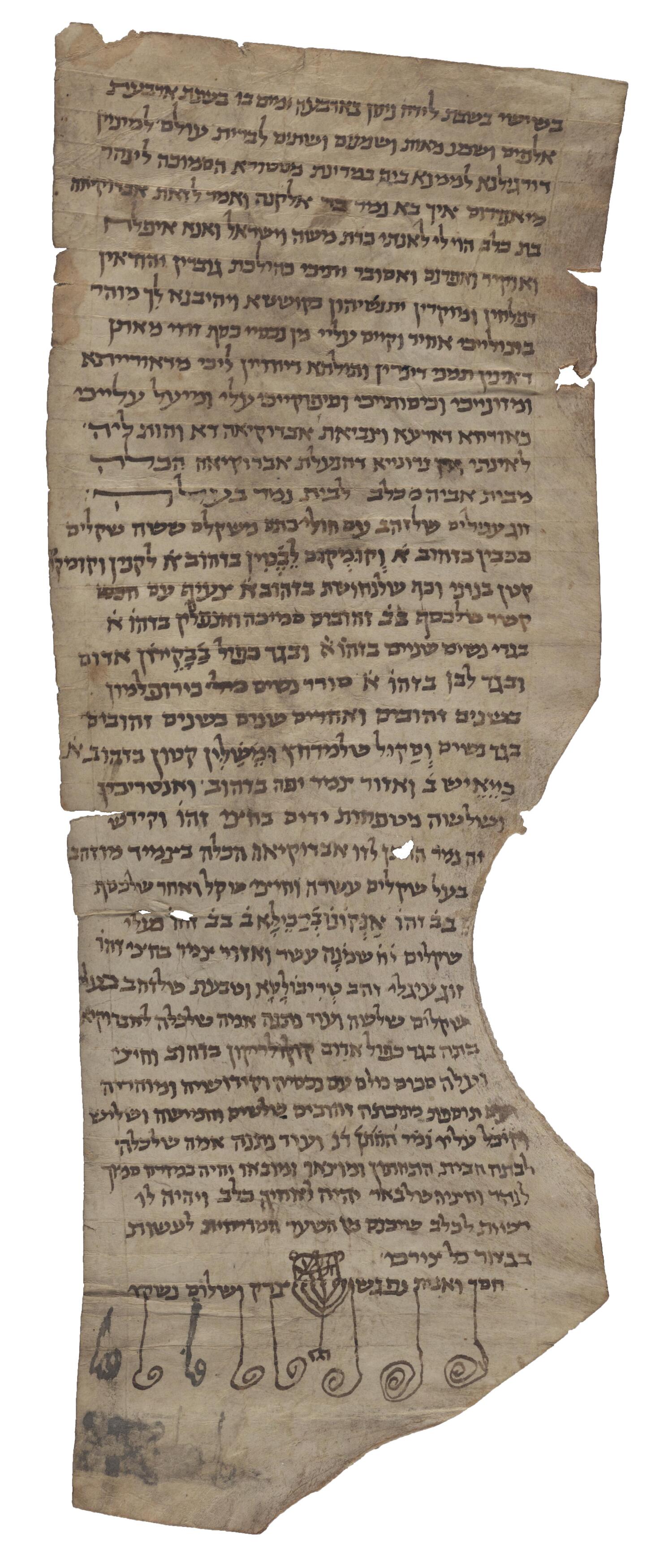

On Friday, fourth of the month Nisan in year 4782 of the Creation of the World, by the reckoning current in the city of Mastaura near the river Maiandros, Namer son of Elkanah came and declared to Evdokia daughter of Caleb: Be my wife according to the law of Moses and Israel, and I shall serve, cherish, maintain and support you in the manner of Jewish men who faithfully serve and cherish their wives. I shall give you your mohar1 as a virgin, a fully valid claim against my property, namely 200 zuz in silver, making 8 1/3 dinars, as required by the Law. I undertake to provide your food, clothing and upkeep and to consort with you sexually according to the way of the world. Evdokia consented to be his wife. This is the dowry that Evdokia the bride brought from the house of her father Mar Caleb to that of Namer her husband: a pair of gold earrings with a fine gold necklace, weight 6 shekels; a small cauldron [valued] at 1 gold piece; and a cooking pot, at 1 gold piece; a wash-basin, a small pot of medium size and a copper spoon, at 1 gold piece; a veil with silver clasp, at 2 gold pieces; a rug and a bedspread, at 1 gold piece; two women’s dresses, at 1 gold piece; a double-faced dress of red cotton and a white dress, at 1 gold piece; a ?palm’s-breadth woman’s scarf, at 2 gold pieces; two more, at 2 gold pieces; a woman’s dress, a bag for the bath, and small tablecloth, at 1 gold piece; two [?] and a fine woollen belt, at a gold piece; a [?] and three handkerchiefs, at half a gold piece. As a wedding gift2 Namer the bridegroom gave Evdokia the bride a gilded bracelet of 10 1/2 shekels; another of silver, at 2 gold pieces; two armbands, at 2 gold pieces, making 18 [eighteen] shekels; a woollen belt, at half a gold piece; a pair of gold earrings with triple pendants and a gold ring, making three shekels. The bride’s mother gave to Evdokia her daughter a double-faced red dress of silk, at one and a half gold pieces. The sum total, including her own possessions, her wedding gifts, the mohar, and the addition to her ketubba, makes thirty-five and one-third gold pieces. The bride’s mother also gave her daughter the lower storey, and its exit and entrance are to the east, close to the river; but half of the well shall belong to her brother Caleb and he, Caleb, shall have the right to enter by the eastern gate to do whatever he may need to do at the well. Mercy and truth have met together; righteousness and peace have kissed each other (Psalms 85:11).
[Verso:] Namer the bridegroom accepted responsibility for this marriage settlement for himself and his heirs after him, to be secured by the choicest of his possessions under heaven, indoors or out, whether landed or movable property, even down to the coat on his shoulders; it is not to have the effect of an asmakhta or a legal formality, but is subject to the full rigour of all the enactments of the rabbis. We have received from the bridegroom Namer ?assurances concerning every detail and matter of what is written and itemised on the other side of this document in due and appropriate form [?].
Valid and effective. aqolutos.3
[signed] Judah son of the late Nabon; Moses son of the late Leon; Shelahia son of the late Joseph; Moses son of the late Rabbi Shabbetai.
Source: CUL T-S 16.374.
Notes
Words in brackets appear in the original translation.
Mohar: a technical term denoting a payment made by the bridegroom. The word is used in a variety of ways; here it has its strict sense of the minimum payment laid down by law, viz 200 zuz for a virgin (for other brides the mohar is only 100 zuz).
The bridegroom’s gift is a voluntary addition to the basic mohar, known formally as tosefet. Unlike the mohar, it is an actual gift to the bride.
aqolutos: Both the transcription of the Greek word and the translation are problematical. Although clearly a Greek term, it has so far only been found in Hebrew or Aramaic documents. [. . . There is] a Tyrian ketubbah datable to the early 11th century with the formula aqolithos ha-niyyaroth, which may mean “[certified as] in accordance with the [attached] papers.” [ . . . ] Later the attestation forms part of the copy, as is the case in our text. The formula aqolithos would then be a fossilised remainder of a fuller expression specifying [ . . . ] with what the copy is in conformity. [ . . . ]
Credits
Published in: The Posen Library of Jewish Culture and Civilization, vol. 3: Encountering Christianity and Islam.
