

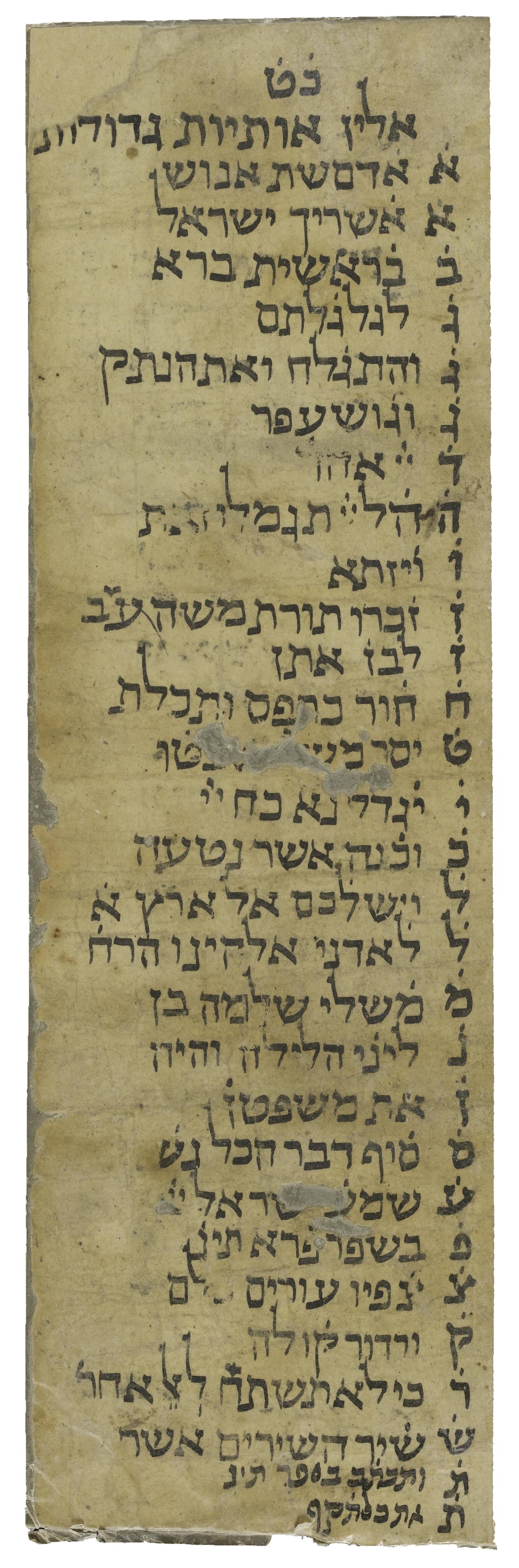
List of Large and Small Letters in the Bible
Image
Please login or register for free access to Posen Library
Already have an account?
You may also like


Cairo Codex: Colophon
I, Moses Ben Asher, wrote this holy book of the Bible, dictated by myself, in accordance with the good hand of the Lord upon me [see Nehemiah 2:18], very clearly (Deuteronomy 27:8), in the province of…

An Early Manuscript Copy of the Book of Word Pairs
The consonantal Hebrew text that is the basis for the Masoretic Bible was transmitted with some orthographic irregularities. The Book of Word Pairs (Sefer okhlah va-okhlah) is an independent Masoretic…

Fine Details of the Accents
Dikduke ha-te‘amim
A Masoretic treatise that describes the vocalization and the accents of Hebrew words.
Epistle
Risāla
A Judeo-Arabic letter addressed to the Jews of Fez arguing for reading the Targum with the weekly Torah reading.
Book of the Principles of Hebrew Poetics
Kitāb usūl al-shi‘r al-‘ibrānī
[ . . . ] The Muslims report that one of their learned men encountered a group of people who did not speak Arabic correctly, and it filled him with sadness, so he briefly…
Book of the Seventy Isolated Biblical Words
Kitāb al-sab‘īn lafẓa al-mufrada
And I saw that there are some among the Hebrews who reject whatever is transmitted from the prophets by way of the unwritten precepts and laws, and similarly those who reject whatever they have heard…