

My father, mother, brothers, and sisters
About This Entry
This moving eulogy is in the voice of a dead child addressing his family members. The child compares his former beauty to a citron (Hebrew: etrog), which is used in the celebration of the Sukkot festival and prized in the Jewish tradition as a beautiful, aromatic fruit. He likens his upbringing to that of a well-watered blade of grass. By burying him in “a house that will not disintegrate until my corpse disintegrates,” his family has lacked compassion for his youthful beauty. Ellipses indicate lacunae in the manuscript.
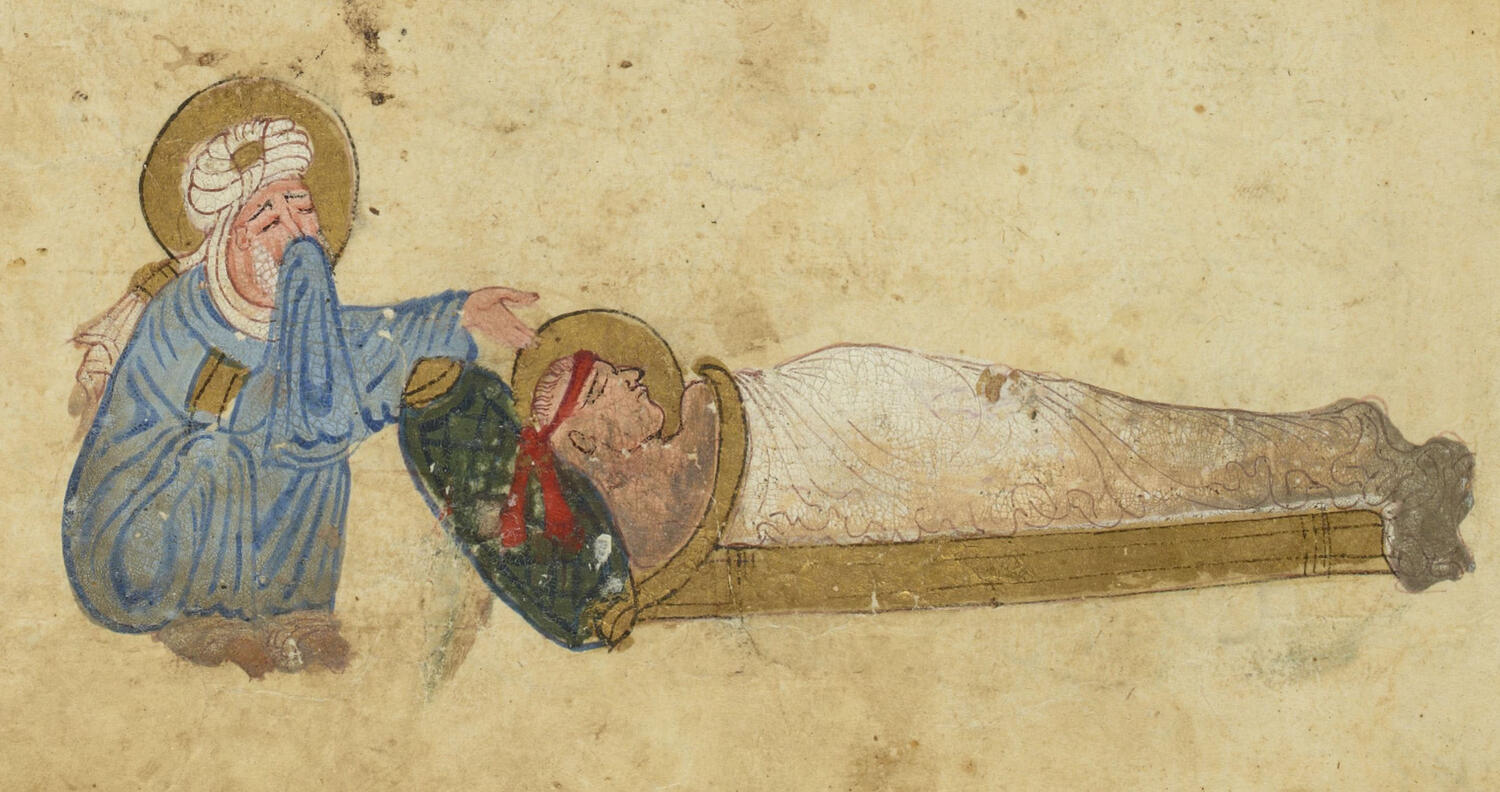

We’re sorry. The Posen Library’s licensing agreements prevent this image from being printed or downloaded.
My father, mother, brothers, and sisters, hear my word and listen to my speech.
Was I not like a citron among you, in my beauty and comeliness, my aroma and my taste?
You raised me like a blade of grass, and withheld no water from me,
My stature was healthy and flourishing, fertile like branches, in the prime of my life.
My soul enjoyed pleasures, and I had delights, when I would retire and when I would awake—
But now, how can your hearts bear it, after all this, now that I have been placed in the earth?
You have covered my glowing beauty with earth and cast my body into a ditch.
You had no compassion in your heart, and you took no pity on my handsomeness, my image.
The evening’s shade is cast over me. My sun set while it was still day for me.
You made me a house [i.e., a grave] that will not disintegrate until my corpse disintegrates.
I sought a lamp, but they told me no, so I knew that I was in the place of darkness.
The moon will not illuminate my nights, and the sun will not shine in my region.
My sun has dimmed. My mother has forgotten me and not woken me from my sleepy slumber.
My face has not been washed from the dust of the grave. She has not rubbed me with oil, nor changed my clothes.
Youths of my age go to their tutor, but my sleep extends in silence.
Children will rejoice tomorrow . . . ; I am prevented from the joy of [discovering] concealed [wisdom].
All my mother’s children are far from me. My name is no longer on my relatives’ tongues.
Hear now what has befallen me, and I will tell you my bitter words.
Pains have seized me from my father’s bosom. They have slaughtered me, and my blood is not seen.
My hands have been bound, my feet have been unshod, my arms have been bent, and the ring has been taken from my finger.
My beauty has gone dark, my likeness has changed. Dust is my perfume, and earth is my food.
This has happened to me. My father and mother do not recognize me.
I call out, but I find no one to give me strength and let me rise from the earth.
Where are my homes? Where is my family? Where are those who love me? Where are my kinsmen?
Why have they abandoned me in the wilderness, with worms as my bed, to feel the maggots around me?
Have they rejected me? Spurned me? Not sought my well-being?
The wedding, days of your joy . . .
Remove the cup of poison from me, and be deeply moved for me, with compassion,
And fulfill your word, which you have promised: I will bring you up out of your graves, O my people (Ezekiel 37:12).
Translated by Gabriel Wasserman.
Credits
Bibliothèque nationale de France, Department of Manuscripts, Arabe 3929, fol. 78r, detail.
Published in: The Posen Library of Jewish Culture and Civilization, vol. 3: Encountering Christianity and Islam.
You may also like

The Proverbs
Lend me your ear, my son, and take discipline;
as a father disciplines his son, so discipline your soul.
I raised my eyes to the ancient paths,
to the expanses of the earth, I turned my face.
I…
Proclaim liberty, tarry not
Proclaim liberty, tarry not,
for the people who are in the creditor’s hand.
Remember Moses’ merit for them,
and Aaron’s too, and Miriam’s.
Take vengeance for their humiliation,
and wage their…

The child—there was no one like him
The child—there was no one like him,
Tender in years, but old in knowledge.
How did he suddenly depart, and he is gone?
He left me forlorn, bereft, mourning,
Crying and wailing that he has been…
Listen, my friend
Listen, my friend, and listen to me well:
Whom do you think all your loose talk can frighten
When God’s my Rock and Light?
Friend you may be,
But keep up all your bluster
And you’ll end up with my…
I'll ascribe might and glory to my God
I’ll ascribe might and glory to my God— God, who established His heavenly lair with the breadth of His hand.He created lips, gave humanity a mouth, and crowned them with beauty and splendor, as a…
Poems I–X: On the Death of His Brother
When his beloved brother Isaac fell ill in the year 4801 [1041], the poet thought in his distress:
Each muscle cramps with fear.
Tear-fed worry chokes the mind like creepers after rain.
Away, all…
You may also like
The Proverbs
Lend me your ear, my son, and take discipline;
as a father disciplines his son, so discipline your soul.
I raised my eyes to the ancient paths,
to the expanses of the earth, I turned my face.
I…
Proclaim liberty, tarry not
Proclaim liberty, tarry not,
for the people who are in the creditor’s hand.
Remember Moses’ merit for them,
and Aaron’s too, and Miriam’s.
Take vengeance for their humiliation,
and wage their…
The child—there was no one like him
The child—there was no one like him,
Tender in years, but old in knowledge.
How did he suddenly depart, and he is gone?
He left me forlorn, bereft, mourning,
Crying and wailing that he has been…
Listen, my friend
Listen, my friend, and listen to me well:
Whom do you think all your loose talk can frighten
When God’s my Rock and Light?
Friend you may be,
But keep up all your bluster
And you’ll end up with my…
I'll ascribe might and glory to my God
I’ll ascribe might and glory to my God— God, who established His heavenly lair with the breadth of His hand.He created lips, gave humanity a mouth, and crowned them with beauty and splendor, as a…
Poems I–X: On the Death of His Brother
When his beloved brother Isaac fell ill in the year 4801 [1041], the poet thought in his distress:
Each muscle cramps with fear.
Tear-fed worry chokes the mind like creepers after rain.
Away, all…